Can a Painting Know More Than the Artist?
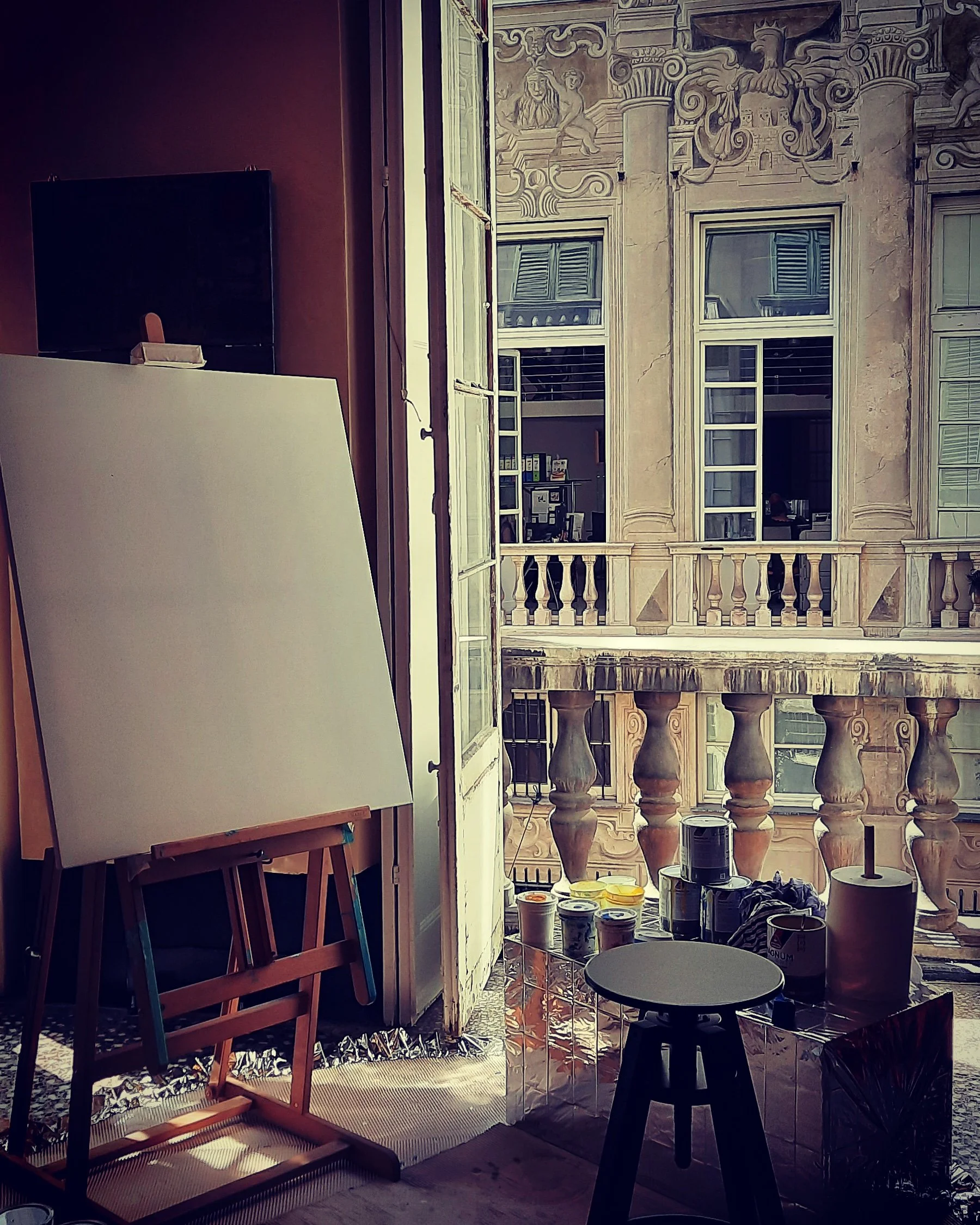
A blank canvas before the first brushstroke. Palazzo Ducale, Genoa Art Week, Italy
When we look at a finished painting, it seems obvious that the idea came first and the work followed.
We tend to imagine the process like this: the artist knows what they want to express, develops the composition, chooses the palette, picks up the brush, and gradually brings the idea to life.
Sometimes that is exactly what happens.
Yet the history of art offers countless examples of works that evolved far beyond their original intention. X-ray examinations have revealed hidden figures beneath the surface, entirely reworked compositions, altered sources of light, and radically transformed spaces. An artist may begin one painting and finish another altogether. These changes are rarely accidental. More often, they emerge from a long process in which the final direction is discovered rather than predetermined.
This raises an intriguing question: is a painting always the expression of a finished thought?
Or can the thought itself emerge through the act of painting?
Modern cognitive science has long moved beyond the idea that thinking exists only in words. Much of our decision-making takes place before we are able to explain it. We recognize a familiar face in a fraction of a second. An experienced physician notices a subtle symptom before listing the evidence. A chess grandmaster senses the strength of a position before consciously calculating every variation.
That does not mean these decisions are irrational. Quite the opposite. The human brain is capable of processing vast amounts of information long before conscious reasoning can translate them into language.
Perhaps painting works in much the same way.
Throughout the process, an artist makes hundreds of decisions. A grey becomes slightly warmer. A vertical line shifts by a few millimetres. The light softens—or grows more defined. None of these choices seems decisive on its own. Yet together they gradually establish the internal structure of the work.
What is remarkable is that many artists are only able to explain these decisions after the painting is finished.
Not because they lack understanding of their craft. On the contrary, their experience has become so deeply embodied that much of their thinking no longer requires constant verbal explanation. Just as a musician no longer thinks consciously about the movement of every finger, an experienced painter begins to think through relationships of colour, mass, rhythm, and light.
At that point, the painting becomes more than something being made.
It becomes a tool for thinking.
This may explain why some works cannot truly be designed in advance. They can only be discovered, layer by layer.
Many artists notice something similar when they look back over several years of work. Patterns emerge that they never consciously intended. Certain colour relationships return. Similar spatial structures appear again and again. The same questions continue to surface, even though no deliberate series was ever planned.
Each painting once seemed complete in itself.
Together, they reveal a much larger investigation.
This is significant not only for the artist.
Collectors often experience something remarkably similar. A painting chosen for its colour or composition gradually reveals something deeper over the years. Details that once seemed insignificant become impossible to overlook. The painting has not changed.
The person living with it has.
Perhaps this is one of the reasons great works of art remain meaningful for decades without becoming mere objects of decoration. They continue to ask questions that can never be answered once and for all.
That may be one of the most remarkable qualities of painting.
It does not always emerge from knowledge.
Sometimes, knowledge emerges from it.
