The Beauty That Doesn't Remain
On Painting, the Nature of Mastery, and the Unseen Life of a Painting
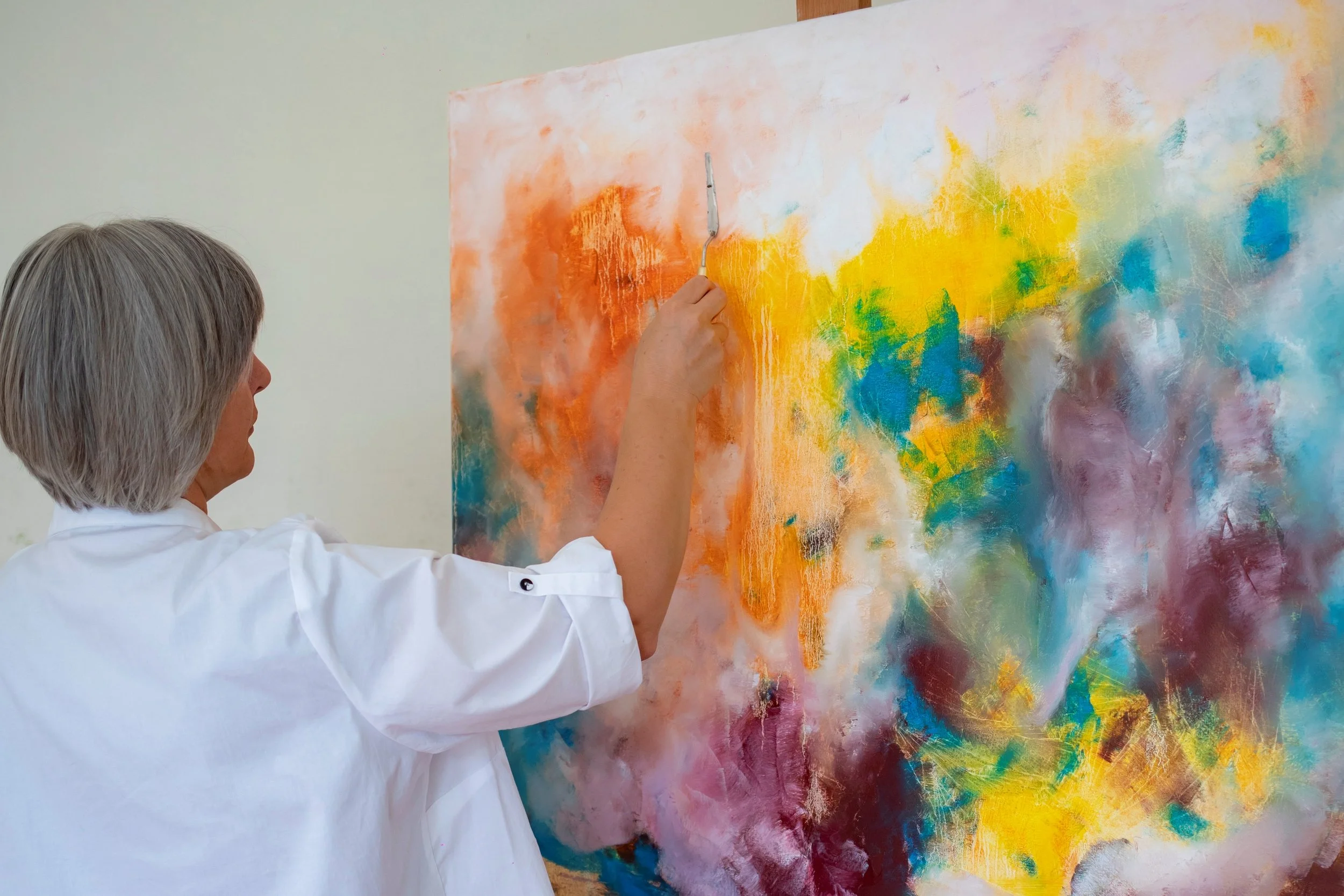
Several years ago, a photo shoot took place in my studio. I had to continue working on a painting while a photographer documented the process and other people watched. I was searching for the right relationships between colour, light, and space, adjusting the angle of my palette knife, studying the surface of the canvas. All of this was perfectly familiar. What felt unfamiliar was having people watching me.
At the time, I didn't want anyone to see an unfinished painting. I had no doubts about my professional decisions, but I considered the intermediate stages of a painting part of my private working space. A work should be shown once it had reached its final form. Everything leading up to that moment belonged in the studio.
Today, I look at the photograph from that shoot differently. Over the years, my understanding of where beauty exists in painting has changed. I used to associate it primarily with the finished work. Now I notice that some of a painting's most interesting states emerge long before its completion, and many of them never remain on the surface.
Sometimes, while working, I encounter a passage that strikes me as extraordinarily beautiful. Two colours unexpectedly form a perfect relationship. A change in texture creates a new sense of spatial depth. A small area of the surface begins to interact with light in a remarkable way. I may pause to appreciate such a moment, knowing that it could disappear a little later.
A beautiful passage does not necessarily belong in the finished painting. It may be too dominant, disturb the balance of the composition, or draw attention away from other relationships. Sometimes I have to paint over a colour, alter the surface, or completely rework an area I had admired only moments before. Professional practice requires an understanding of both the expressive quality of an individual element and its place within the composition as a whole. Yet the beauty that existed before the change does not become any less real. It appeared at a particular moment, was seen, and was experienced. It does not have to remain on the canvas to matter.
I have become increasingly interested in this temporal dimension of painting. When viewers look at a finished painting, all its elements exist before them simultaneously. The artist, however, knows the work as a succession of states. They remember colour relationships that no longer exist, areas changed for the sake of the whole, unexpectedly beautiful combinations that disappeared beneath subsequent layers of paint. Sometimes traces of earlier decisions remain visible on the surface, but much of what happened cannot be reconstructed, even through the closest examination of the finished work.
For the artist, a painting is a space that exists through time. The finished canvas has its own integrity, yet the experience of creating it extends far beyond what ultimately remains visible.
Gradually, I began noticing another aspect of my work that I had rarely considered from an aesthetic perspective. I had watched videos of myself painting many times, and I discovered that I enjoyed observing the way I worked.
The movements of my hands. The way I choose a tool, pick up paint, adjust the position of a palette knife. The way I tilt my head to examine the surface, move closer to the painting, or step back several paces. The way my body assumes a particular position depending on the scale of the work and the nature of the action.
I realised that these movements were beautiful. Their expressiveness had nothing to do with any desire to look beautiful while working. My attention was directed towards the painting. Every movement had a practical purpose and arose from a specific artistic task.
Over time, I began thinking about how professional experience changes the nature of these actions. When someone is first learning to use a tool, many things demand conscious attention. They must control the position of the hand, calculate the amount of pressure, monitor how much material they are using, and choose the right angle of contact with the surface. Gradually, these tasks cease to exist as a sequence of separate decisions. They become part of a familiar way of working with paint.
Through years of practice, the body learns distance, pressure, balance, and the nature of contact between tool and surface. The hand senses how much paint to pick up and how it will behave when the palette knife is tilted differently. The body's position changes naturally with the scale of the task. The eye assesses the result of one movement while the hand is already preparing for the next. Some professional decisions become so familiar that they no longer require separate conscious consideration.
This freedom in handling a tool makes it possible to concentrate on more complex relationships. When the mechanics of movement no longer demand constant attention, there is more room to perceive colour, light, and space, and to evaluate how even a small change affects the entire composition.
Yet painting never becomes entirely predictable. The behaviour of paint depends on its composition, viscosity, the thickness of the layer, and the condition of the surface. Even a familiar material enters into new relationships with what already exists on the canvas. Experience allows me to sense these differences and respond to them, sometimes before I have consciously formulated what needs to be done.
What fascinates me is how knowledge gradually changes the form in which it exists. At first, we study the properties of materials, learn techniques, and begin to understand the consequences of our actions. Then much of what once required deliberate concentration becomes natural. What appears effortless to an observer may be the result of thousands of hours of practice.
It is possible to explain in great detail how to hold a palette knife, how much pressure to apply as it moves across the surface, or how to judge the amount of paint required. But understanding these principles is not enough to reproduce the movement of an experienced painter. Between knowing how something should be done and being genuinely able to do it lies an experience that cannot be acquired through explanation alone.
Over time, the very sensation of the material changes, along with the ability to judge distance, distribute attention, and notice barely perceptible changes in the surface. Many movements become so natural that, while working, I no longer experience them as separate actions.
That is why watching these videos turned out to be unexpectedly interesting. They allowed me to see my own work from a perspective unavailable to me when I stand before the canvas.
While painting, I experience movement from within. I feel the position of my body, the resistance of the material, the effort in my hand, and the contact between tool and surface. My gaze is directed primarily towards the painting. I can see the mark left by the palette knife, but I cannot simultaneously observe my own movement in the way another person can.
On video, everything is different. I see the position of my hand, the turn of my head, the changing distance, the sequence of gestures. What I experience while working as physical sensation and professional action takes on an external visual form. I recognise my movements and, at the same time, discover them anew. They reveal years of practice that have gradually become part of my natural way of moving before a canvas.
What interests me most is that this naturalness was not there from the beginning. It developed gradually through repetition, observation, mistakes, discoveries, and continual engagement with materials. Behind the apparent ease of certain movements lies experience that no longer needs to display its own complexity.
The beauty of professional action does not necessarily lie in how striking it looks. Sometimes the most expressive movements are almost imperceptible. A slight turn of the tool, a change in pressure, a brief pause before the next stroke may be more interesting than a broad, dramatic gesture. Their precision comes from understanding what needs to be done. Sometimes mastery and aesthetic expressiveness meet in a single action. And then beauty becomes visible in the very manner in which that action is performed.
Someone watching an artist work can see the movement but cannot feel what happens in the hand at the moment the tool touches the surface. The artist experiences that sensation but cannot see themselves from outside. The camera makes one kind of experience accessible while leaving another beyond reach.
In a sense, this resembles the relationship between the artist and the viewer of a finished painting. The viewer sees the work as it has become. The artist also knows everything it has passed through. They experience different aspects of the same process.
Gradually, I became interested in allowing others to see what had previously remained within the studio. I began recognising an independent aesthetic value in the states, movements, and relationships that usually disappear before a viewer has the opportunity to encounter them.
The finished work remains the purpose of my practice. Its integrity demands decisions that sometimes destroy beautiful intermediate states. Yet the artistic experience extends beyond what remains on the surface. It includes the beauty of disappearing colour relationships, physical engagement with materials, and movements in which years of practice have become almost invisible.
I work beautifully.
There was a time when I did not recognise this as an observation worth making. Today, I enjoy watching the way my hands handle tools, how my body's position changes, how familiar actions unfold in a natural sequence. There is beauty in these movements, although I have never deliberately tried to create it.
In the photograph taken several years ago, I am holding a palette knife. I am leaning slightly towards the canvas, examining an area of a painting that is still unfinished. Back then, I wanted the photographer to see as little as possible of what happened before a painting reached its final form.
Now, when I look through old photographs and videos, I find myself noticing the things I barely paid attention to while working: the position of my hand, the slight tilt of my head, the naturalness of movements developed over years of practice. And I enjoy watching the person I see in those images.
That is me at work. And I find it beautiful.
