What Remains When the Artist Disappears
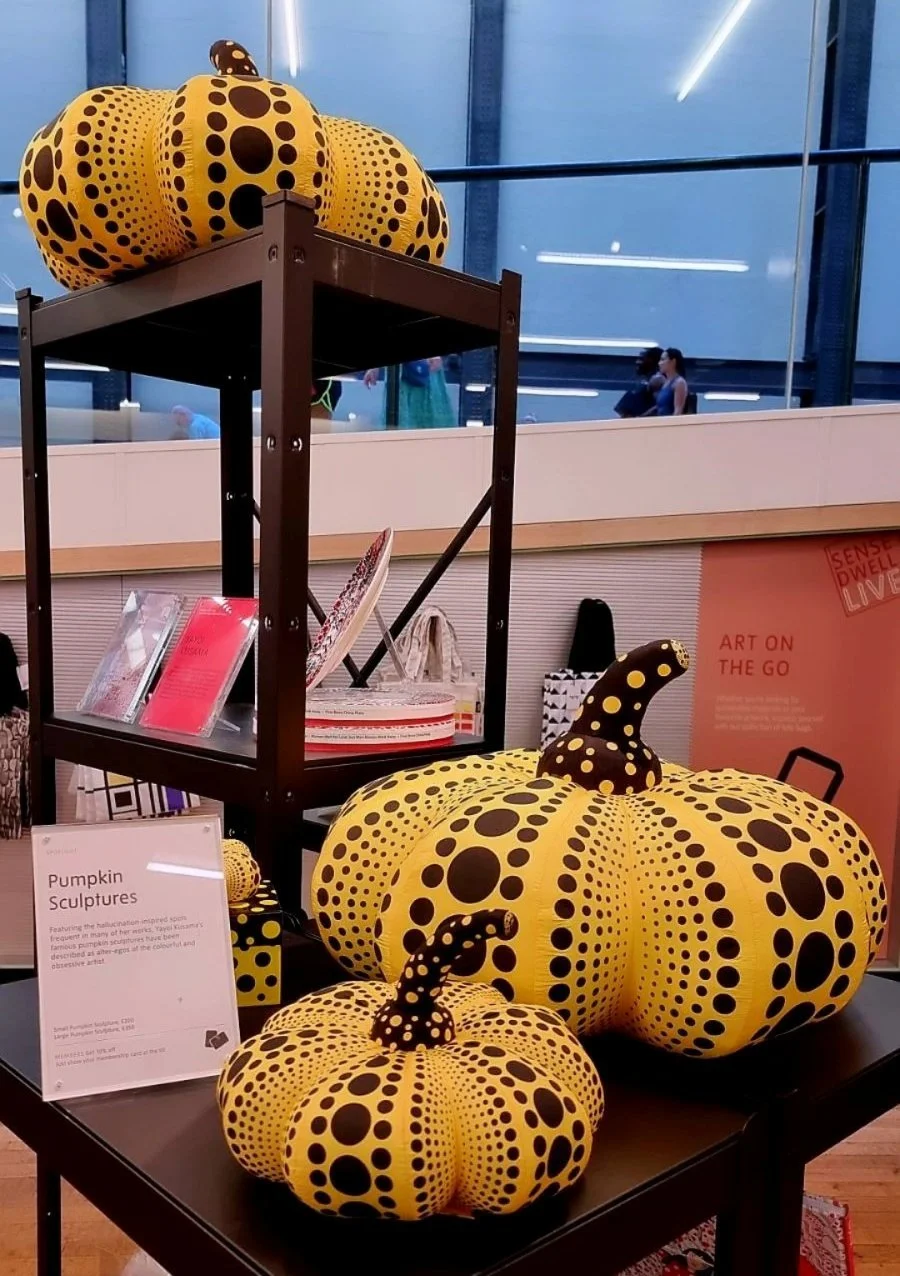
Yayoi Kusama, Pumpkin Sculptures, museum display, 2022. Photograph by the author.
In 1966, some fifteen hundred silver mirrored spheres appeared on the lawn outside the Italian Pavilion at the Venice Biennale. Yayoi Kusama was not an officially invited participant. She spread the spheres across the grass, stood among them, and began offering them to visitors for roughly two dollars apiece. Beside her was a sign: YOUR NARCISSISM FOR SALE. A visitor could approach, lean towards the perfectly reflective surface, see their own face in it, and buy the object. The organisers soon put a stop to the sales. The work was titled Narcissus Garden. Today, it feels almost uncannily precise as a work about a time that had yet to arrive.
It is easy to read the episode as an early critique of the art market: the artist quite literally turns art into a commodity and conspicuously assigns it a price. Yet nearly sixty years later, Narcissus Garden reads as something more complicated. Kusama was not simply selling mirrored spheres. She was selling the viewer an object that returned the viewer to themselves. This was decades before the smartphone, Instagram, the museum selfie, and the attention economy in which being seen beside a work can sometimes matter more than the work itself. The phrase YOUR NARCISSISM FOR SALE has ceased to feel entirely metaphorical. It now reads almost like a literal description of a cultural reality that did not yet exist in 1966.
What makes Narcissus Garden feel contemporary, however, is not that Kusama somehow predicted the smartphone. Artists rarely predict technologies. What they sometimes do is recognise a human mechanism long before a device arrives that can make it ubiquitous. Narcissus existed long before the front-facing camera. What is more interesting in Kusama’s work is that the viewer is given a mirror, but never just one. There are fifteen hundred reflective surfaces before them. The work promises an encounter with the self while simultaneously depriving that encounter of its singularity.
Here Narcissus Garden unexpectedly meets one of the central ideas in Kusama’s practice: self-obliteration. The term is easily reduced to the notion of “making oneself disappear,” but for Kusama it was more complex. In her accounts of her perceptual experiences, a repeated pattern could escape the boundaries of an individual object and spread across a room, her body, the surrounding world. The boundary between the person and the environment ceased to feel secure. Repetition later became one of the fundamental mechanisms of her art: a net could extend without an obvious beginning, end, or centre; dots could cover entire surfaces; mirrors could multiply objects and bodies until what had appeared separate gradually became difficult to experience as separate at all.
The mirror therefore does something peculiar in Kusama’s work. It gives a person back their image, yet by multiplying that image it also weakens its privileged position. A single reflection confirms: here I am. Hundreds of reflections pose a different question: why should any one of them be considered the primary one?
The distinction may seem slight, but it changes the way her work can be understood. Narcissism and self-obliteration no longer need to be treated as simple opposites. In one, the individual attempts to preserve the self at the centre of attention; in the other, the boundaries of that self become unstable. Kusama brings both conditions into the same artistic experience. The viewer arrives with a sense of separateness, with a body and a reflection, and enters a system of repetition that begins to unsettle that separateness.
The title Narcissus Garden consequently becomes almost literal. In the ancient myth, a single reflection is enough to hold Narcissus completely captive. Kusama offers an excess: not one mirror, but an entire field of mirrors. And beside that field, there is a price.
It is perhaps the price that makes the 1966 work particularly compelling today. The reflection is connected not only to perception but also to exchange. It can be selected, paid for, and taken away. Kusama turns the act of looking at oneself into a transaction. Yet this was not simply a mockery of the art market. After the intervention, Kusama spoke of wanting to make contemporary art available to people as readily as goods in a supermarket. Within a single gesture, then, several things coexist: a critique of the structures of the art market, deliberate publicity, an attempt to democratise access, and the very real sale of an object.
Nearly six decades later, the mechanism of seeing oneself, recording oneself, and presenting one’s presence to others has become so ordinary that we barely notice it. A mirrored sphere is no longer required. The reflection has become instantaneous, portable, and capable of existing independently of the place in which it originated. The smartphone did not create Narcissus. It simply made the production of one’s own reflection almost continuous.
But Kusama’s story makes this more complicated still, because it was not only the viewer who became subject to endless reproduction.
The artist herself, whose practice was so deeply invested in repetition, gradually became one of the most recognisable figures in contemporary art. Dots, nets, mirrored spaces, pumpkins, even Kusama’s own distinctive silhouette formed a visual system that could be recognised almost instantly. Here lies a paradox more interesting than the familiar opposition between artistic seriousness and popularity. An artist who investigated the dissolution of the boundaries of the individual self through repetition created an artistic identity of extraordinary resilience.
This is not necessarily a contradiction. It may instead reveal something about repetition itself. Repetition can erase the singular while strengthening the system. One dot signifies very little. Thousands of dots become an environment. One reflection belongs to a particular person. An endless sequence of reflections becomes a principle. A single artistic gesture may disappear among others; a gesture sustained over decades becomes a language.
Something similar happened to Kusama herself. The more her art turned towards repetition, the more clearly the source of that repetition could be recognised. The author seemed to diminish within the system she had created while simultaneously becoming more identifiable through it. This is one of those peculiarities that resists a neat resolution: the disappearance of the individual element does not necessarily entail the disappearance of authorship. Sometimes the opposite occurs. The system becomes so coherent that the artist’s name begins to be present even where the artist physically is not.
Kusama lived long enough to witness the scale of this transformation. This distinguishes her story from the familiar narrative of the artist whom the world discovers too late. She saw major museum exhibitions, enormous audiences, extraordinary market success, and the spread of her visual language far beyond museum walls. She continued to work inside a world that had already learned to recognise her almost instantly.
With the artist’s death, what changes is not simply the degree of her fame. What changes is the structure of the relationship between artist and work.
As long as an artist is alive, the world they have created remains unfinished in at least one respect: another gesture is still possible. A new work can disturb an established interpretation, contradict earlier works, or force historians to reconsider a convenient chronology. The living artist remains a source of uncertainty. After death, that possibility disappears. The body of work closes, even as its meanings continue to change.
For Kusama, this acquires particular resonance because of self-obliteration. It is important not to turn death into a beautiful literal fulfilment of an artistic concept; that would be far too easy. The physical absence of a person is not the same thing as Kusama’s exploration of the dissolution of the boundaries of the self. Yet a new tension now exists between them.
Throughout her life, Kusama created systems in which an individual form could continue beyond its own limits: a dot became a field of dots, a net required no centre, a reflection receded into an illusion of infinity. For the first time, that system now continues without the possibility of another intervention by its creator.
This is where the question of disappearance becomes genuinely interesting. Not because the artist is no longer here, but because the work reveals its capacity to continue without her.
Museums will reassemble this history in new ways. Scholars will discover relationships within it that had previously gone unnoticed. The market will establish new prices. Viewers who never shared a lifetime with Kusama will enter her mirrored spaces and encounter their own bodies there. Images of those bodies will multiply in other spaces, on the screens of people who may never encounter the original installation. The artistic system will continue to generate new relationships, interpretations, and reflections, although its author can no longer add a single element to it.
In this sense, infinity in Kusama’s work is not only something represented. It becomes a property of the work’s continuing life.
In 1966, fifteen hundred mirrored spheres lay on the grass outside the Italian Pavilion. Each returned the surrounding world: the sky, the trees, the buildings, the people passing by, and the person who leaned towards it to look at their own face. No reflection remained. Another immediately appeared in its place.
Perhaps this is why Narcissus Garden feels even more precise today than it did nearly sixty years ago. Not because Kusama predicted our time, and not because the present has somehow proved her right. The work uncovered something more persistent: our desire to find ourselves in an image, and the strange capacity of an image to outlive the person who created it.
The person before the mirrored sphere changes. The reflection disappears. Another takes its place.
The work continues.
