Why Time Behaves Differently Inside Museums
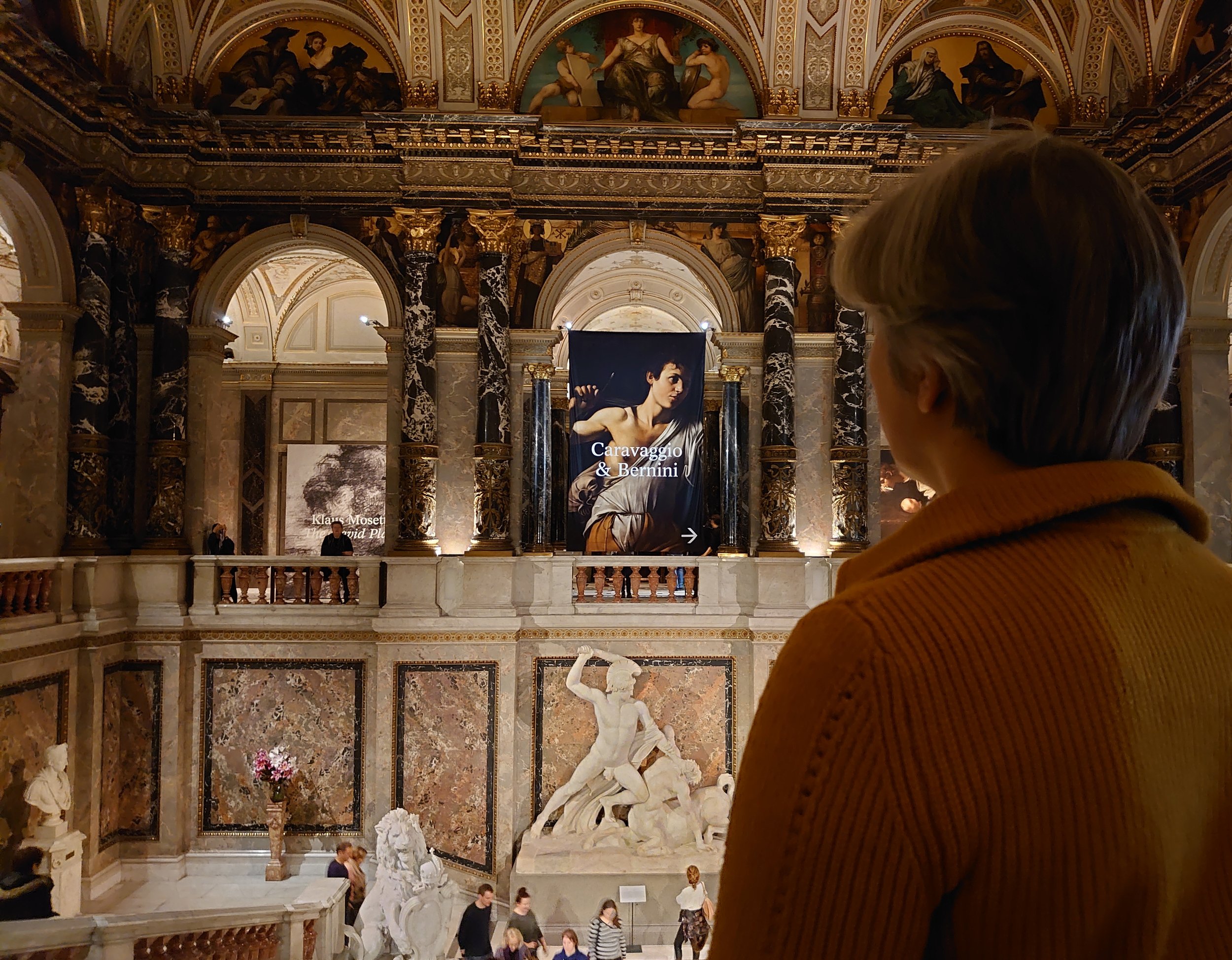
Kunsthistorisches Museum, Vienna, Austria. During the Caravaggio & Bernini exhibition
When we leave a museum and glance at our watch, something curious often happens. It feels as though hardly any time has passed, even though the light outside has already begun to change. Or perhaps the opposite is true, and only a few hours seem to contain the weight of an entire day. Our perception of time quietly shifts. Somewhere between the first gallery and the last painting, it seems to stop obeying the hands of a clock and begins to follow an altogether different rhythm.
We like to think of time as something objective. A minute lasts sixty seconds regardless of where we are or what we are doing. Yet the human mind has never experienced time objectively. It stretches in anticipation, contracts beneath the weight of routine, disappears in the middle of a profound conversation, and almost ceases to exist in those rare moments when we become completely absorbed in what we see.
That is why museums possess such an unusual power. They do not literally slow time down. Instead, they offer something far rarer: for a few precious hours, they free us from the constant need to measure it, compare it, manage it, and fear losing it.
Beyond the museum walls, almost everything competes for our attention. Inside them, that competition quietly dissolves. Phones lose their authority. Conversations soften. Advertisements disappear. No one asks us to buy something else, open another window, or answer another notification. For the first time in a long while, our attention belongs entirely to us.
The modern world is built on the opposite principle. Every screen demands an immediate response. Every notification insists that it matters more than the last. Images replace images so rapidly that our minds gradually lose the ability to distinguish what is truly meaningful. We learn to scan instead of seeing, to recognise instead of noticing, to react instead of observing.
Perhaps that is why many people experience an unexpected discomfort during their first moments inside a museum. Nothing happens in front of a painting. It does not move. It does not change. It does not compete for our attention, ask for approval, or explain itself. It simply remains silent. And that silence may be one of the most unfamiliar experiences left to us in the twenty-first century.
Great painting asks not for speed, but for presence. It exists fully only at the moment when the viewer stops hurrying.
There is a curious paradox. Most visitors arrive determined to see as much as possible. They move through dozens of galleries, photograph hundreds of works, carefully follow the exhibition map, and yet, weeks later, remember only two or three paintings. Not because the others were less important, but because a genuine encounter with art is almost never a matter of quantity. A painting becomes an event only when a particular silence begins to exist between the work and the person standing before it.
Sometimes it happens without warning. You are walking through a gallery, barely slowing your pace, when suddenly you stop. For no obvious reason. You have not yet read the label. The artist's name may mean nothing to you. The subject remains uncertain. Yet something tells you that the conversation has already begun before you have understood why you stopped in the first place. Encounters like these cannot be planned, and they are precisely what make museums places where time begins to behave differently.
We often imagine that paintings preserve the past. In truth, great works of art never belong exclusively to the time in which they were created. Standing before Caravaggio, Rembrandt or Vermeer, what astonishes us is not the age of the painting, but its freedom from age. Centuries suddenly lose their weight. The immense historical distance separating the artist from the viewer quietly disappears. We are not encountering the past. We are encountering another human consciousness. And if that encounter is real, four hundred years can become smaller than a few passing seconds.
Perhaps that is why museums have never been mere repositories of art. They are places where different eras continue to meet. Ancient sculptures stand beside contemporary visitors. Artists who have long since disappeared continue asking questions of people they could never have imagined. Time does not vanish here. It simply ceases to move in a straight line.
For an artist, a museum becomes something even more profound. It is a place where humility arises naturally, not because masterpieces surround us, but because we begin to understand how much human labour can outlive the person who devoted a life to it. Every painting contains thousands of decisions, doubts, revisions and solitary hours that can no longer be seen. The finished work is all that remains visible. Hidden beneath its surface are years of someone's life.
Perhaps that is why museums change artists so deeply. They remind us that art is not born from inspiration alone. It is born from time - from the time someone willingly gave to a single piece of work.
And that may also explain why we so often leave a museum carrying an unexpected sense of calm. Outside, nothing has changed. Cars continue to move through the streets. Phones begin vibrating again. People hurry back to their lives. Yet something within us has grown quieter. Not because the museum altered the passage of time, but because, for a brief moment, it altered us.
Perhaps this has always been the true power of art. Not to stop time, nor simply to preserve the past for future generations. A great work of art accomplishes something far rarer: it returns us to the fullness of the present moment. For a few precious minutes, everything that usually separates us from the world falls away - our haste, our habit of looking past things instead of at them, our endless need to think about what comes next. What remains is a gaze, a silence, and a profound sense of presence that cannot be bought, accelerated or summoned at will.
Perhaps that is why we so often leave a museum believing that time itself has changed.
It has not.
We have.
And sometimes, that is enough to see the whole world differently.
