How Art Helps Consciousness See Itself
There is a curious paradox. Over the course of several thousand years, humanity has learned to measure the distance to galaxies, decode the genome, investigate the workings of the brain, and build machines capable of solving problems that, until recently, seemed uniquely human. Yet one task remains almost as difficult as it was two and a half millennia ago, when the words "Know thyself" were inscribed above the Temple of Apollo at Delphi. Those words have outlived empires, religions, scientific revolutions, and technological eras because they point not to a lack of knowledge, but perhaps to a fundamental limitation of human consciousness.
We can observe the world, other people, our own actions, memories, and emotions. Yet there is one thing we can never observe directly: the very way in which we experience the world. Consciousness is both the observer and the thing attempting to observe itself. That is why certain aspects of our experience remain inaccessible - not because they are too profound, but because there is no direct vantage point from which to see them. This leads to a question that, it seems to me, is asked surprisingly rarely: if consciousness cannot fully perceive itself on its own, what enables it to do so?
At this point, people usually turn to philosophy, psychology, religion, or neuroscience. Art is mentioned far less often, as though it belonged solely to the realms of aesthetics or culture. We say that art expresses emotion, reflects its time, examines society, or communicates ideas. All of this is true. Yet none of these explanations answers a much simpler question: why can a work of art never be replaced by an explanation of it?
No one imagines that a harmonic analysis could replace a piece of music. We understand that a description of one of Bach's fugues will never become the music itself. Yet when it comes to painting, we readily accept the substitute. We discuss symbols, composition, and the artist's biography as though they were enough to stand in for an encounter with the work. If art merely transmitted information, an explanation would long ago have become a complete substitute for the painting.
Yet it never does.
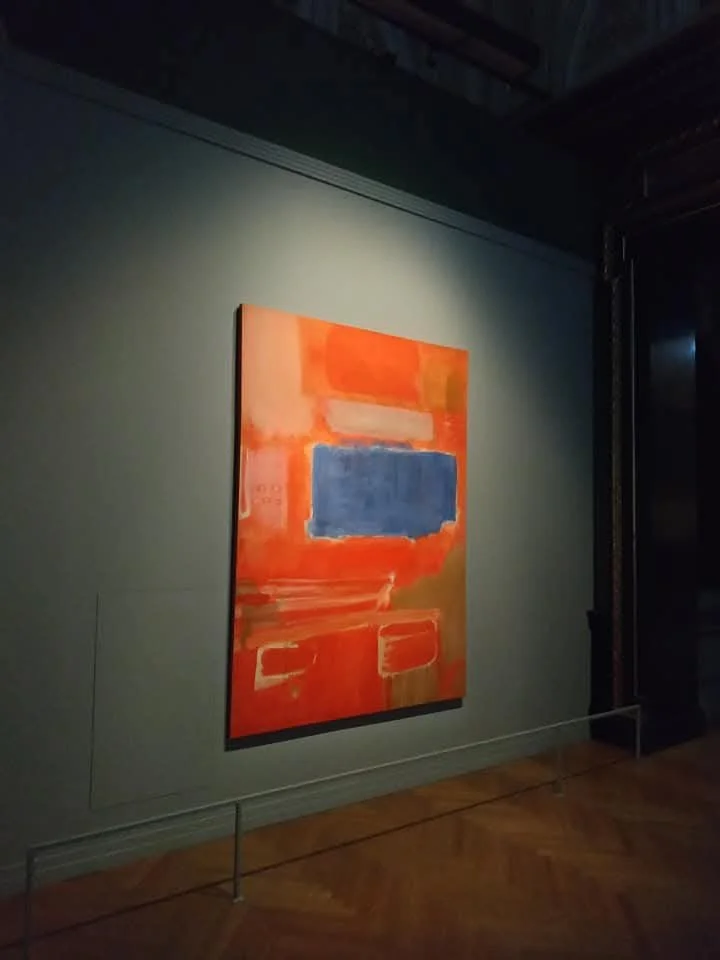
Several years ago, I visited an exhibition of Mark Rothko's paintings. Today I no longer remember the museum labels, the sequence of the galleries, or even every work I saw. What I remember vividly are the first moments spent standing before the paintings. The experience was almost physical, moving from a sense of inner lightness to a tension that could not possibly be attributed to narrative, because there was no narrative. Within minutes, it was not the paintings that had changed. It was the state in which I was looking at them.
When I left the museum, I was no longer thinking about Rothko. I was thinking about my own freedom as an artist. That sense of freedom has remained with me for seven years. It was then that I first began to question my assumptions about what art actually is. What had happened in that room? The paintings had explained nothing. They had offered no new information and persuaded me of no theory. Yet something had shifted. The space from which my own work would later emerge had changed.
Perhaps this reveals one of art's most important qualities. It does not change people directly. It changes the conditions under which they become capable of change. The distinction seems almost imperceptible, yet it allows us to reconsider a question that otherwise remains unanswered.
If this is true, however, an obvious objection follows. Why do most works of art leave us untouched? Why do thousands of paintings pass unnoticed while a single one can remain with someone for a lifetime?
I believe the answer is that art does not exist solely within the work itself. It comes into being through an encounter. The artwork may be a necessary condition for that encounter, but it can never guarantee it. This is why no one can predict which work will become a defining experience for a particular person at a particular moment in life. Art begins not when the artist finishes the painting, but when a space opens between the work and the viewer - a space in which a new kind of experience becomes possible.
Perhaps this is also why great works are never exhausted by interpretation. We often say that they contain an infinite number of meanings. I suspect that something else is happening. They remain alive because each generation approaches them with its own experience and leaves, in some subtle way, transformed. The work remains the same. The person does not.
At this point, it becomes clear that this essay is not really about art.
It is about the human being.
There is a fundamental characteristic of consciousness: certain dimensions of our own existence become visible only when we encounter something outside ourselves - something complex enough to cease being merely an object and become a genuine interlocutor. Art may be one such form. It is not the only one. Love, nature, music, literature, and profound conversation can all bring us into contact with ourselves. Yet art occupies a distinctive place among them because it asks for nothing in return. It does not seek to persuade, promise utility, or offer ready-made answers. It offers only presence. And perhaps that is precisely why it can reveal what no explanation ever can.
We live in an age that instinctively trusts information. We tend to believe that understanding means acquiring more knowledge. Yet some things become accessible not when knowledge increases, but when the very way we experience the world begins to change. Perhaps that is why the question of art has never been only a question of beauty or culture. It is, more fundamentally, a question of human consciousness.
If there are dimensions of our own experience that can never be reached through analysis or explanation alone, then we need places where such encounters can become possible. Perhaps this is why art remains necessary even today - not because the world would be less beautiful without it, but because certain regions of human experience would remain inaccessible even to ourselves.
And if that is true, then perhaps art exists not simply to help us see the world.
It exists so that, one day, we may finally be able to see ourselves.
