The Distance From Which a Painting Begins
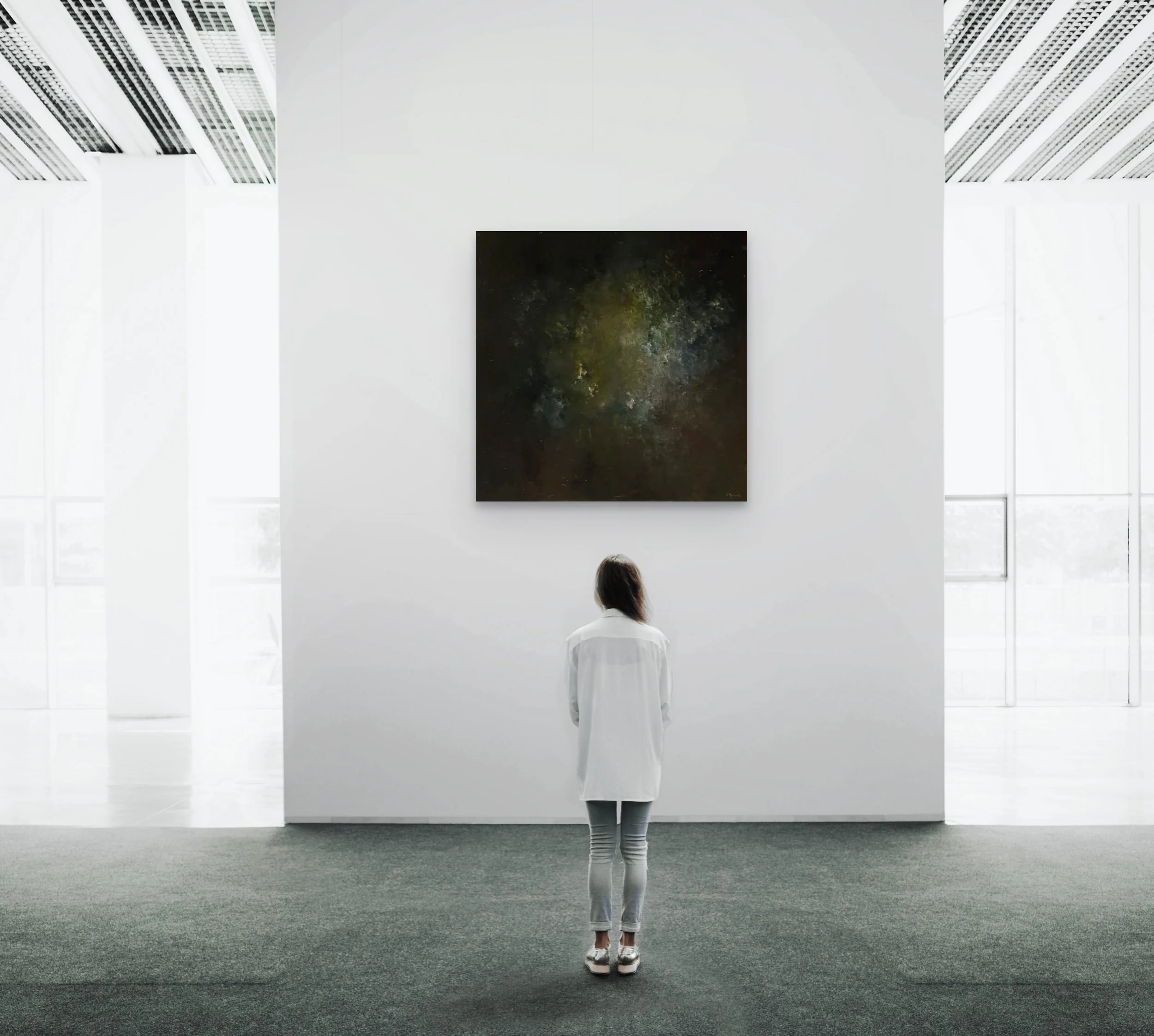
In the studio, there is a movement an artist repeats hundreds of times and eventually stops noticing: approach the canvas, make a few brushstrokes, step back, look, then move closer again. From the outside, it may seem like a simple way of checking the work as a whole. But the longer I paint, the more interested I become in the movement itself. Why is it sometimes necessary to physically move away from a painting in order to understand what is happening within it? Why does information that cannot be seen at arm’s length suddenly become obvious from three or four metres away?
We tend to assume that proximity gives us more information. In most cases, it does. Move closer to the surface of a painting and individual brushstrokes become visible, along with the edges of layers, the transparency of paint, changes in texture, and subtle shifts in colour. We can see things that, from across the room, simply do not exist for the eye. But a strange exchange takes place: the more clearly we see the material of the painting, the easier it becomes to lose the image as a whole.
What appeared from a distance to be a face becomes, up close, a series of areas with different colour temperatures. A shadow turns out not to be a shadow at all, but a complex meeting of colours. A contour that seemed perfectly defined reveals that it was hardly drawn anywhere. Sometimes all it takes is moving closer to a good painting for the depicted world to begin to fall apart before our eyes. Then we step back, and it returns.
Nothing on the canvas has changed. No new brushstroke has appeared, no colour has shifted, no figure has moved. Only the distance between the surface and our eyes has changed. Yet that alone has been enough to turn a collection of separate elements into a face, a body, a space, or light. To me, this is one of the most remarkable qualities of painting: an image can emerge from information that the eye is no longer able to distinguish individually.
This is where painting unexpectedly meets the physiology of vision. The eye does not work like a camera, recording everything before it with equal precision. Vision detects contrasts, groups elements, recognises boundaries, and completes forms. The brain does not simply receive a finished image of the external world; it is continuously involved in constructing what we see. Artists were working with this long before modern studies of visual perception existed. They did not need to understand the structure of the retina or the terminology of perceptual psychology to discover something simple: two colours that remain separate on the surface can begin to work together at a certain distance; several patches can become volume; an incomplete contour can be perceived as a complete form. What is literally present on the canvas and what a person ultimately sees are not always the same thing.
In that sense, part of the painting is created by the artist, and part by vision. This is why distance interests me not simply as a condition for comfortable viewing, but as one of the components of the work. It adds nothing to the physical surface, yet it determines which relationships within that surface become available to us. Viewed from a few centimetres away, an image presents one set of relationships. From two metres, another. From five, another still. With every step, some information disappears, while new relationships emerge among what remains. Losing detail does not necessarily mean losing meaning. Sometimes, in order to see the whole, the eye has to stop seeing some of its parts.
This idea extends far beyond painting. Perceptual psychology examines how separate elements are organised into coherent forms. Optics explains why fine distinctions become impossible to resolve as distance increases. Architecture constantly works with the fact that an object is perceived differently depending on the observer’s position and movement through space. Stage design takes into account a viewer who encounters the set not from close range but from a particular distance. Even typography works in a similar way: a letterform that functions beautifully on the page of a book may disappear on the façade of a building, while a form that seems crude up close can become precise and clear from farther away. In all of these cases, distance does more than make an object appear smaller. It changes the way the object becomes legible.
Painting, however, introduces an additional complexity: a painting is rarely experienced from only one viewing point. We can move in front of it. We may first notice it from a distance, then approach, stop, perhaps come almost close enough to inspect the surface, and then step back again. Each time, the physical object before us remains the same, yet the visual experience has changed. This is why I find it difficult to think of a painting as a single, fixed image. There is the surface created by the artist, but there are also different states of that surface within the viewer’s perception.
Up close, a painting can become almost a material object: we notice the paint, the movement of the brush, the thickness of a layer, edges, and subtle variations in the surface. From a certain distance, those traces cease to exist independently and begin to form an image. Farther away, details weaken, but larger relationships become stronger — light and dark, mass and emptiness, direction, rhythm, colour. Sometimes it is from a distance that a painting first announces itself. A person enters a space and does not yet know what is depicted, has not examined a face or seen the texture of the surface, yet a particular relationship of colour, scale, and contrast has already reached them before the subject has.
What makes this especially interesting is that the order of perception is almost the reverse of the order of creation. An artist may spend months constructing an image through individual decisions. A viewer encounters the result in a fraction of a second: first receiving the whole, and only later, if they move closer, discovering what that whole was made from.
Perhaps this is why artists step back from the canvas so often while working. For a moment, the artist is trying to stop being the person who knows every decision that has been made and to test whether the painting exists for an eye that knows none of them. Up close, the artist knows too much: where a colour has just been placed, what has been corrected, which area still needs work. By stepping back, the artist forces the work to lose some of that information. What remains is a much simpler question: does it exist as a whole?
Several metres of empty space in front of a painting can therefore matter far more than they appear to. An architect might speak about viewing distance and sightlines. A specialist in visual perception might refer to angular size, contrast, and visual acuity. A museum professional might think about the visitor’s route and the point from which a work first enters the field of vision. An artist will probably just step back and look. These are different professional languages for describing the same physical event: there is space between a person and an image, and that space affects the image the person receives.
This is why the dimensions of a painting tell us less about it than we sometimes imagine. Two canvases of exactly the same size can behave very differently at the same viewing distance. One keeps the viewer close to its surface. Another needs several metres before its individual elements come together. A third begins to act from almost across the entire room, before it is even clear what it depicts. Physical dimensions can be measured with a ruler. Perceptual scale exists only in the encounter with a viewer.
This leads to a question that seems far more interesting to me than the familiar one of how far away we should stand from a painting. Perhaps there is no single correct distance. There is a distance from which we can see how a painting was made. There is a distance from which the image comes together. There is another from which detail almost disappears and structure remains. The fullness of a work may lie not at any one of these points, but in our ability to move between them.
The viewer, then, is not simply standing in front of an unmoving work. Through movement, the viewer changes the amount and character of the information from which perception is constructed at any given moment. Move closer, and the whole begins to separate into the artist’s individual decisions. Step back, and those decisions disappear into the whole. The canvas itself remains completely still. Perhaps this is why painting is never quite as static as it seems.
And perhaps there is a distance at which a painting becomes itself. Not because it becomes wrong at any other distance, but because somewhere between the surface of the canvas and the viewer, a subtle transition occurs: individual colours cease to be individual colours, brushstrokes cease to be brushstrokes, fragments come together, and the eye stops perceiving the surface as a collection of elements. It sees the painting.
The space between the work and the viewer then ceases to seem empty. We tend to think of the painting as being on the wall and the viewer as standing in front of it, with several metres of air simply left between them. But perhaps it is within those few metres that one of the most important things in painting takes place: a material object becomes a coherent visual experience.
Perhaps that is where the painting begins.
