A Painting Does Not End at the Edge of the Canvas
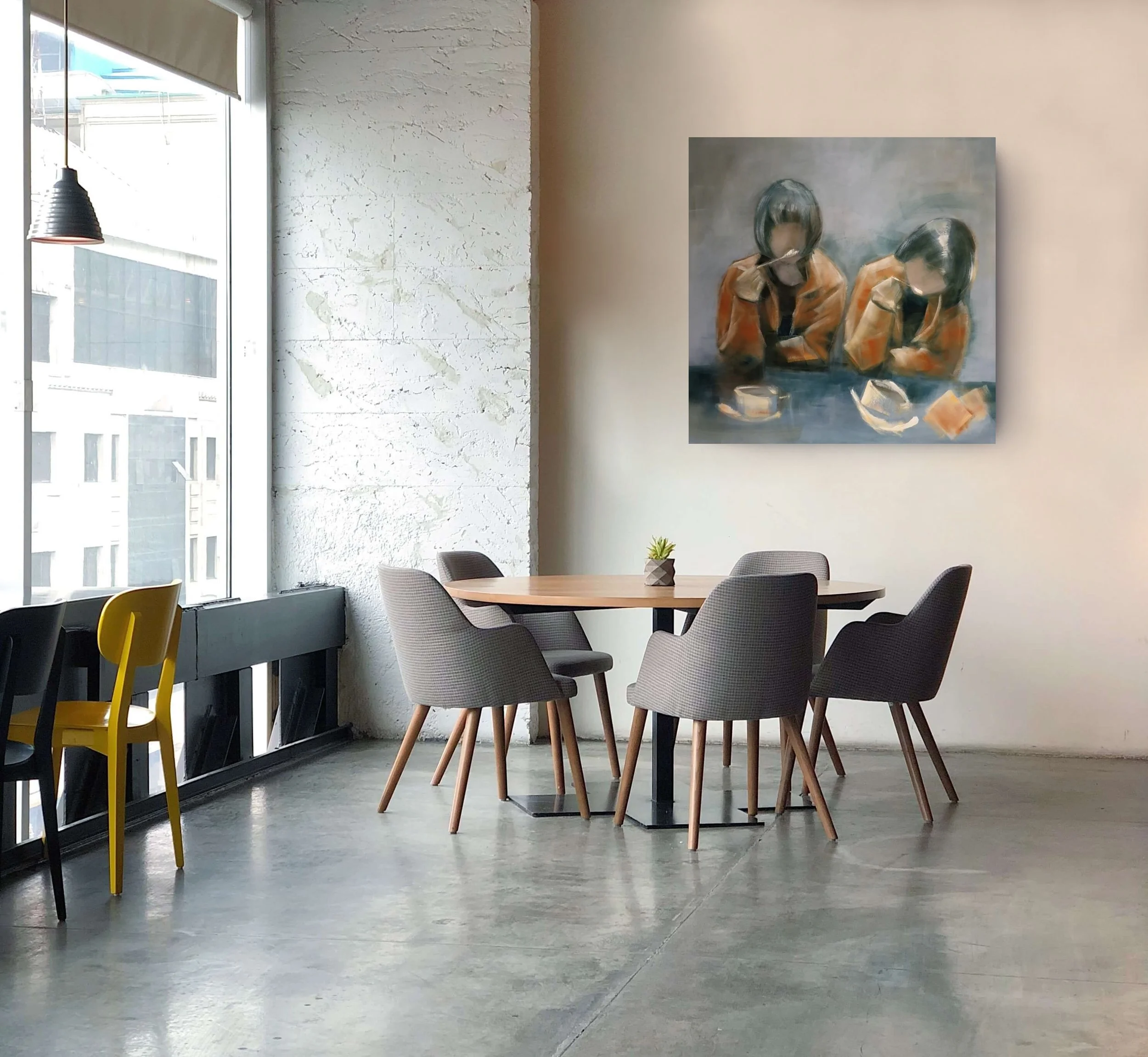
An artist usually knows the moment when a painting is finished. Sometimes that decision comes after weeks of work; sometimes it arrives almost instantly. At a certain point, it becomes clear that another brushstroke would add nothing. The painting no longer asks for intervention, and the artist steps away.
We tend to think of this moment as the completion of the work. But I have increasingly come to believe that there is another kind of completion, one the artist is rarely there to witness. It happens later, when the painting leaves the studio and enters a space for which it was never literally made: a particular wall, a particular quality of light, a particular height, surrounded by architecture, objects, and people who may pass by it every day.
Physically, nothing has happened to the painting. The dimensions of the canvas remain the same. The pigments have not changed. The composition has not shifted by a millimetre. And yet the work changes. A hundred centimetres of canvas in a studio and the same hundred centimetres on the wall of a large space are the same physical object, but they are no longer quite the same experience.
We never perceive a painting in complete isolation. Scale exists only in relation to something else: the human body, the height of a wall, the distance from which we are able to step back. Colour exists beside other colours. A dark field changes depending on whether it is surrounded by white space or held within complex shadow. A surface that appeared almost matte under even studio lighting may suddenly reveal unexpected depth when natural light begins to move across it.
Even distance becomes part of the work. Some paintings ask us to come closer. Others only begin to exist fully when several metres of air open between the work and the viewer. Sometimes a space reveals a compositional balance that was almost impossible to sense in the studio. Sometimes architecture unexpectedly amplifies the scale of a painting. At other times, a work becomes quieter within a very large space, and it is precisely this quietness that gives it greater force.
This is why I am interested in reversing the question we usually ask about art. We often ask what a painting does to a space. But what can a space reveal in a painting that the studio could not?
For me, this is where the decorative understanding of placing art begins to fall away. Finding a place for a painting is not simply a matter of finding the wall on which it looks best. It is a final act of interpretation, carried out through elements that already exist beyond the canvas itself: light, scale, distance, architecture, and time.
And perhaps time is the most important of them all. In an exhibition space, we encounter a painting as an event. We have come there specifically to look. Our attention has already been prepared for the encounter. In the spaces of everyday life, something very different happens. At first, we notice the work constantly. Then we stop consciously looking at it each time we enter the room. The painting becomes so much a part of the space that its presence begins to feel natural. It would be easy to assume that, at this point, we are seeing it less.
But I think something more interesting happens. We begin to see it for longer.
Not for several minutes in front of a painting, but over months and years. In the morning and in the evening. In winter and summer. In strong sunlight and in light that is almost disappearing. At different periods of our own lives and in different states of attention. Gradually, the work begins to reveal qualities that could never have been discovered in a single encounter.
Perhaps this is why presence has become such an important subject in my painting. While working on Living Presence, I was interested not in depicting an event, but almost the opposite: a space in which nothing demands immediate attention. A person can remain beside another person, an object, a particular light, or simply silence without needing to turn that moment into something more. Over time, however, I began to realise that a painting itself can exist in much the same way.
It does not have to insist on being looked at. It can simply be present.
And when that happens, the relationship between a person and a work of art becomes much longer than the act of looking itself. A painting can accompany ordinary life without turning every encounter with it into an event. Sometimes a person passes it without noticing. Sometimes they stop. Sometimes, years later, they suddenly see something in it that they had never seen before. Not because the painting has changed, but because the light has changed, the space has changed, the distance has changed - or the person has.
Perhaps this is why a work of art can never be fully understood at the moment when the artist declares it finished. In the studio, the making of the physical object comes to an end. Its life in space is only beginning.
And if that is true, then the edge of the canvas is not really the boundary of the work. Beyond it continue light, architecture, distance, human movement, and time: everything the artist can no longer control, but which will eventually become part of how the work is seen.
There may be a moment when an artist truly needs to finish a painting. But there is another moment when the painting needs to leave the artist, so that a space can reveal something within it that even the person who created it could not see.
