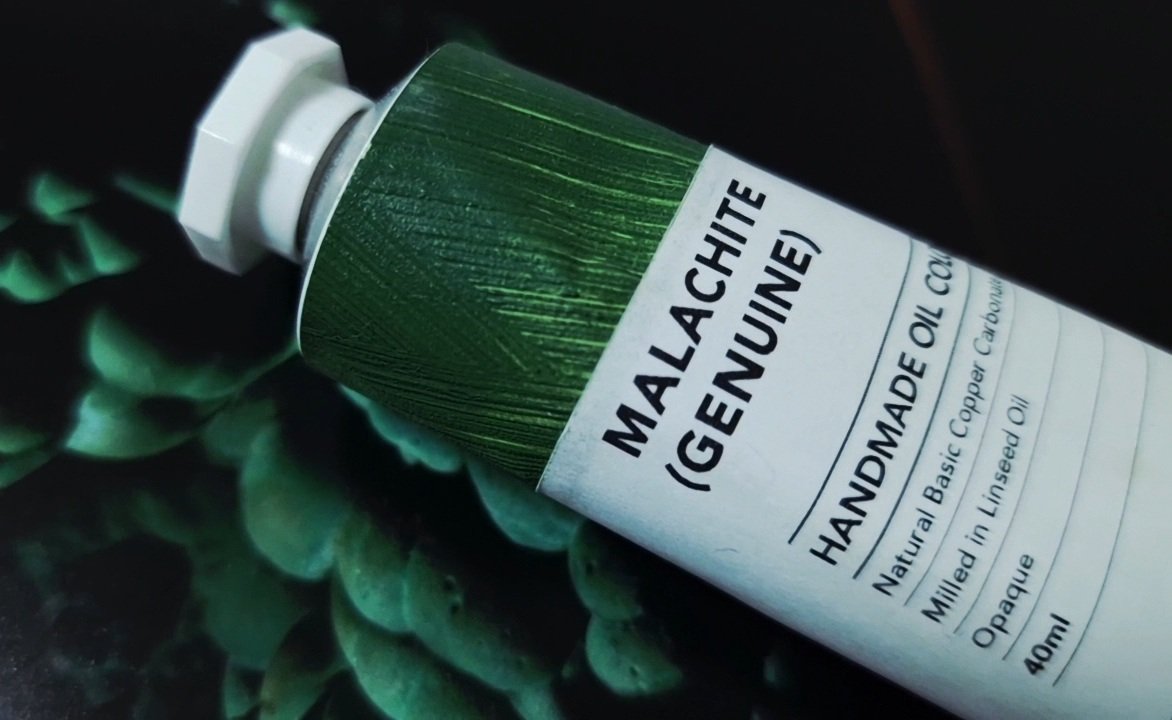
Genuine Malachite - The Colour That Cannot Be Commanded
Some materials in the history of painting challenge our very idea of perfection. Malachite is one of them. The more thoroughly an artist attempts to refine it, the greater the risk of losing the very quality for which the mineral was chosen: the depth and intensity of its green.
Malachite forms in the oxidised zones of copper deposits, where water, copper and carbon dioxide participate in complex chemical transformations. Its green existed long before painting. But to transfer that colour onto a painted surface, people had to learn how to break the stone, reduce it to powder, clean and separate its particles, and combine them with a binder. In doing so, they discovered that the beauty of a mineral and the beauty of the paint made from it are not quite the same thing.
Grinding malachite changes the way its particles interact with light. Larger grains can retain a rich, saturated green, while excessive grinding produces a paler, less intense pigment. What might appear to be a technical improvement - a finer, more uniform texture - can result in a loss of colour. The artist must find a balance between the intensity of the pigment and the working properties of the paint, between the desire to refine a material and the need to preserve its character.
This was understood long before the development of modern optics. Around the turn of the fifteenth century, Cennino Cennini described a green pigment known as verde-azzurro, associated with malachite green, in his treatise Il Libro dell'Arte. He warned against grinding it too vigorously, since excessive grinding could leave the colour dull and ashen. There is remarkably precise practical knowledge in that warning. Painters could not yet explain the phenomenon in terms of light scattering and absorption, but they already understood that further processing did not necessarily improve a material. Sometimes it destroyed the very qualities that made it valuable.
About a century later, malachite was among the pigments used by Raphael. Around 1506–1507, he painted the small Madonna of the Pinks, now in the National Gallery in London. Researchers identified malachite among the green pigments used in the painting, but technical examination revealed another fascinating detail concerning colour. The curtain to the left of the Virgin was originally purple. Beneath the visible green paint, researchers found an earlier layer containing azurite and a red lake pigment. Raphael had changed his mind while painting. Five centuries later, the examination of those paint layers allowed researchers to reconstruct part of that decision-making process.
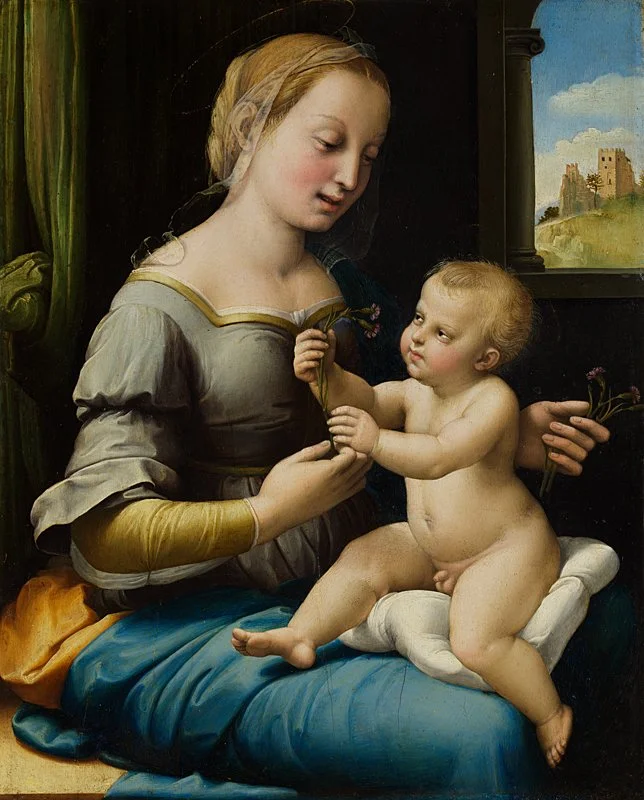
Raphael (1483–1520), The Madonna of the Pinks (La Madonna dei Garofani), c. 1506–1507. Oil on yew wood, 27.9 × 22.4 cm. The National Gallery, London, NG6596.
Image: © The National Gallery, London. Source: https://www.nationalgallery.org.uk/paintings/raphael-the-madonna-of-the-pinks-la-madonna-dei-garofani
What particularly interests me is how discoveries like this change our understanding of historical paintings. We are accustomed to seeing a finished work as though every relationship of colour were inevitable. Yet beneath its surface remain other decisions, earlier combinations, revisions and traces of the artist at work. The material preserves information that the visible image no longer reveals. Sometimes the chemical composition of a pigment, or the barely perceptible boundary between layers of paint, brings us closer to a moment when the artist had not yet decided what the finished painting would become.
There is another reason why I find the history of malachite so compelling. Contemporary painters have access to an extraordinary range of colours developed for stability, consistency and ease of use. We have become accustomed to judging materials by the purity of their colour, the fineness of their grind, their uniformity and their ability to behave as expected. Historical pigments remind us that artistic value does not always coincide with technical perfection. Sometimes graininess, irregularity or a particular response to processing are not flaws to be eliminated, but the very qualities for which a material is chosen.
For centuries, malachite held its green within the stone, until people learned to turn it into paint. Yet the harder they tried to extract all its beauty, the paler it could become. Perhaps nature granted us the privilege of admiring perfection, but not the right to command it entirely.
