The Provenance of the Analytical Signal
When researchers analyse a historical painting, they are dealing with an object after decades or centuries of existence. XRF can detect and map the presence of chemical elements within the capabilities and limitations of a particular measurement configuration. Spectroscopic methods can provide information about chemical compounds, while the examination of cross-sections can reveal their distribution within the stratigraphy of the paint layers. These data are used to reconstruct artists’ materials and techniques, investigate ageing processes and, in some cases, contribute to questions of dating and attribution. Between the creation of an artwork and the moment of analysis lies its entire subsequent material history.
Over that time, the original material system changes. Pigments interact with the binding medium and with components of adjacent layers; new compounds form; certain ions and degradation products can migrate through a multilayer structure. Organic components undergo oxidation and hydrolysis, while exposure to some solvents can extract soluble components from the paint film. The nature of these processes depends on the composition of the materials, environmental conditions and the history of the object itself. As a result, the present-day location of a detected substance may, in some cases, differ from its original location.
The condition of an artwork may also have been altered by conservation treatments. Over the course of its existence, a painting may have been cleaned repeatedly, varnished and subsequently stripped of later coatings, consolidated, lined or subjected to other interventions. Such treatments can introduce new materials into the object, remove existing components or alter them. In oil paintings, for example, experimental studies have investigated paint-film swelling caused by organic solvents and the extraction of soluble low-molecular-weight components. The effects of any particular intervention depend on the composition and condition of the paint, the treatment system used and the conditions under which it was applied. Observations made for one type of treatment therefore cannot simply be transferred to another without additional evidence.
The provenance of a present-day analytical signal is consequently not always self-evident. A detected compound may belong to the original material system, may have formed through subsequent chemical change, may have migrated from another part of the object, or may derive from a material introduced at a later stage.
A well-documented example is provided by certain historical arsenic-containing pigments. In a study of five samples from artworks containing orpiment, realgar and Emerald Green, arsenic compounds were detected beyond the original pigmented regions. Their distribution varied between objects and extended into adjacent paint layers, grounds, varnish coatings and, in some cases, the support. The authors relate this distribution to the degradation of the original pigments and the subsequent migration of arsenic-containing products. These findings apply to the objects examined and do not justify assuming the same mechanism or extent of migration in every artwork containing an arsenic-based pigment.
This example points to a broader problem. Researchers observe an artwork in its state at Tₙ, while some of the questions addressed through analysis concern earlier states, extending back to T₀.
The statements “substance X was detected in layer Y” and “substance X was an original component of layer Y” have different evidential structures. The first may be the result of a measurement. The second requires establishing a historical relationship between the detected substance and the particular stage in the object’s history under investigation.
Within the Material Memory Project, this problem can be approached through the provenance of the analytical signal. This is a working framework rather than the name of a separate analytical method or an attempt to replace established terminology in conservation science.
It is important to distinguish this from data provenance. In scientific research, data provenance concerns the origin of the data themselves: the conditions under which they were acquired, the equipment used, processing procedures, transformations and other information required to trace the history of a research result. The question here is different. What matters is the provenance of the material feature registered by the measurement.
The task is to establish the origin of the detected component and, insofar as the available evidence permits, to determine whether its present location belongs to the original structure of the artwork or results from subsequent changes.
This may require consideration of the substance’s position relative to other layers, its chemical form, associated elements, particle morphology, reaction products, results obtained through several analytical methods and the known history of interventions. The evidence required will depend on the specific question. In some cases, the combined evidence may allow the origin of a component to be established with reasonable confidence; in others, several explanations may remain compatible with the observed state.
Increasing the sensitivity of analytical methods does not in itself resolve this problem. Greater sensitivity can make it possible to detect smaller quantities of a substance, obtain more detailed spatial distributions of elements or distinguish additional chemical forms. This expands the range of available observations, but the historical origin of a detected component still requires separate justification.
A trace component originating in an initial paint layer and a substance introduced into the object much later may both be detected during the same investigation, although their significance for reconstructing the artwork will be entirely different. This is particularly important when analytical data are used in studies of technique, dating or authentication. The chronological significance of a detected material depends not only on its identification but also on how securely it can be associated with a particular stage in the object’s history.
Documentation of conservation interventions is therefore relevant to subsequent analytical investigation as well. Records of materials introduced or removed, treatment agents used, areas treated and the sequence of operations can assist in interpreting results obtained years later. In the absence of such documentation, it may still be possible to detect a change without having sufficient evidence to establish precisely when or why it occurred.
For a historical artwork, T₀ is no longer directly observable. Researchers have access to the state at Tₙ and reconstruct earlier states from surviving material evidence, historical documentation and other sources. Unknown events between those states limit the degree of certainty such a reconstruction can achieve.
For an artwork being created today, some of the initial information can still be recorded directly. The manufacturer and exact commercial name of a material, its declared pigment composition, binding medium, batch number, sequence of layers, media used, dates of work and available technical documentation can all be recorded at the time of creation. In research projects, this documentation can, where appropriate, be supplemented by analysis of the specific material used.
T₀, however, is not a complete description of the artwork’s initial material state. Any record is limited by what was known, documented and measured.
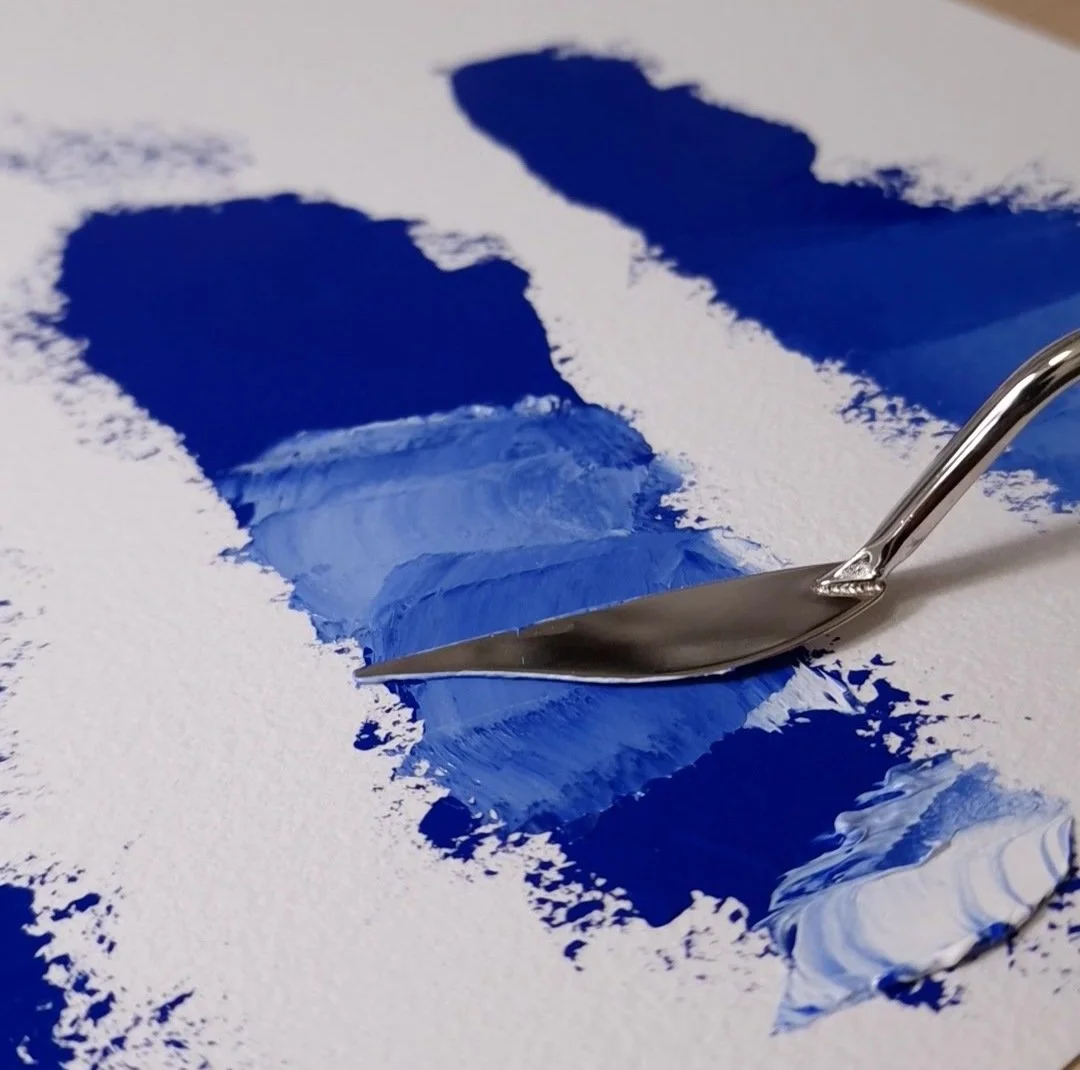
An artist’s record of Ultramarine Deep, manufacturer X preserves one level of information. A batch number provides a more precise identification of the particular product. The manufacturer’s technical documentation provides information about the declared composition. Instrumental examination of a sample may add information that is absent from the documentation. Each of these sources has its own limitations and addresses different questions.
For T₀, it is therefore important to preserve not only a statement about a material, but also the basis on which that statement was made. Such a record might read:
PB29 - declared by the manufacturer.
Binding medium - declared by the manufacturer.
Batch number - recorded from the packaging.
PB29 identified in the examined sample by Raman spectroscopy; measurement parameters and spectrum retained.
Presence and composition of additives - not investigated.
The final formulation is important. Raman spectroscopy can provide highly specific identification of many pigments and other materials, but the result depends on the area examined, the composition of the mixture, fluorescence, excitation wavelength and other experimental conditions. It is therefore more precise to record a specific analytical finding together with the conditions under which it was obtained than to state simply that a material was “confirmed by Raman”.
This form of documentation makes it possible to distinguish information originating from the manufacturer, information recorded directly by the artist, information obtained instrumentally and parameters that remain unknown. For the Material Identity Stack, this distinction is essential: what is preserved is not simply a material characteristic, but the evidential basis for each significant claim about that material.
Under this approach, T₀ does not eliminate uncertainty. It allows us to identify more precisely where that uncertainty begins.
Subsequent changes in storage conditions, analytical investigations, observed ageing and conservation interventions form the next part of the object’s material history. Within MMP, this sequence can be documented as transmission history, recording events capable of altering the material state of the artwork or affecting the subsequent interpretation of that state.
A future analytical conclusion can then distinguish between observation and reconstruction. A record stating that, at Tₙ, substance X was detected at a particular point or in layer Y using a specified method belongs to the observed state and should include the relevant limitations of the measurement. Explaining how X came to be there between T₀ and Tₙ requires a separate chain of evidence.
For historical artworks, much of this history has to be reconstructed from surviving evidence. For works being created today, some of that information can still be preserved as their material history develops.
A century from now, a researcher will still be working with Tₙ. But T₀ does not have to exist solely as a reconstruction. The artwork can be accompanied by a record of the materials used, what was known about them at the time of creation, how that information was established, and which parameters remained unknown.
The precision of a measurement determines how confidently an observed material feature can be described. Establishing what that feature tells us about the history of an artwork requires its provenance to be justified separately.
