PB27 Is Not a Material History
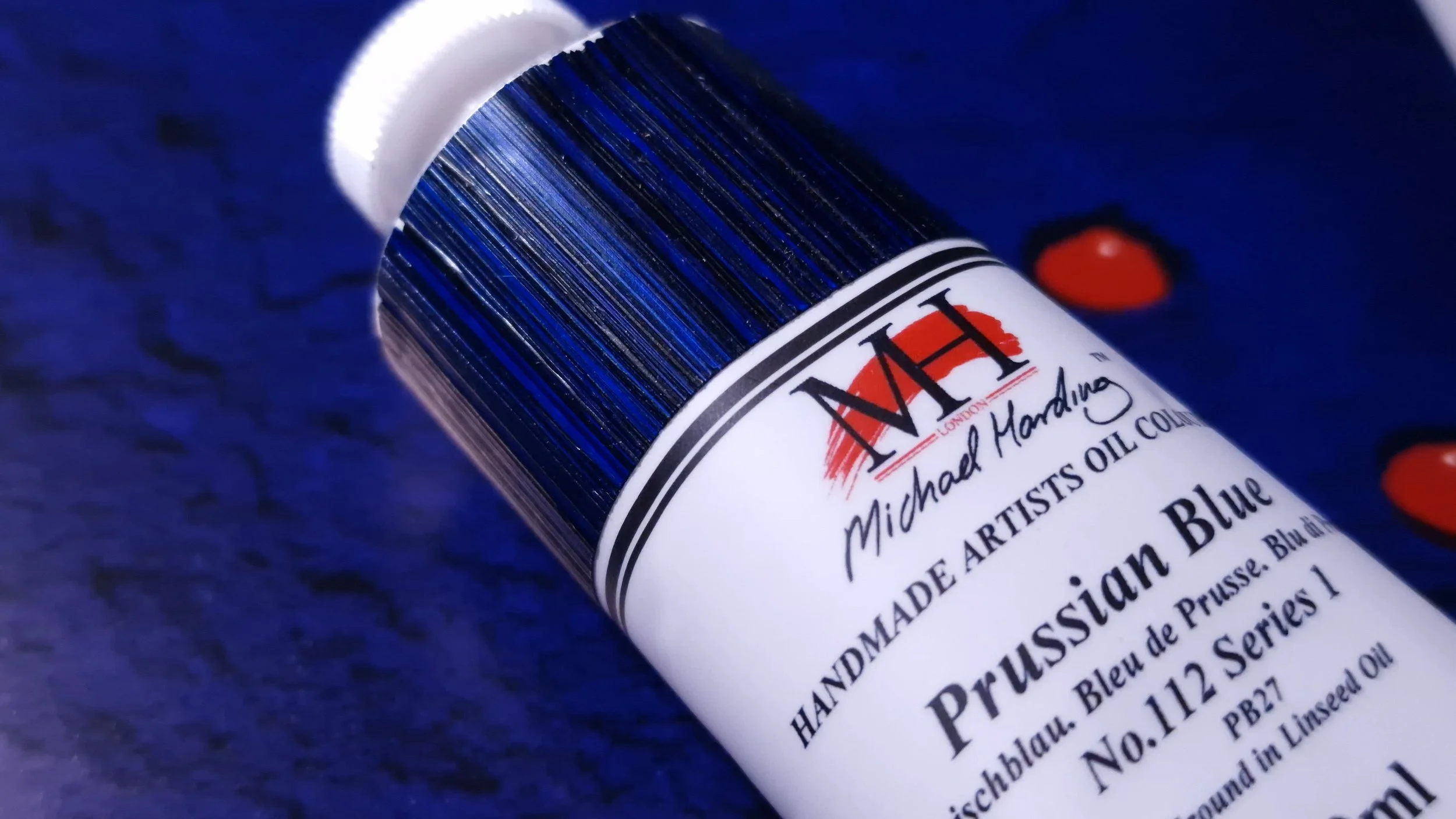
A few characters on a modern tube of Prussian Blue seem to tell us almost everything we need to know: PB27. For an artist, this functions almost like a pigment passport. Names may vary between manufacturers, as may hue, consistency and handling, but PB27 tells us something fundamental: the pigment category to which the material belongs. That is entirely sufficient for one purpose and entirely insufficient for another - reconstructing its material history.
Prussian Blue appeared in the early eighteenth century and became one of the first synthetic pigments of the modern era. Historical Prussian Blue, however, was never a single unchanging material. Recipes changed, as did raw materials and methods of preparing precursors, oxidation, washing and purification. Changes in production were accompanied by changes in the characteristics of the resulting pigment. Modern industrial Prussian Blue is considerably more standardised, but three centuries of its existence cannot be treated as a single continuous material formulation simply because this pigment category is now identified as PB27.
In a 2024 study, Suzanne Reus and her colleagues examined methods of Prussian Blue production described in nineteenth- and early twentieth-century sources and experimentally reconstructed several of the most common technological variants. For comparison, they also reconstructed two eighteenth-century recipes. The resulting pigments were analysed using ATR-FTIR, XRD and SEM-EDX. Different production methods produced differences in process-related impurities, particle size and morphology. These differences were not confined to the analytical characteristics of the pigment powders: oil paints prepared from the reconstructed pigments also differed in hue and tinting strength.
For the history of artists’ materials, this matters. A change in manufacturing technology can alter the properties of a material without producing a new Colour Index designation. Two paints may quite correctly contain PB27, yet that shared classification does not in itself demonstrate that all the characteristics relevant to an artist, researcher or conservator are the same.
The Colour Index was never intended to preserve the technological biography of a material. It identifies a pigment or colorant; it does not record the origin of raw materials, manufacturing processes, particle distribution, process-related impurities, or changes in production between different periods and manufacturers. Identifying PB27 analytically in a historical paint layer therefore answers an important question - which pigment is present - while leaving others open: how was it manufactured, which aspects of production are reflected in its composition and structure, and what properties did the particular material that reached the artist’s palette actually have?
Some of this information can occasionally be recovered through analysis. In historical Prussian Blue, certain accompanying components may retain evidence of particular manufacturing processes. Reus and her colleagues explicitly consider process-related impurities as potential sources of information about the production method used. This distinction matters: production history does not necessarily disappear completely, but once the original documentation is lost, it has to be reconstructed from residual evidence within the object and from historical sources.
The situation with contemporary materials is fundamentally different because much of this information exists at the time of manufacture. Manufacturers know their raw materials and production processes, control product specifications and document at least some significant changes. Artists usually receive a much narrower set of information: the colour name, Colour Index designation, sometimes the binder, and ratings for lightfastness, transparency or opacity. Formulations and certain technological parameters are understandably proprietary information. Yet there is a substantial territory between disclosing an industrial formula and leaving no accessible historical documentation at all. Dates of significant changes, the nature of changes in raw materials or processes, batch specifications, reference samples, paint-outs, and comparable samples from before and after reformulation can all be preserved without disclosing proprietary know-how.
Prussian Blue is particularly revealing for another reason. Its long-term behaviour cannot be described by the designation PB27 alone. Historical colour changes have long been documented, while modern research shows how strongly outcomes can depend on paint-layer composition, binder, associated materials and exposure conditions. The phrase “the properties of PB27” therefore requires context. An experiment generally describes the behaviour of a particular PB27 material in a particular system under particular conditions. Extending that result to the entire three-hundred-year history of the pigment without additional evidence is not justified.
On my table now is a modern tube of Prussian Blue labelled PB27. There is genuine chemical continuity between this pigment and eighteenth-century Prussian Blue. But chemical continuity does not establish complete material identity. If changes in manufacture affect particle morphology, impurities, hue, tinting strength or long-term behaviour, those differences belong to the history of the material whether or not the designation on the tube changes.
This is where a form of loss appears that is easy to miss. The pigment has not been discontinued. The name has not disappeared. PB27 remains PB27; the paint is still sold and artists continue to use it. There is no obvious event that would normally trigger an effort to preserve documentation.
A material does not have to disappear for information about it to be lost.
A manufacturing process may change, an earlier specification may cease to be used, documentation may remain internal to a company or eventually become inaccessible, and reference samples may never be retained. Decades later, the name and Colour Index designation may still create an impression of continuity even though some of the information needed to distinguish different states of that material over time has already been lost.
For the Material Memory Project, this expands the meaning of material loss itself. Discontinuation is the most visible case because it has an event and a date. Loss occurring within continuous production is much harder to detect. Outwardly, the material persists, while the resolution with which its history can be reconstructed gradually diminishes.
Prussian Blue has existed for more than three hundred years. The history of PB27 shows that continuity of production does not in itself ensure continuity of documentation. Information loss can begin long before a material disappears - and remain unnoticed precisely because the material is still there.
