What Exactly Do We Preserve When We Preserve an Artist Material?
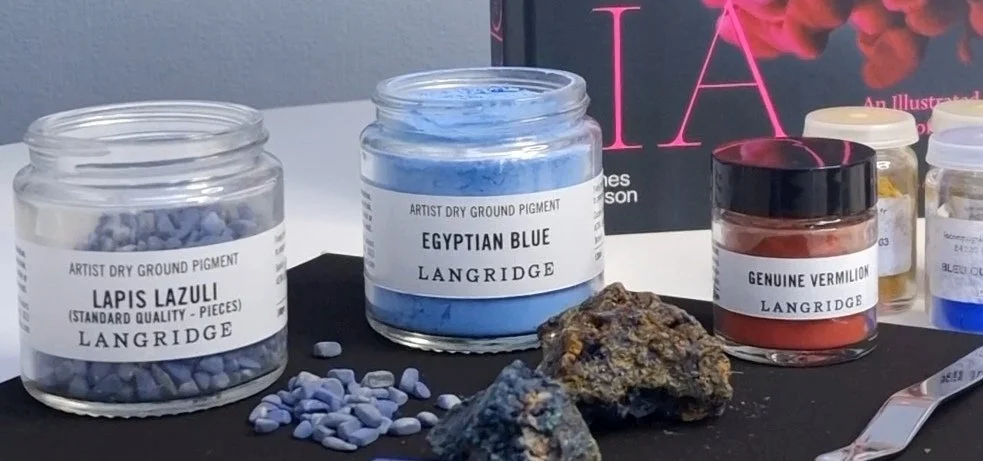
When an artist material disappears from production, we tend to say that it has been lost. But that is not always true. A pigment may continue to exist as a chemical substance. Samples may remain in museum and research collections. Its composition may be known, its properties described in technical literature, and works made with it may survive in collections around the world. In some cases, even unused historical stocks of the material still exist. From the perspective of the archive, the material survives. Yet the artist can no longer place it on a palette.
This contradiction raises a question that seems simple only until we try to answer it: what exactly do we preserve when we preserve an artist material? The substance itself? Information about it? The works in which it is present? Or the possibility of continuing to work with it? These things are closely connected, but they are not the same.
Within the Material Memory Project, I propose that we consider an artist material not only as a physical substance with a particular chemical composition and a set of measurable properties. In the fullest sense, it becomes an artist material within practice: when it is available to artists, used by them, brought into contact with other materials, and gradually becomes the subject of accumulated practical knowledge. This distinction is especially clear in the case of pigments. A pigment sample in a research collection and the same pigment on an artist’s palette may be chemically identical, yet they exist within two very different systems of relationships. In one, the material is an object of preservation and study. In the other, it is an instrument of action, choice, and experimentation. In the first case, we can continue to learn about the material. In the second, we continue to learn what can be done with the material. The difference between these two forms of knowledge is greater than it may initially appear.
Chemical analysis can determine a pigment’s composition. Technical documentation can tell us about its lightfastness, particle size, toxicological characteristics, or interaction with a binder. Historical sources can help reconstruct its origins and methods of manufacture. The study of artworks can show us how artists of the past used it. All of this is exceptionally important. But none of these forms of preservation, by themselves, continue artistic practice, because a material exists in art not only through its properties but through the experience of working with those properties.
An artist gradually learns how thinly a particular paint can be spread before it loses the optical quality they are seeking; how it behaves in mixtures; what happens when it is applied over another layer; how dramatically its character changes with a different ratio of pigment to binder; which effects emerge in glazing and which disappear in opaque application. Two chemically similar materials may demand entirely different decisions. Sometimes that difference cannot be understood from a specification. It has to be discovered through use.
And this knowledge rarely belongs to one person. It accumulates over decades, sometimes centuries. One artist discovers a particular property of a material; another uses it differently; a teacher passes an observation to a student; a manufacturer adjusts a formulation in response to practical experience; a conservator, decades later, observes the consequences of a decision once made in the studio. Around the physical substance, an entire culture of use gradually develops.
Research into practical and professional knowledge has long recognised forms of knowing that cannot be fully reduced to written instruction. The concept of tacit knowledge, associated above all with Michael Polanyi, describes precisely this territory: we can know and do more than we are able to fully articulate in words. Contemporary conservation research likewise recognises the importance of accumulated hands-on and tacit knowledge within professional practice. For artist materials, this distinction is fundamental. If we preserve a sample of a material while allowing the practice of working with it to disappear, the substance survives, but the entire system of knowledge that once existed around it may not.
For this reason, I propose distinguishing at least three forms of material preservation. The first is Physical Survival: the substance itself continues to exist, whether in artworks, collections, laboratory samples, historical stocks, or other material forms. The second is Documentary Survival: information about the material is preserved - its composition, origin, manufacture, properties, methods of use, research, photographs, formulations, and the accounts of artists and conservators. The third is Continuity in Practice: the material remains available for use, artists continue to work with it, compare it, test it, transmit experience, and discover new ways of interacting with it. These three conditions can coexist, but they can also diverge.
It is here that we encounter a situation for which our existing vocabulary is not entirely adequate. A material may be exceptionally well preserved physically and extensively documented while simultaneously ceasing to exist as part of living artistic practice. Imagine a pigment whose production has ended. Samples remain in research collections. Its chemical structure is known. Museums hold thousands of works containing it. Studies have been published on its ageing and its interaction with binders. Perhaps unused historical stocks survive somewhere as well. Has that material disappeared? For the chemist, no. For the museum, no. For the art historian, probably not. But for the artist who wants to investigate its possibilities through their own work today, the answer may be entirely different.
This distinction allows us to formulate one of the central principles of the Material Memory Project: the preservation of a material is not the same as the continuation of a material. A material can outlive its own practice. It is precisely this interval - between the existence of the substance and the existence of the possibility of working with it - that is of particular interest to the project.
We tend to think of the loss of artist materials as an event: production ends, a source of raw material disappears, a substance is restricted, a manufacturing process becomes economically unviable, or a producer replaces one pigment with another. The industry has a perfectly understandable word for this: discontinued. Manufacturers do indeed face situations in which the cessation of industrial pigment production eventually forces the corresponding artist colour out of production. But the end of production is only one moment in a much longer process.
After production stops, the material may remain in artists’ studios for years. Some still have tubes; others may have substantial stocks of dry pigment. Someone may still be teaching techniques developed around it. New paintings continue to be made. New observations continue to emerge. Practical knowledge is still being produced even though the material infrastructure that once made its transmission to the next generation possible has already begun to disappear. This creates a peculiar transitional state: the material is still alive in practice, but the possibility of continuing that practice has already become limited.
This is why the boundary of loss cannot be drawn solely at the factory gate. There is another boundary, and it runs through the artist’s palette.
To describe the final disappearance of a material from active artistic practice, the Material Memory Project proposes the term Palette Extinction. Palette Extinction does not mean the physical disappearance of a substance. It does not mean the destruction of museum samples, the loss of a chemical formula, or the disappearance of works in which the material is present. It describes something else: the point at which an artist material ceases to be an accessible part of living practice and passes from the realm of direct experience into the realm of historical knowledge.
The word extinct has occasionally been used informally for pigments that are no longer produced or distributed. The distinction proposed here is narrower. The end of production and disappearance from practice are not necessarily the same event. Years, or even decades, may separate them. And it is within this interval that something perhaps even more difficult to preserve begins to disappear: not the substance, not the formula, not even the instruction, but the accumulated knowledge of how the material behaves, knowledge sustained by repeated, direct interaction with it.
For this form of knowledge, the Material Memory Project uses the term Practice Memory: the accumulated body of observations, decisions, skills, and ways of handling a material that emerge, are tested, modified, and transmitted through direct practice. Practice Memory is closely related to established concepts of tacit and embodied knowledge, but its focus is somewhat different. What concerns us here is not only the knowledge held by an individual practitioner, but the continuing relationship between a material and a community of practice. As long as a material continues to be used, this memory is not simply preserved. It develops.
This is what fundamentally distinguishes living practice from an archive. An archive can preserve evidence of knowledge that has already been produced. It can preserve an extraordinary amount, and without it a significant part of the history of materials would be lost. But an archive cannot, by itself, continue the experiment that once took place between a material and the hands of thousands of artists. For that to happen, the material has to return to practice.
When that possibility disappears, we encounter what the Material Memory Project defines as Material Discontinuity: a break between the survival of a material and the continuation of its use. The substance may remain physically present, documented, and available for research, while the line of direct practical interaction with it has been interrupted.
This does not mean that every disappearing material should be returned to the market. Some materials fall out of use for serious reasons: toxicity, environmental damage, scarcity of raw resources, changes in legislation, or the development of safer technologies. The preservation of artistic practice cannot automatically take precedence over human health or the environment. But recognising why a material disappears does not remove the need to understand precisely what is being lost. If a hazardous pigment is withdrawn, we may reasonably conclude that its return to widespread use is undesirable. That does not mean we should stop paying attention to the knowledge that once developed around it. On the contrary, the moment of disappearance may be precisely when documentation becomes most urgent.
There is a period in which a material exists not only in museum collections but also in the hands of people who know it directly. They can tell us not only what it is, but how it behaves. They can compare it with substitutes not merely through technical data but through experience. They may recognise differences that never appear in a manufacturer’s specification. If this moment is missed, decades later we may possess a perfectly preserved substance and a far less complete understanding of what that substance once meant to an artist.
This changes the question of preservation itself. Perhaps we should ask not only, “Has this material survived?” but also, “In what forms has it survived?” Has the substance survived? Has the documentation survived? Has the possibility of using it survived? Has practical knowledge survived? And is that knowledge still being developed, or are we already dealing only with its historical traces?
Making these distinctions does not diminish the importance of museums, archives, conservation science, or technical art history. On the contrary, it expands the object of preservation. If an artist material exists simultaneously as substance, documented history, and practice, then its cultural biography cannot end with its chemical composition. A material continues to participate in art for as long as new relationships can still emerge between its physical properties and human action.
When an artist material disappears, then, we may lose it twice. First, we lose the possibility of working with it. Later, we lose the understanding of how it was worked with. The material itself may survive the first loss: it can remain in a painting, a jar, an archive, or a laboratory. The second loss is much harder to survive.
It is the space between these two losses that forms one of the central fields of inquiry for the Material Memory Project. Because preserving an artist material may mean more than preserving what it is made of. It may also mean trying to preserve the memory of what human beings learned to do with it.
