A Pigment Disappears Before We Stop Making It
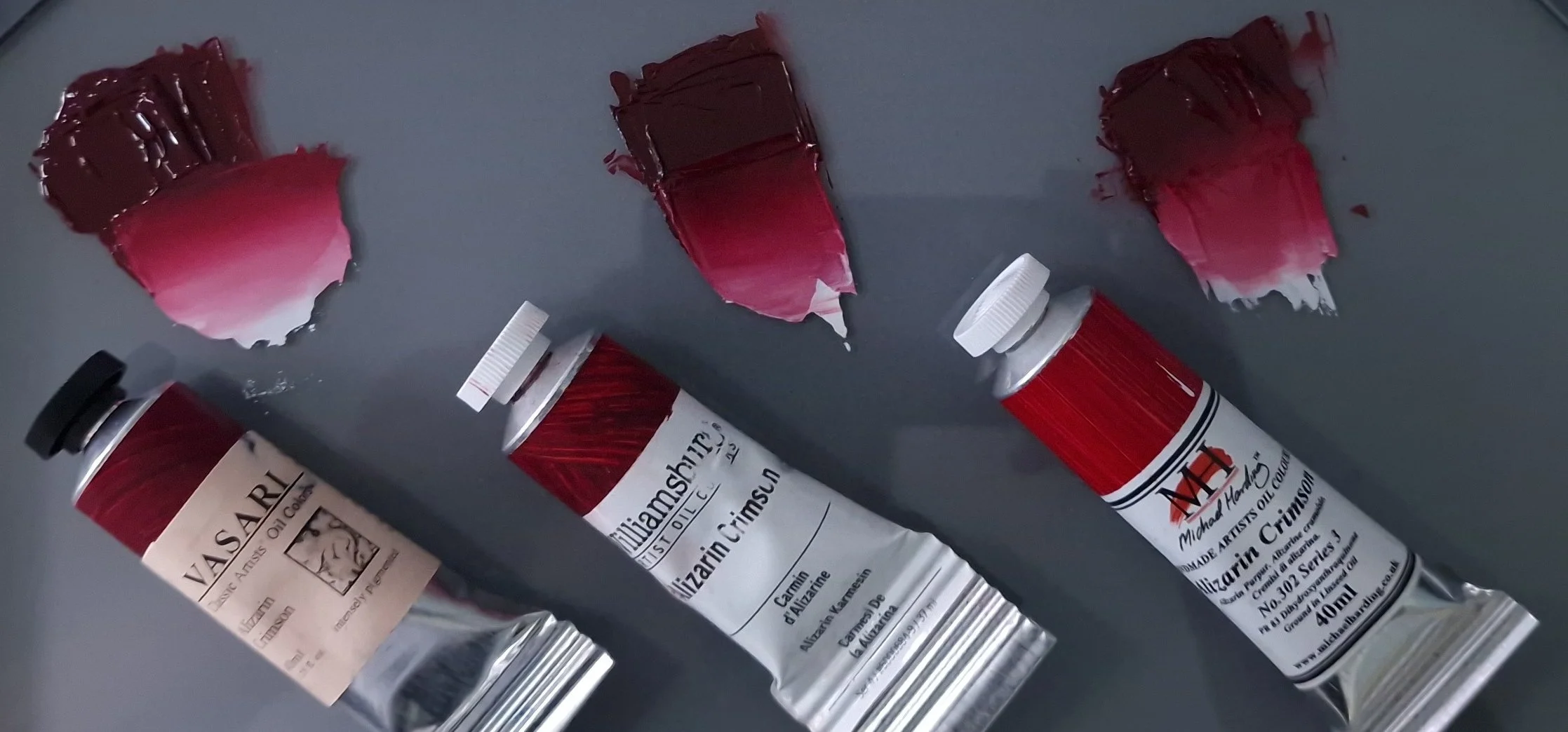
When an artists’ material disappears from production, we can usually name the reason. The raw material became too expensive or difficult to obtain. Regulations changed. The manufacturing process became too complicated. The pigment was found to be toxic. Environmental requirements shifted. Demand was no longer sufficient to justify producing it in small batches. A discontinuation notice appears in a catalogue, artists buy the remaining tubes, and within a few years the material moves from the category of the available into the category of the historical. This sequence seems natural: production disappears first, then the material, and with it, gradually, the practice of using it. But perhaps, in some cases, the sequence runs in the opposite direction. Perhaps a pigment begins to disappear much earlier - at the moment when its differences cease to be considered significant.
The contemporary artist works within an extraordinarily convenient system for choosing materials. If a particular colour is too expensive, unavailable, or discontinued, an alternative can almost always be found. Manufacturers create substitutes for historical colours. Catalogues suggest closely related hues. Retailers recommend alternatives. Digital tools allow colours to be compared according to their visual characteristics. When the original material is unavailable, the question arises almost automatically: what is its closest equivalent? At first glance, there is nothing problematic about this. Painting has always developed through substitution. Artists have adapted to disappearing raw materials, changing technologies, and the arrival of new pigments. It would be unreasonable to expect the contemporary paint industry to preserve every material that has ever existed. The problem lies somewhere else - in the word equivalent itself.
What exactly is supposed to be equivalent? Hue? Lightness? Chroma? The colour in mass tone? The colour in tints? Spectral reflectance? Transparency? Tinting strength? Behaviour in mixtures? The optical properties of a thin paint layer? Or the material itself? These questions matter because two pigments can produce a remarkably similar colour impression while remaining entirely different substances. The colour perceived by the eye is the result of a complex interaction between light, pigment particles, the binding medium, the thickness of the paint layer, and the surface beneath it. Particle size and shape, refractive index, transparency, pigment concentration, and the way light is scattered all affect what happens within a paint film. Two paints can therefore occupy almost the same position on a colour map and still behave very differently in a painting.
One colour may be almost opaque while another allows light to penetrate more deeply into the paint layer. One may dominate a mixture immediately, while another alters it gradually. One may retain its character in a thin glaze while another almost disappears. Their mass tones may appear similar, yet their behaviour when mixed with white may diverge considerably. One may create a particular optical depth through several transparent layers, while another may approximate the same visible colour through an entirely different optical mechanism. We may achieve a similar colour. But have we obtained the same material?
The distinction between those two statements appears relatively unimportant while the original pigment remains readily available. An artist can buy both, compare them, and decide whether the difference matters within their own practice. The situation changes when one of the materials gradually becomes rare or expensive. If a more accessible pigment produces a sufficiently similar colour impression, choosing it seems entirely rational. For many purposes, the difference may genuinely be irrelevant. One artist chooses the more affordable option. Another does the same. A teacher who no longer considers the expensive material necessary stops including it on students’ materials lists. A new generation of artists begins its practice with the substitute already in place.
Nothing dramatic happens. The material is still being manufactured. It is still present in the catalogue. But the number of people who know why it matters gradually begins to diminish. This is where the economic history of a material begins to intersect with the history of knowledge.
Rare and expensive pigments almost inevitably exist within conditions of limited demand. Low production volumes increase costs. Higher prices make alternatives more attractive. Falling demand further reduces the economic justification for manufacturing the material. Eventually, the manufacturer faces a perfectly rational decision: continuing to produce something that fewer and fewer people buy is no longer economically viable. From the outside, this looks like an ordinary market response. Demand disappeared, so production stopped. But that statement tells us nothing about why the demand disappeared.
Perhaps artists genuinely ceased to need the material. Or perhaps something more interesting happened: they gradually ceased to know what it was that made the material necessary in the first place. These are fundamentally different processes.
We tend to think of knowledge about artists’ materials as something that can be preserved. A pigment can be placed in a museum collection. Its chemical composition can be identified. Its spectral properties can be measured. Its manufacturing history can be documented. Historical recipes can be digitised. Samples of paint layers can be examined centuries later. But another form of knowledge exists that is considerably more difficult to preserve.
An artist who has worked with a particular pigment for decades knows things about it that may never appear in a technical data sheet. They know how thinly it can be applied before the colour loses its character. They know how it behaves beside particular colours. They know how quickly it takes control of a mixture. They know what happens to light after the second or third transparent layer. They know when the paint becomes heavy and when it unexpectedly acquires depth. Some of this can be described. Some of it can be measured. But part of this knowledge exists only within practice itself.
Michael Polanyi described this kind of understanding as tacit knowledge. His famous proposition was simple: we know more than we can tell. This is particularly relevant to the relationship between an artist and a material. Practical knowledge accumulates through hundreds of small decisions, repetitions, mistakes, adjustments, and observations. It exists not merely as information about a substance, but as the ability to work with it.
A material can therefore be physically preserved and still be lost. We can keep a jar of pigment in an archive and lose the generation of people who knew what to do with it. We can preserve its chemical formula and lose sensitivity to its behaviour. We can preserve a painting and lose the sequence of decisions through which the material came to look the way it does. In that sense, the disappearance of a material does not begin with the end of production. It begins with the end of practice.
This is where the idea of an “equivalent” acquires a very different significance. Substitution itself is not the problem. Sometimes it is necessary. Sometimes a new material is objectively superior to an older one. Sometimes a historical pigment is dangerous, unstable, or environmentally unacceptable, and there is no meaningful reason to return to it. Preserving material diversity should not become a cult of the past. But substitution and equivalence are not the same thing. The word substitute preserves information about difference: the original material is unavailable, or we have chosen not to use it, so we work with something else. The word equivalent can erase that difference. It implies that little of consequence has been lost because another material performs the same function.
And this leads to a question that extends far beyond any particular pigment: who decides which properties of a material are significant enough to preserve? If visible colour becomes the primary criterion, everything else can easily become secondary information. If two materials produce a sufficiently similar hue, differences in their optical behaviour begin to look like specialist subtleties. If fewer artists make use of those subtleties, they are gradually transmitted less often. And if they cease to be transmitted, the next generation no longer experiences their disappearance as a loss.
A closed loop begins to form. First, a sufficiently good substitute becomes available. Then there is less reason to work with the original material. As the practice declines, practical knowledge declines with it. As that knowledge disappears, so does the ability to perceive the difference. Once the difference is no longer perceived, paying for it begins to seem unnecessary. Demand falls. Only then does the manufacturer discontinue production. We usually see the final stage of this sequence and call it the disappearance of a material. But by that point, the most important loss may already have taken place.
A material can become culturally unnecessary before it becomes economically unviable.
This allows us to think differently about the market for artists’ materials. Markets do not merely respond to material obsolescence. Under certain conditions, they can participate in producing it - not because anyone consciously intends to eliminate a rare pigment, but because the system rationally optimises itself around the differences that buyers continue to recognise as meaningful. If a difference cannot be seen on a screen, is difficult to explain through a handful of specifications, and is even harder to translate into a justification for a higher price, its economic value becomes extraordinarily vulnerable.
The preservation of artists’ materials may therefore be much more complicated than asking which pigments are still being manufactured. Perhaps we need to document not only what a material is, but also what artists know how to do with it. Not only chemical composition, but practice. Not only colour, but behaviour. Not only what can replace a disappearing material, but what ceases to exist when that replacement takes place.
Because several decades later, it may be too late to ask the question. If a generation of artists has never worked with a particular material, it cannot experience the absence of possibilities it never knew existed. A strange form of disappearance then becomes possible. The material may still exist in a museum collection. Its chemical formula may remain in scientific literature. Its name may survive in historical catalogues. A modern colour may even be created that reproduces its visible colour impression with remarkable accuracy. But there may no longer be anyone capable of passing on the knowledge of why the original material was different.
A pigment does not disappear when production stops. It begins to disappear when its differences cease to matter.
Perhaps, then, the central question is not whether we will be able to reproduce a colour after a pigment disappears. The more difficult question is this:
Will we still remember what it was that needed to be reproduced?
