A Painting Does Not Need to Change to Become Contemporary
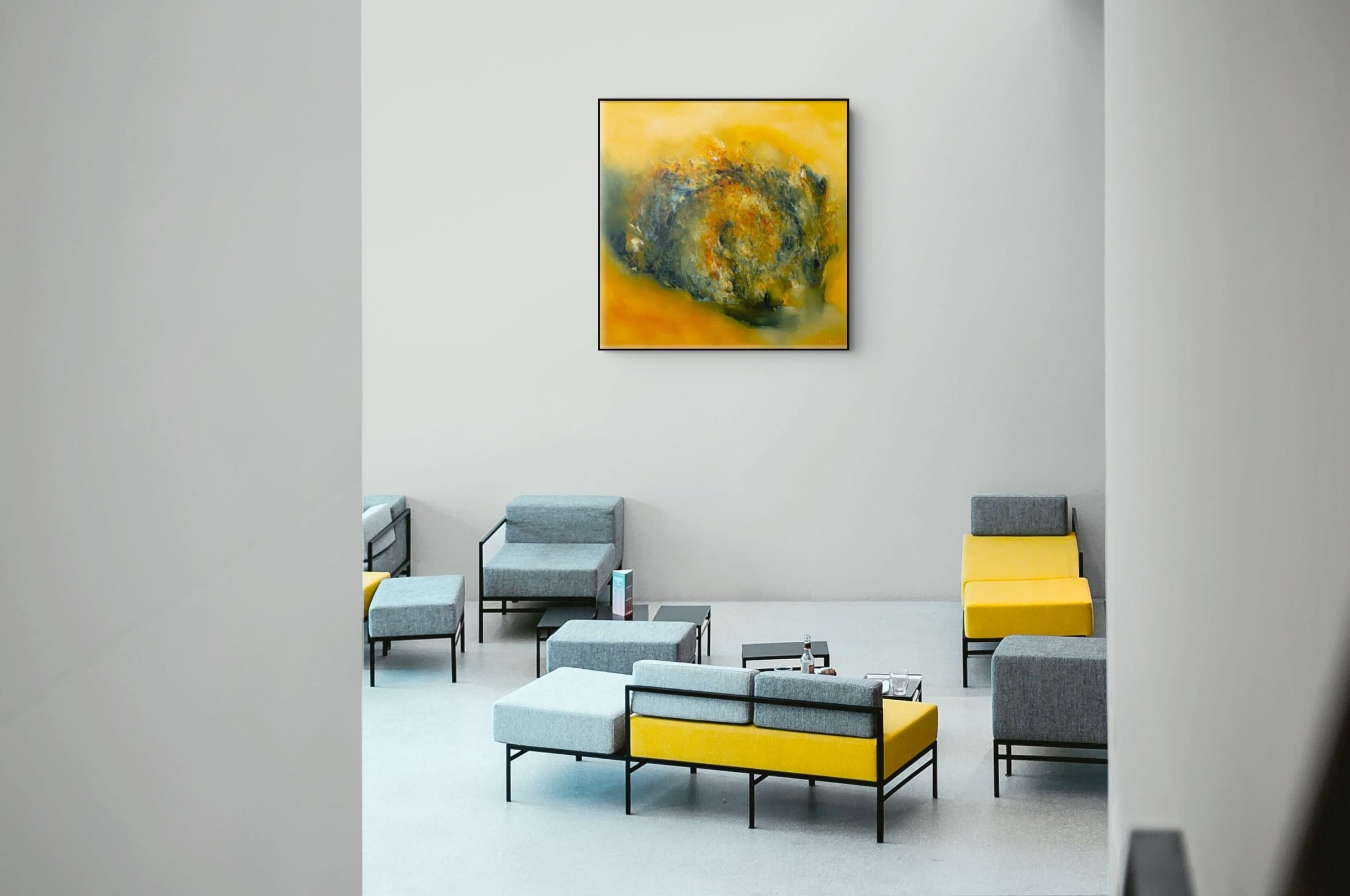
World in Formation, 2021. Oil on canvas, 100 × 100 cm. Architectural scale view
What happens to painting when the world of images around it changes
In the summer of 2021, I painted the work now titled World in Formation. At the time, I was preoccupied with something that seemed quite simple: at what point do relationships between colours begin to register as form? I did not want to depict a specific object. I was interested in the state immediately before an object appears - when the eye is already trying to recognise something but has not yet decided what, exactly, it is looking at. The central structure of the painting might suggest a mineral, a landscape, an organism, or an architectural fragment. Yet as soon as one image begins to take shape, the painting destabilises that certainty again.
In 2021, I thought of the work primarily in terms of creation. Five years later, what interests me in it is somewhat different. Not because the painting has changed. The world of images around it has. And that has led me to a broader question: does a work of art itself need to change in order to remain contemporary?
2021 was an unusually intense year for the art market. After the shock of the previous year, the market recovered rapidly. Emerging names moved quickly into the auction circuit, NFTs went from a largely niche phenomenon to one of the art industry’s dominant stories, and figurative painting experienced a powerful commercial resurgence. Artsy’s auction data from that year is revealing: among 351 paintings made after 2010 and sold for more than five times their low estimate, 87% were figurative works. This does not mean that painting in 2021 was overwhelmingly figurative. But it does say something about the kinds of images the market was rewarding most aggressively: legible, recognisable works capable of establishing an immediate relationship with the viewer.
Against that background, I was working with abstraction. Not as an act of opposition to the market - that was never my intention. I was simply interested in a different mechanism. What happens before recognition? How much information does the eye need before a set of colour relationships stops being perceived as fragments and begins to become something that exists? And perhaps more importantly: when that moment arrives, who is actually creating the form - the artist or the viewer? In World in Formation, wholeness is not given in advance. It has to be assembled. In 2021, I did not think of this as a particularly radical quality of the painting. Today, I do.
In the five years since, the art market has moved through an entirely different phase. The post-pandemic surge was followed by two years of decline. In 2025, the global art market grew again - by 4%, to approximately $59.6 billion - yet Art Basel and UBS describe what is happening not as another boom, but as an ongoing recalibration. The recovery remains measured and uneven. But another change interests me more. During those same years, the status of the image itself has changed dramatically.
We have been talking about visual overload for decades, but the situation now feels qualitatively different. An image no longer necessarily requires any extended process of making. It can appear almost instantly, be corrected, expanded, multiplied, adapted, and replaced by another before we have had time to establish any meaningful relationship with it. Our problem is no longer a shortage of images. Perhaps what is becoming scarce is the experience of having to form an image for ourselves.
This is where physical painting begins to interest me differently. Not because painting is “better” than a digital image. Nor because the artist’s hand should somehow be positioned against technology. That opposition seems too simple. A more interesting question is: what can painting offer when the production of images is no longer scarce?
In World in Formation, the viewer is not given a finished answer. The painting does not say: this is a stone. This is land. This is a body. This is architecture. It gives enough for recognition to begin, but not enough for recognition to be completed. The longer you look, the more possibilities appear - and the easier it becomes for each of them to dissolve again.
That instability feels especially significant to me now because so much of our visual environment is moving in the opposite direction: eliminating the delay between desire and result. We enter a prompt - an image appears. We click - another opens. We do not like it - we replace it. Painting can afford to be far less efficient.
A physical painting demands time. You cannot move closer to the surface of the paint and remain at the same distance. You cannot see the entire composition and the microscopic movement of the surface at once. Vision is constantly forced to choose, adjust, and return. A painting does not simply sit in front of the viewer. It unfolds through the duration of looking. And that duration cannot be completely compressed.
What is interesting is that this question is no longer confined to painters. When Artsy asked sixteen leading curators to identify the tendencies shaping 2026, their responses repeatedly returned to slower forms of artistic practice, renewed attention to the handmade, materiality, craft, and the physical experience of art. Technology and AI have not disappeared from the conversation, but they are increasingly being considered alongside material experience rather than as its automatic replacement. Curator Juana Williams has spoken about a return to materiality as a form of resistance to hyper-digitalisation, while also pointing to artists constructing imagined worlds that feel convincing yet remain deliberately unstable.
I find that important. This is not a romantic return to “real art made by hand.” Materiality is not interesting because it is old. It is interesting because it forces us to deal again with limitation, resistance, and time. Materials do not always behave as we want them to. A painting does not have to resolve itself immediately. The viewer does not have complete control over what will be seen.
For that reason, a physical artwork can be no less contemporary than a technological one. Sometimes it becomes contemporary precisely through what it refuses to accelerate. Even the current Venice Biennale, In Minor Keys, proposes a deliberate shift into a slower register - a return to the body, sensation, the earth, listening, and human scale. Within its curatorial framework, the artist is not simply a producer of yet another image, but someone capable of creating new relationships and new possibilities within an unstable reality. This is very far from the assumption that the new must necessarily look new.
When I return to World in Formation, it is important to me not to attribute knowledge to the painting that it could not have had. It did not anticipate the development of AI. It was not a critique of the digital image. It was not made as a commentary on the art market of 2026. And that is precisely what makes its present relevance more interesting to me.
The work did not need a new concept in order to enter a new context. The context itself changed - and in doing so made more visible a quality that had been present in the painting from the beginning. In 2021, the question of assembling a whole could be read through experiences of instability and recovery. Today, the same mechanism raises questions about how we recognise images at all in a world where images are increasingly easy to produce and where the boundary between what is seen, created, and constructed is becoming less and less distinct.
Ten years from now, the context will almost certainly be different again. But the underlying question will remain: how do we create form from uncertainty, and a sense of wholeness from fragments?
This is where I become particularly interested in the difference between a work built around a theme and a work built around a question. A theme may belong to its time. A question can outlive it.
We often use the word contemporary almost as a date. Something is contemporary because it was made now, speaks the language of the present, and responds to current events. But perhaps there is another kind of contemporaneity. A work can become contemporary again and again - not by changing physically, but by encountering each successive present.
Every era brings its own anxieties, technologies, ways of seeing, and expectations of art. A strong work does not need to reflect all of them. It is enough for its internal structure to remain open enough, and precise enough, to withstand another encounter. In this sense, time stops being simply the distance from the date of creation. It becomes one of the dimensions of the work itself.
The canvas remains the same. The paint does not rearrange itself. The composition does not adapt to new conditions. We change. And with us, what becomes visible within the work changes too.
In World in Formation, the process of formation itself is the subject of the painting. But five years later, I understand that statement more broadly than I did in 2021. It is not only the image that is being formed. What is also being formed is the relationship between the work and the viewer, between the material object and time, between what is actually present on the surface and what our minds attempt to construct from it.
Perhaps this is why some paintings become not less, but more relevant with age.
They do not predict the future. They contain a question large enough to survive it.
