Before the First Brushstroke
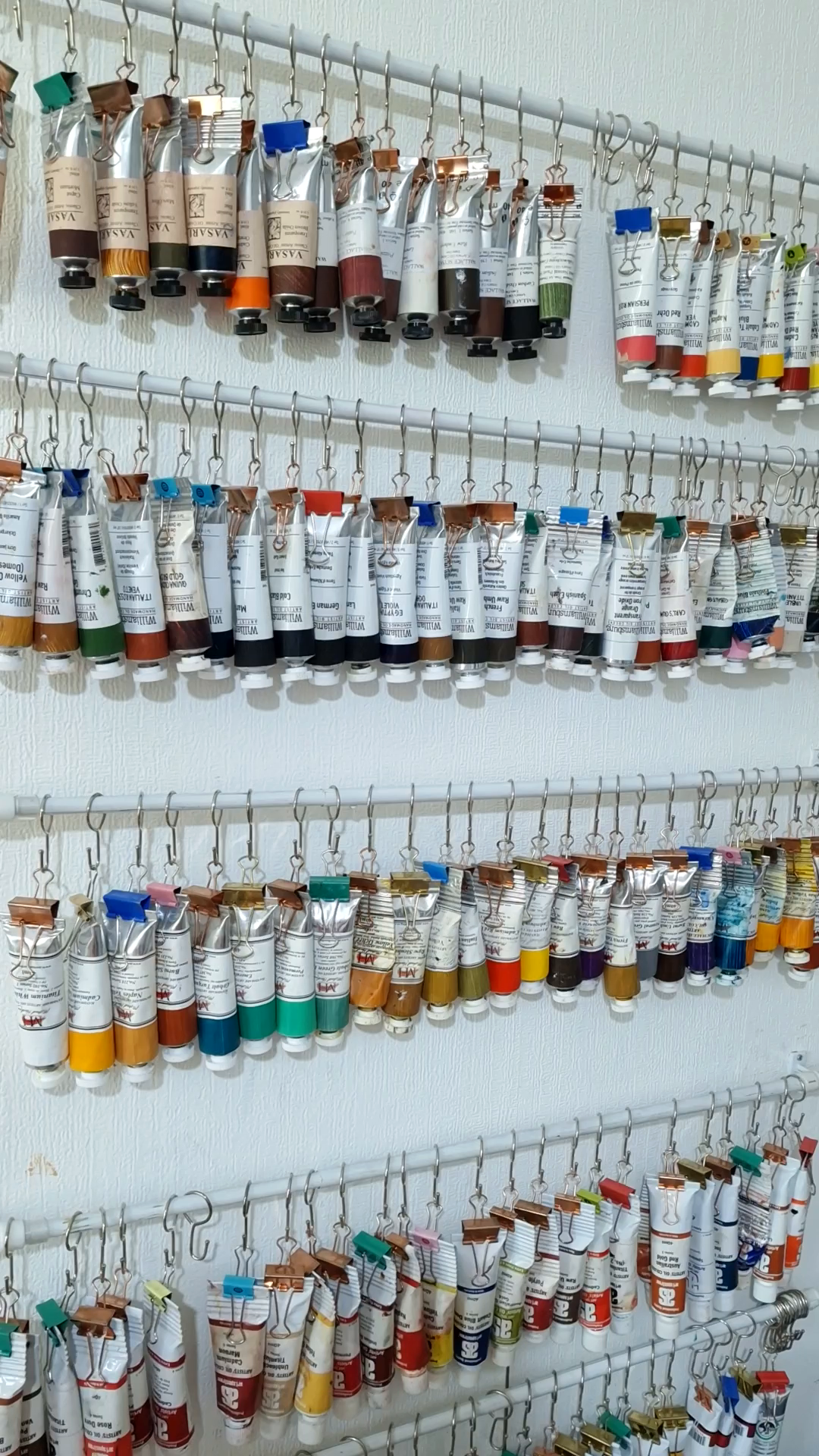
The photograph shows a small part of the paints I work with. I did not build this collection around brands, nor because professional paint automatically makes a painting better. It does not. The reason is much more practical: two tubes bearing the same colour name can behave very differently. Even the same Colour Index designation does not guarantee the same paint. Pigment concentration, particle characteristics, binder, dispersion and formulation all affect how a paint moves under the brush, how strongly it alters a mixture, how well it holds the mark of a tool, how it behaves in a thin layer, and what happens to the colour when it is mixed.
These differences matter in my painting before an image even begins to appear. I work in layers, so in one situation I may need a colour that remains optically active beneath subsequent layers; in another, a paint capable of retaining the physical trace of a brush or palette knife. Elsewhere, transparency and the ability to build depth gradually may matter more, while sometimes a very small amount of a strong pigment is enough to shift a much larger mixture. Over time, my palette has developed around these very specific requirements.
Some materials I buy for one particular property. Others I compare across different manufacturers because the same pigment can feel remarkably different once it becomes a finished paint. Some tubes remain in use for years; others do not return to the palette after a few tests. There are paints I may need in only a few places within a single painting, yet replacing them with a different formulation would already produce a different result.
With this kind of selection, price quickly stops being the main point of reference. An expensive paint can be completely unsuitable for a particular task, while a familiar pigment may behave unexpectedly when made by another manufacturer. What interests me is not the prestige of a material, but how it behaves and how precisely I can control it.
Over time, a much larger collection of paints and other materials has grown alongside my working palette, a small part of which is shown in the photograph. For me, this is not a collection of beautiful tubes. It allows me to compare actual properties: how a paint comes out of the tube and responds to pressure from a tool, how readily it mixes, how far a small amount of pigment travels through a mixture, what happens to it in a thin layer, and what kind of surface it leaves once dry. Sometimes the difference is immediately apparent. Sometimes it only becomes noticeable after several hours of working with the paint, or in the next layer.
Most of this information is no longer visible in the finished painting, and perhaps that is as it should be. A collector is not buying a list of materials or a technical demonstration. They see the surface, colour, depth, the movement of the paint and the physical presence of the painting itself. But the qualities of that surface are not determined only at the moment the brush touches the canvas. Behind them are dozens of decisions about materials, some made long before a particular painting existed.
This small collection is part of where my paintings begin.
