Can a Museum Preserve a Material That No One Knows How to Use Anymore?
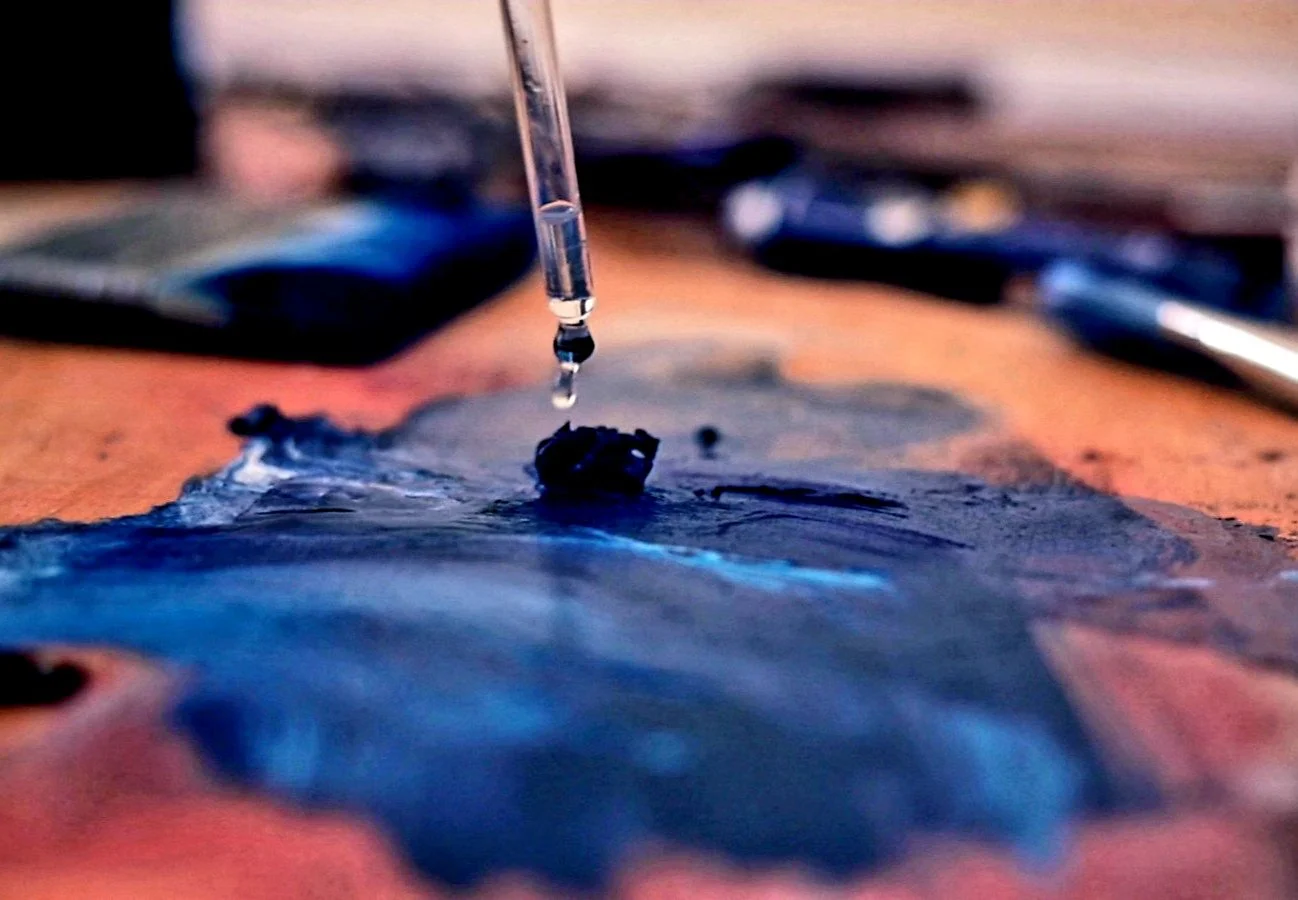
A museum can preserve a tube of paint for a hundred years. It can keep a pigment sample, determine its chemical composition, document its origin and method of manufacture, and maintain carefully controlled storage conditions. A conservation laboratory can examine particle size and shape, the composition of the binder, ageing products, and the material’s interaction with other components of the paint layer. Decades from now, we may know more about the chemistry of a particular pigment than the artists who once worked with it every day. But does that mean the material itself has truly been preserved?
Consider what happens when a pigment gradually disappears from artistic practice. At first, almost nothing seems to happen. The substance itself may continue to exist. Samples remain in collections, and paintings made with it survive in museums. Its Colour Index can still be found in databases, its chemical formula in technical literature, information about its manufacture in archives. Old tubes of paint may even survive. From the perspective of documentation, the loss can appear minimal. Yet this may be precisely the moment when something begins to disappear that is almost impossible to place in museum storage.
An artist who works with a particular material for years develops knowledge that may never become text. How thin can this paint be applied before its particular optical character changes? What happens when it is placed over a warm ground rather than mixed with another colour? Which pigments make it unexpectedly dense, and which allow it to retain its depth? How does it behave under the brush after twenty minutes, several hours, several days? Which combinations are technically possible but visually lifeless? Which effect first appears to be a mistake, only to become, after the tenth repetition, part of the artist’s own language?
Knowledge of this kind rarely exists as a complete set of instructions. It is distributed across the hand, the eye, memory, repetition, mistakes, corrections, conversations in the studio, and thousands of almost imperceptible decisions. An artist may use this knowledge every day without being able to fully articulate why a particular decision works. It exists not simply as information about a material, but as an accumulated capacity to work with that material. An artistic material can therefore survive physically while disappearing culturally.
This distinction changes the meaning of preservation itself. We tend to assume that if a sample exists, the formula is known, the manufacturing process has been documented, and works made with the material remain available for study, then the material has not been lost. But for artistic practice, that may not be enough. A pigment does not exist only as a substance. It exists within a chain of relationships: between matter and light, material and tool, surface and time, eye and hand, the experience of one artist and the experience of the next. The disappearance of a material therefore does not necessarily begin with the production of the final tube. It may begin much earlier, at the moment when the transmission of practical knowledge about what can be done with that material is interrupted.
This distinction matters because knowledge rarely disappears all at once. It may survive for decades in fragments: among a handful of artists, technicians, manufacturers or conservators; in old manuals, notes, recipes and studios. But the survival of fragments is not the same as the survival of a living practice. Somewhere between archival information and transmitted practice lies a boundary that we rarely record.
Materials do not simply execute an artistic intention; they participate in shaping it. Across generations, artists learn what a particular substance allows them to see and to make. A certain transparency makes a certain kind of depth possible. A particular particle structure creates a particular relationship with light. The way a material dries changes how a layer can be constructed. The behaviour of two pigments in a mixture may reveal an effect that was never formulated theoretically because artists learned it through repetition, observation and work rather than through language. What passes from one generation to another, then, is not merely a substance or a recipe. It is a relationship between material, perception and the trained hand.
But what happens when that chain is broken? A researcher fifty years from now may obtain the same chemical compound. A manufacturer may reconstruct the historical formulation. A conservator may determine the necessary particle size and binder composition. It may even be possible to produce a material chemically very close to the historical original. Yet none of these achievements automatically restores the accumulated studio knowledge that once existed around it. The substance may return, while the practice does not.
This raises a question far more difficult than simply asking which pigments are disappearing today: what exactly must survive before we can say that an artistic material has been preserved? The substance itself? The manufacturing process? Historical formulations? Reference samples? Paintings made with it? Documented observations by artists? People who still know how to work with it? Or the continuity of practical knowledge from one working hand to another?
Perhaps the unit of preservation should not be the artistic material alone. Perhaps what also needs to be preserved is the chain through which knowledge of that material is transmitted. If so, museums, archives, conservators, manufacturers and artists face a very different task. It is not enough to preserve a substance once it has fallen out of use. We need to learn to recognise the moment when a living practice begins to become historical information: when fewer people work with a material, when manufacturing skills begin to disappear, when practical observations are no longer passed on, and when the last generation of artists who genuinely know its behaviour can still communicate what no chemical formula will ever be able to reconstruct.
This is where a largely overlooked space begins to emerge. Between the working studio and the museum archive lies an interval in which knowledge is still alive but has already become vulnerable. Perhaps this is precisely the moment that requires our attention: not when a material has finally disappeared, but while there are still people capable of transmitting the experience of working with it.
We have learned to preserve the material evidence of the past with extraordinary precision. But perhaps, all this time, we have been preserving materials without preserving the artist’s relationship with them. If so, the disappearance of an artistic material cannot be measured simply by the number of tubes remaining, or even by the presence of samples in museum collections. A more important question is whether a living connection still exists between the substance and the person who knows what that substance is capable of doing in a painting.
Perhaps the true point at which an artistic material disappears is not when its final sample is produced. It is when the last person capable of passing on not only what that material was, but what could be done with it, is no longer there to do so. If that is true, we need to learn to recognise disappearance much earlier - while knowledge still exists not only in an archive, but in someone’s hands.
