Who Pays to Keep a Colour Possible?
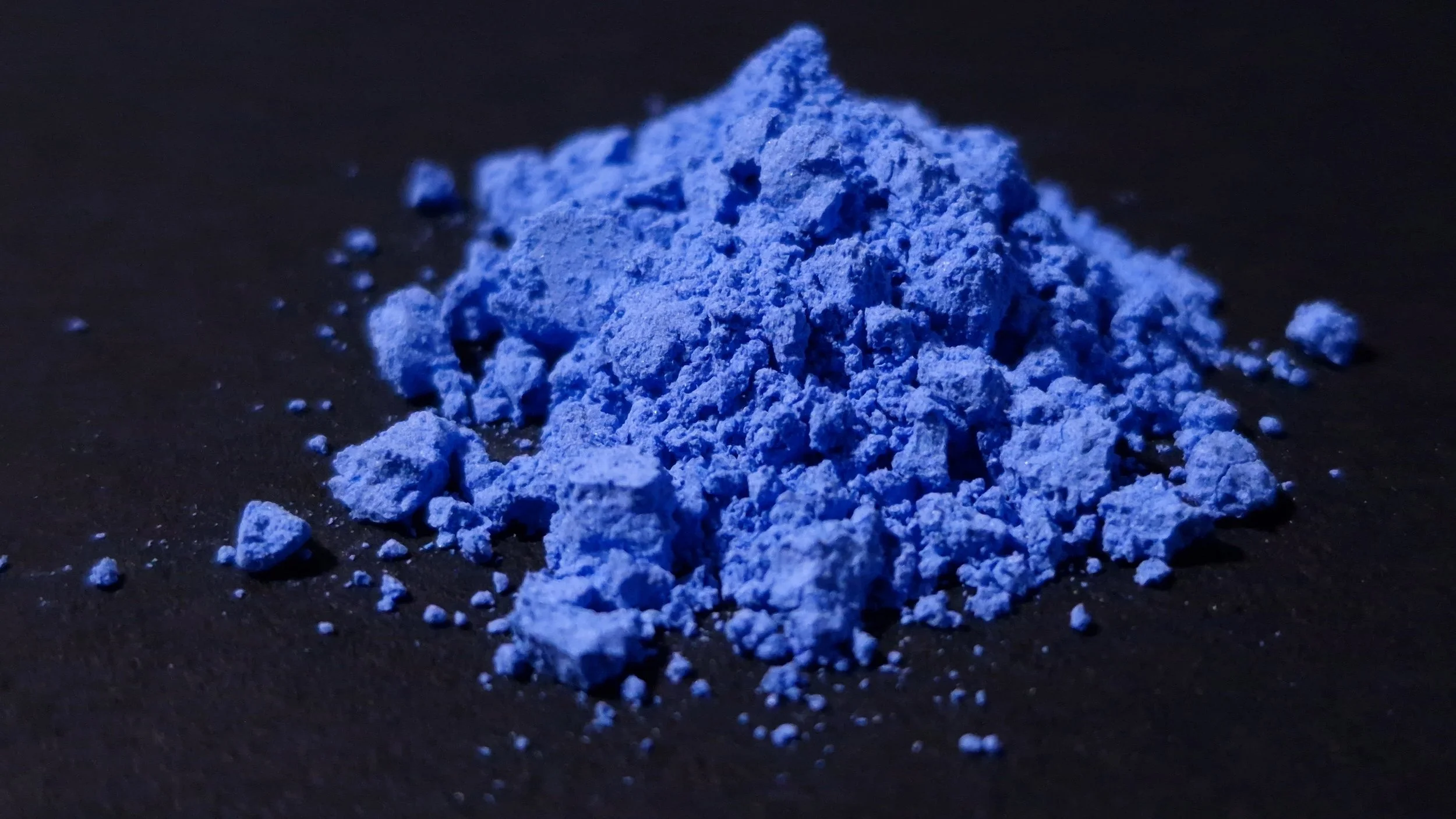
Genuine Lapis Lazuli pigment
Imagine an artistic material that has existed for a hundred and fifty years. It can be found in paintings held in museum collections, examined under a microscope, identified by its chemical composition, and described within the history of painting. Generations of artists have learned to work with its transparency, density, drying characteristics, behaviour in mixtures, and interaction with light. It unquestionably belongs to the history of art. Yet there is something strange about this. While the material exists within a nineteenth-century painting, its preservation may be considered a cultural responsibility. While it sits in a tube on the shelf of a contemporary manufacturer, its continued existence has to justify itself through sales. Chemically, it may be the very same pigment. Culturally, we treat it as though these were two entirely different things.
Perhaps this contradiction reveals one of the least visible problems in the material culture of art. An artists’ paint manufacturer is not a museum. It buys raw materials, pays for equipment and skilled staff, complies with safety and environmental regulations, tests its products, and manages storage, documentation, insurance, and logistics. All of this has a cost. If a raw material becomes difficult to obtain, regulatory requirements become more complex, a supplier ceases production, or demand for a particular pigment becomes too small, a perfectly rational question eventually arises: does it still make sense to continue producing it? From a business perspective, the answer may be no, and it would be unreasonable to expect a private company to sustain an economically unviable material indefinitely simply because artists consider it important.
But what happens when a material’s commercial value ends before its cultural value does?
The market knows how to measure demand. It is far less capable of measuring the consequences of disappearance. By definition, a rare material is used by relatively few people, so at precisely the moment when it becomes most vulnerable, the market has fewer and fewer reasons to sustain it. A paradox emerges: the fewer users remain, the weaker the economic case for continuing production becomes - and the closer we come to a point at which the loss may become irreversible. Yet the number of people using something tells us very little about the scale of its cultural value. We have long accepted this logic in other areas of culture. A rare manuscript does not become less significant because only a handful of scholars read it. An archival document is not destroyed because demand for it fails to cover the cost of storage. An endangered craft may be recognised as culturally vulnerable precisely because too few people remain who can pass it on to the next generation. In relation to artists’ materials, however, this logic operates far less effectively.
This is particularly strange because the history of art already knows how important manufacturers can be. The archives of historical colourmen now allow researchers to reconstruct ranges of materials, formulations, commercial networks, and relationships between artists and their suppliers. Surviving palettes and paint tubes become museum and research objects. Manufacturing records that were once simply part of doing business become, a century later, sources of knowledge about how the painting of a particular period was materially possible at all. What was once production documentation becomes a cultural archive. This raises an uncomfortable question: why are we so good at recognising the value of a manufacturer’s archive from the past, yet so rarely ask what knowledge is held by a manufacturer in the present?
A contemporary manufacturer may hold far more than a paint formula. Within production exists knowledge about raw materials, suppliers, acceptable variations in substances, methods of processing, equipment, sequences of operations, failed batches, changes in formulation, and the small technical decisions through which a material acquires the properties familiar to artists. Not all of this is written down, not all of it can be transferred with a formula, and not all of it can be reconstructed once the production chain has disappeared. Discontinuing a material may therefore mean losing far more than a single item from a catalogue.
Usually, we notice only the final moment. A company publishes the word discontinued. Artists buy the remaining stock, some object to a reformulation, others search for a substitute, and within a few years the new material becomes normal. But discontinued is not a cause. It is the final line of a much longer story. Before it, a raw-material supplier may have disappeared, a manufacturing process may have changed, equipment may have become unavailable, specialists who understood the technology may have left, the cost of meeting new requirements may have risen, or the number of artists who still needed that particular material may have declined. We see the company that ultimately stops production and easily assume that it was the company that decided the material’s fate. But perhaps what we are really seeing is the last person switching off the light in a room everyone else has already left.
This fundamentally changes the question of responsibility. The manufacturer may not be the party that destroys a material, but the one that has continued, longer than anyone else, to keep it within living artistic practice. If the cost of doing so ultimately falls on that manufacturer alone, the cultural system has effectively delegated to a private company a decision whose consequences extend far beyond its commercial product range. The company never asked for that power. But the absence of other participants makes its decision cultural.
Can the discontinuation of a single pigment really change what an entire generation of artists will make? At first glance, perhaps not. Art is constantly changing. Some materials disappear and others emerge. New pigments may be safer, more stable, more lightfast, and technologically superior to older ones. Artists have always adapted, and the history of art is, in many respects, a history of such adaptation. But replacing a material is not a neutral event. An artist does not work with an abstract “blue”, “red”, or “yellow”, but with a substance. A particular transparency determines the possibility of a particular glaze. Tinting strength changes the proportions of a mixture. Particle size and shape affect the interaction with light. Drying rate determines the sequence of work. The behaviour of paint on a surface changes the movement of the brush. Sometimes a new material gives the artist more possibilities, sometimes different ones, and sometimes it closes off a possibility that existed before.
Therefore, the palette of a generation is not simply a set of available colours. It is the boundary of its available material possibilities. And that boundary is not shaped by artists alone. It is influenced by the chemical industry, environmental regulation, the availability of raw materials, international logistics, the economics of small-scale manufacturing, suppliers’ decisions, and the size of the professional artists’ materials market. As a result, some of the aesthetic possibilities of the future may be determined by decisions that were never made as aesthetic decisions at all.
Perhaps this is the most uncomfortable part of the problem. We are accustomed to writing the history of art through artists, ideas, movements, political events, and technological innovations. But there is another history as well: the history of what was physically available for an artist to work with - what could be bought, mixed, applied to a surface, and made to reflect light in a particular way. When a particular material possibility disappears, the next generation adapts. Another generation later, artists may no longer perceive what happened as a loss. They will work within a new range of materials and experience that range as natural. At that point, it is not only the material that disappears. The memory that the range of choices was once wider disappears with it.
This is where the preservation of other forms of practical knowledge becomes particularly relevant. If an endangered craft can be assessed according to the number of remaining practitioners, the possibility of transmitting the skill, and its economic viability, why can we not at least ask an analogous question of an endangered artistic material? Not in order to declare every historical pigment an untouchable piece of cultural heritage, and not in order to place preservation in opposition to safety, ecology, or technological progress. The question is different: can we learn to distinguish replacement from loss? Can we recognise when a new material genuinely preserves the essential artistic possibilities of the old one, and when something disappears with the old substance that cannot be recovered simply by matching its colour? Can we at least know what exactly we have decided not to preserve?
This does not require maintaining the production of every historical material indefinitely. In some cases, production genuinely should end. But between endless production and disappearance without a trace lies a considerable field of possible action: preserving reference samples and raw materials, documenting manufacturing processes and changes in formulations, interviewing technicians and artists who still work with the material, conducting comparative research on substitutes, and transferring production records into archives. What matters most here is time. If this work begins fifty years later, objects will remain. If it begins before disappearance, people will remain too.
Perhaps, then, we need to recognise a new moment in the biography of an artistic material: a moment when it is still a commercial product but should already be recognised as potentially vulnerable cultural knowledge. Not a status that automatically demands preservation. Not a prohibition against discontinuing production. Not even a claim that the material is irreplaceable. Simply a moment when someone should stop and ask: if this material disappears, what exactly will disappear with it?
Today, such a moment may not exist. A material can move from living artistic practice to discontinued without any independent assessment of what will be lost. The commercial decision is made where the commercial problem arises. The cultural question appears much later — sometimes when there is already nothing left to reconstruct. Between these two moments lies a space that is particularly important to recognise: a material may already possess historical, technological, and artistic value while still lacking the status that activates mechanisms of cultural preservation. It is too culturally significant to be merely a commodity, yet still looks too much like a commodity for anyone to consider it heritage.
It is within this interval that the material is left almost entirely on its own. And with it, the manufacturer.
Perhaps, then, we should stop asking only, “Why did the company discontinue this pigment?” There is a much more difficult question: why did we allow the manufacturer to remain the only one expected to pay the difference between a material’s commercial value and its cultural value? And another question follows: what happens if today we decide that sustaining a material is too expensive, only to discover twenty years later that reconstructing the lost production process, supply chain, and practical knowledge is vastly more expensive - or no longer possible at all?
Perhaps the most expensive moment to preserve a material comes precisely after we have decided that preserving it was too expensive.
This is not an argument for preserving everything. It is an argument for making loss visible. Manufacturers of artists’ materials do more than produce commodities. In some cases, they sustain an infrastructure of artistic possibility. And if the cultural value of that infrastructure genuinely exceeds its commercial value, the difference between the two cannot indefinitely remain on the balance sheet of a single company. Who should assume that difference - a museum, an archive, a research foundation, the state, the professional community, the manufacturer itself, or some new form of partnership between them - remains an open question. But perhaps it is a question we finally need to begin asking.
Because otherwise, the palette of the future will not be determined only by what artists want to create. It will also be determined by what proved profitable enough, accessible enough, and simple enough to survive the present. Everything else may disappear so quietly that the next generation of artists will not even know what they once might have been able to choose between.
