Who Decides Which Pigment Disappears Next?
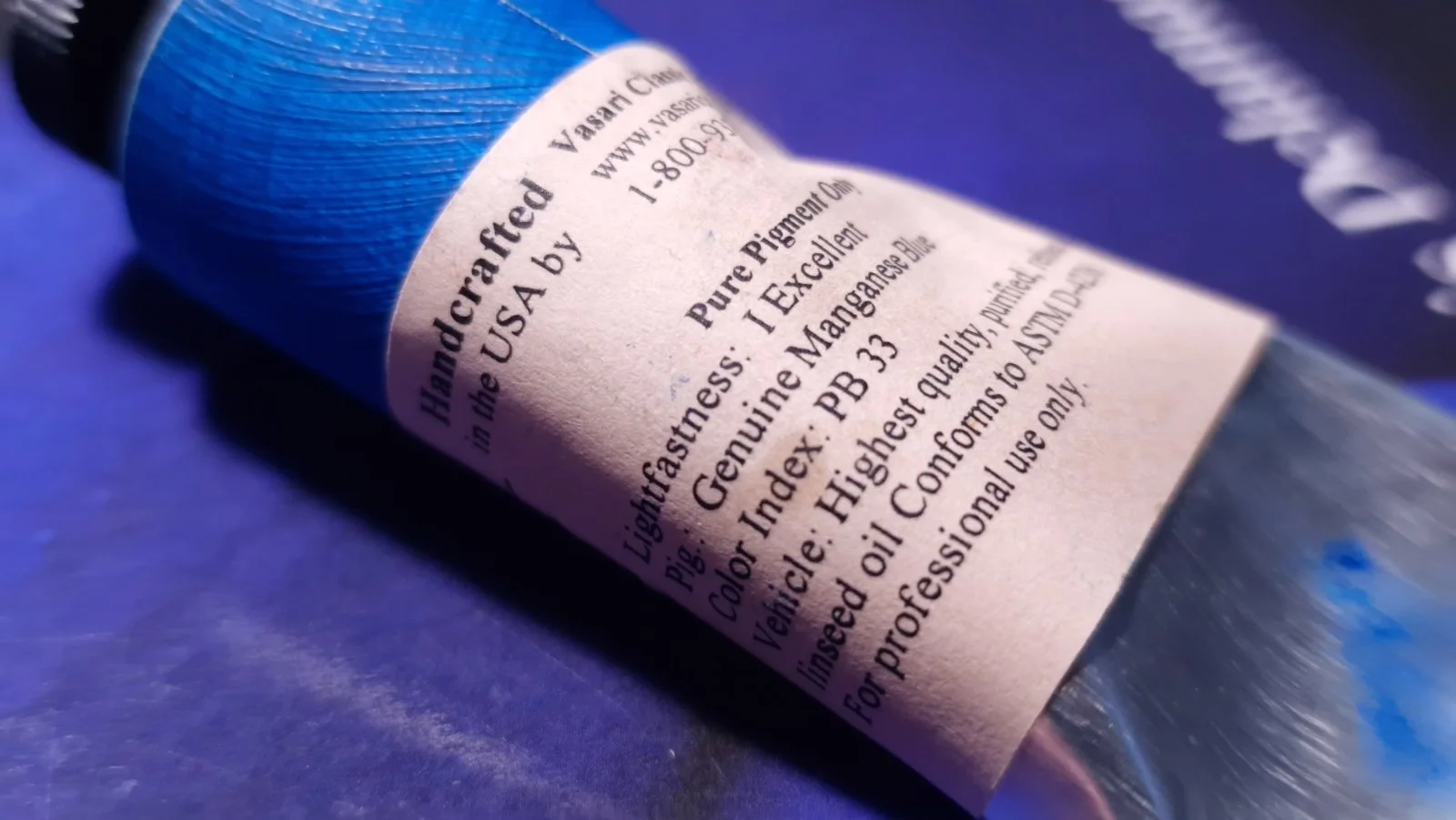
Genuine Manganese Blue (PB33), artists’ oil colour. Material Memory Project research archive.
When an artists’ pigment disappears from production, it almost never looks like a cultural event. A museum does not close, a work of art is not destroyed, and an artist’s name does not vanish. A manufacturer simply stops producing a particular colour. The reason may be toxicological regulation, changes in environmental standards, the disappearance of raw materials, instability in supply chains, production costs that have become too high, or demand that has become too low. A catalogue is marked discontinued, the remaining stock is sold, and the market moves on. But is it really only a product that disappears?
A pigment is not simply a chemical substance with a particular composition. In the hands of an artist, it becomes a system of possibilities. Its opacity and transparency, particle size and shape, ability to scatter light, behaviour in mixtures, glazing characteristics, drying rate, and interaction with the binder determine not only what the paint looks like, but what can actually be done with paint. When a material with unique properties disappears, the artist does not simply lose one colour from the palette. They may lose a particular way of constructing an image. This is why the phrase “it can be replaced” requires far more caution than it seems to. A modern substitute may be close in hue, but that does not make it equivalent. It may reflect light differently, have a different density, transparency, texture, or tinting strength, and behave entirely differently in mixtures. On a colour swatch, two colours may look almost identical. Within a painting, they can produce fundamentally different results.
History has already witnessed such disappearances. Some pigments now survive only in old tubes, laboratory samples, museum collections, or works by artists of previous generations. Along with them, practical knowledge gradually disappears: how much material to use, how it behaves alongside other pigments, what kind of layer it can sustain, what happens to it after a week, a year, or several decades. A formula can be recorded and a sample can be placed in an archive, but the knowledge of the hand is far more difficult to preserve. And this leads to a more serious question: who, in reality, decides which part of painting’s material culture will be passed on to the next generation?
Formally, there may be no single person or institution making that decision. Responsibility is distributed among raw-material suppliers, chemical companies, regulators, environmental legislation, the economics of production, insurance requirements, logistics, and consumer demand. Each participant makes a rational decision within the limits of their own responsibility, yet the cumulative result of those decisions may be cultural: a particular material ceases to exist as a living artistic practice. This creates a strange paradox. We have highly sophisticated systems for preserving works of art, yet far weaker systems for protecting the material conditions that make the works of the future possible in the first place.
Museums may spend decades investigating which pigment an artist used three hundred years ago. Conservation laboratories study microscopic particles of paint layers, reconstruct the composition of binders, trace the origins of minerals, and determine the sequence in which colours were applied. Yet when a rare material disappears today, the process often remains almost entirely a matter of the manufacturer’s economics: can the raw material still be sourced, can it legally be used, is there sufficient demand, and is continued production financially viable? This raises an uncomfortable question: do we begin to regard a material as culturally significant only when it is already too late - after it has disappeared?
The manufacturer itself may be particularly vulnerable within this system. The continued existence of a rare pigment on the professional artists’ materials market may effectively depend on a small company. If production becomes economically or legally impossible, that company is faced with a decision whose consequences extend far beyond its own business. It may discontinue the paint and, in doing so, without any cultural mandate or institutional support, effectively determine the range of material possibilities available to the next generation of artists. What appears from the outside to be a commercial decision may therefore have consequences that belong to a much larger cultural history.
This does not mean that every historical material should remain in production indefinitely, or that questions of toxicity and environmental safety should be ignored in the name of tradition. On the contrary, the complexity of these conflicts is precisely why the issue should not remain exclusively within the market. Between the unconditional preservation of a hazardous material and its disappearance without a trace lies an enormous field for research: documenting production methods, preserving reference samples, investigating safer methods of manufacture and use, supporting manufacturers, creating material archives, transmitting practical knowledge, and developing genuinely functional alternatives. Perhaps the real question is not whether every disappearing material should be saved, but whether we have developed adequate ways of recognising what is being lost before the loss becomes irreversible.
Perhaps, then, the question of the next disappearing pigment needs to be framed differently. Not simply, “Can industry continue to manufacture it?” but “Who should determine whether this material represents a form of cultural value worth attempting to preserve?” And if no one currently bears that responsibility, that absence itself becomes part of the problem.
Because the material history of art is shaped not only by what humanity chooses to preserve in museums. It is also shaped by what we allow to disappear from artists’ studios. And perhaps, a hundred years from now, researchers will not only ask why a particular pigment disappeared. They may also ask why the generation that still knew how to use it watched it disappear - and did not consider that sufficient reason to act.
