Irreversibility
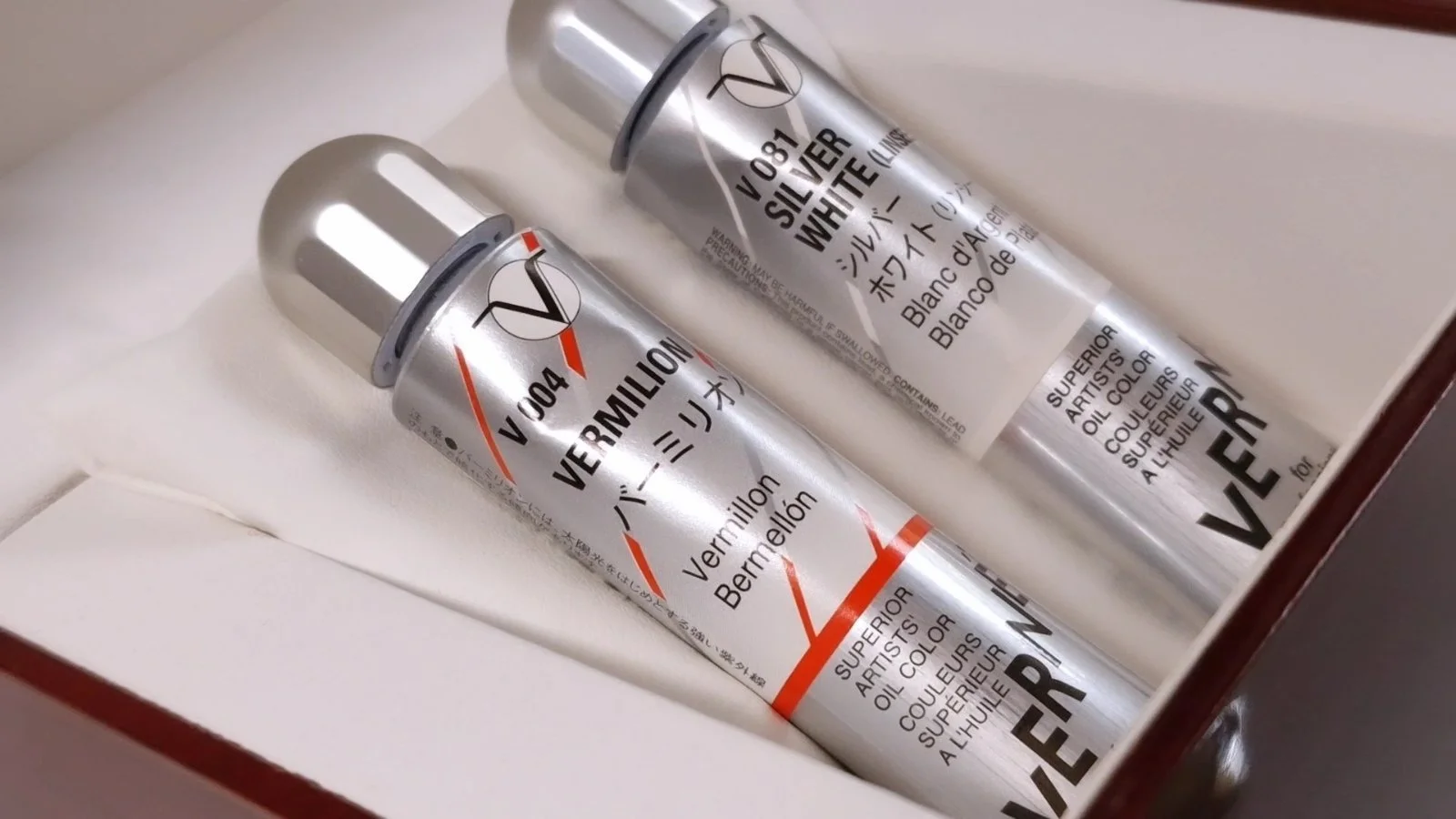
Holbein Vernét V004 Vermilion, mercury sulfide (PR106), and V081 Silver White, basic lead carbonate (PW1), from the Material Memory collection.
Loss has the advantage of being visible. When an artwork burns, an archive is destroyed, a material disappears, or a production process comes to an end, we can name what has happened as a loss and often assign it a date. Irreversibility is more difficult to recognise because it often begins while, outwardly, nothing appears to have been lost: the object still exists, the documents remain in the archive, the material is still being produced, the equipment is still operating, and the specialist still arrives at the workshop or laboratory each morning. Yet one possibility may already have closed, sometimes quietly and permanently.
Loss is an event. Irreversibility is a process.
We are good at recording the first and considerably less good at noticing the second. A conservator alters the state of an object through a necessary intervention; an archivist decides which records will be retained; a researcher consumes part of a sample during analysis; a manufacturer changes a raw material or replaces a piece of equipment; a specialist leaves a factory, leaving specifications behind but taking with them thousands of small decisions that were never written into those specifications.
These situations belong to very different professional fields, yet they share the same underlying structure: a decision made today changes the boundaries of what it will remain possible to know tomorrow. This is why irreversibility deserves to be considered not simply as a property of material damage, but as a problem of preservation in its own right.
Not every irreversible change is a mistake, and this distinction matters. Otherwise, any discussion of irreversibility quickly collapses into an argument for changing nothing, studying nothing and intervening in nothing.
Some irreversibility is unavoidable. Materials age, chemical systems change and accidents happen. We can slow certain processes and reduce the probability of others, but we cannot remove material objects from time.
Some irreversibility is necessary because preservation itself may require change. A damaged object may need to be stabilised, contamination removed or a wet material dried. Sometimes preserving something means altering it, and the question is not whether irreversibility has been avoided but whether its cost is justified by the loss it prevents.
There is also chosen irreversibility, where a genuine professional choice exists. Destructive sampling is an obvious example: part of a material is consumed in order to produce knowledge. The decision may be entirely justified, but some possibilities for studying that material disappear with the sample.
Then there is another kind, far less conspicuous: unrecognised irreversibility. No one has decided to lose anything because no one has recognised the disappearing possibility as something of value. Old packaging is discarded; a previous production batch is not retained; a surface is cleaned before its condition has been adequately documented; a technologist is never interviewed; a formula is recorded while the practical parameters of the process remain only in human experience.
Unrecognised irreversibility begins when something disappears before we have recognised that it matters.
This form is particularly interesting, not because it necessarily causes greater damage, but because a conventional system of risk management may fail to see it at all. We cannot protect something that has not yet been identified as valuable.
Consider the last surviving sample of a discontinued material. It can be analysed today, and the method may require consuming part of it. The research is sound, the question important and the result worth obtaining; no professional error need be involved.
Now imagine exactly the same analysis when a thousand comparable samples exist. The physical action is the same, the scientific procedure is the same and the quantity of material consumed is the same. The only difference is what remains afterwards. In the second case, hundreds of opportunities remain to repeat the analysis, test the result by another method or ask an entirely different question. In the first, some of those possibilities may disappear with a few milligrams of material.
The cost of irreversibility, therefore, does not reside in the action alone. It also depends on how many possibilities survive it.
This takes the problem well beyond the material object. An archival document is valuable not only for the information we already know how to extract from it; a sample is more than the analysis we can perform today; a production record contains more than whatever its author thought worth recording; and an artwork is not limited to the questions contemporary conservation science knows how to ask of it. All of these have another important property: we can return to them.
The possibility of returning is fundamental to the production of knowledge. New analytical methods emerge, research questions change and attributions are reconsidered. What one generation regards as an insignificant manufacturing detail may provide the next with the explanation for a material's behaviour. This is precisely why documentation cannot always replace the object, just as a recipe cannot necessarily preserve a technology.
A formula may be preserved perfectly while the material itself is effectively lost, because an actual production process consists of more than a list of ingredients. Temperature, sequence of operations, characteristics of the raw materials, equipment, acceptable tolerances and human judgement all shape the behaviour of the finished product. Some of this knowledge can be written down; some of it exists only in practice.
A formula can outlive a technology.
This is particularly visible in artists' materials. When a manufacturer announces that a paint is being discontinued, we tend to treat that date as the beginning of its disappearance. By then, however, the process may have been under way for years. A supplier changed first, then a piece of equipment was replaced; later, the person who had overseen production for decades left. Old batches were exhausted, working records were not retained, and only after all of this did the final product disappear from the catalogue.
Which of these was the moment of loss?
Perhaps there was no single moment. What existed instead was a sequence of thresholds of irreversibility. Beyond one threshold, the original raw material could no longer be obtained; beyond another, the former production process could no longer be observed. Later, it became impossible to compare particular batches, to ask the specialist why an operation had been performed in a certain way, or eventually to examine the original material itself.
The product may still have existed while the range of things that could be known about it was already contracting.
This, I think, is where the real problem lies.
Preservation systems are necessarily built around things whose value has already been recognised. This is reasonable: everything cannot be preserved. Yet it also means that every generation passes on to the next not the past in its entirety, but the consequences of its own selection.
The same is true in a museum, an archive, a laboratory, a factory, an artist's studio or a scientific collection. We decide which samples to retain, which properties to measure, which documents matter and which questions to ask a person while they are still available to answer them. Future researchers inherit not only what we learned; they inherit the boundaries created by what we chose to keep.
Irreversibility should therefore not be understood as something that preservation must avoid at all costs. Without irreversible decisions, it would be impossible to conserve, investigate or manage collections at all. But there is a fundamental difference between unavoidable, necessary, chosen and unrecognised irreversibility. The first three can at least be seen and considered; the fourth often becomes visible only in retrospect.
Perhaps, then, preservation should not begin only with the question of what we are obliged to save. There is an earlier question:
Where are the possibilities for future action and inquiry becoming fewer right now?
This does not require us to preserve everything. It requires us to recognise the moment of choice earlier, because the most valuable piece of evidence is not always the one that has already yielded the greatest amount of information. Sometimes it is the one to which we can still return.
Perhaps this is ultimately what we pass on to the future: not a complete set of answers and not a past preserved intact, but the possibility of returning to an object, a document, a material or a process and seeing in it something that we ourselves did not see.
Preservation cannot guarantee the future an answer. It can try not to destroy the possibility of asking the question.
