Material Identity Stack
WHAT DOES A PIGMENT CODE ACTUALLY PRESERVE?
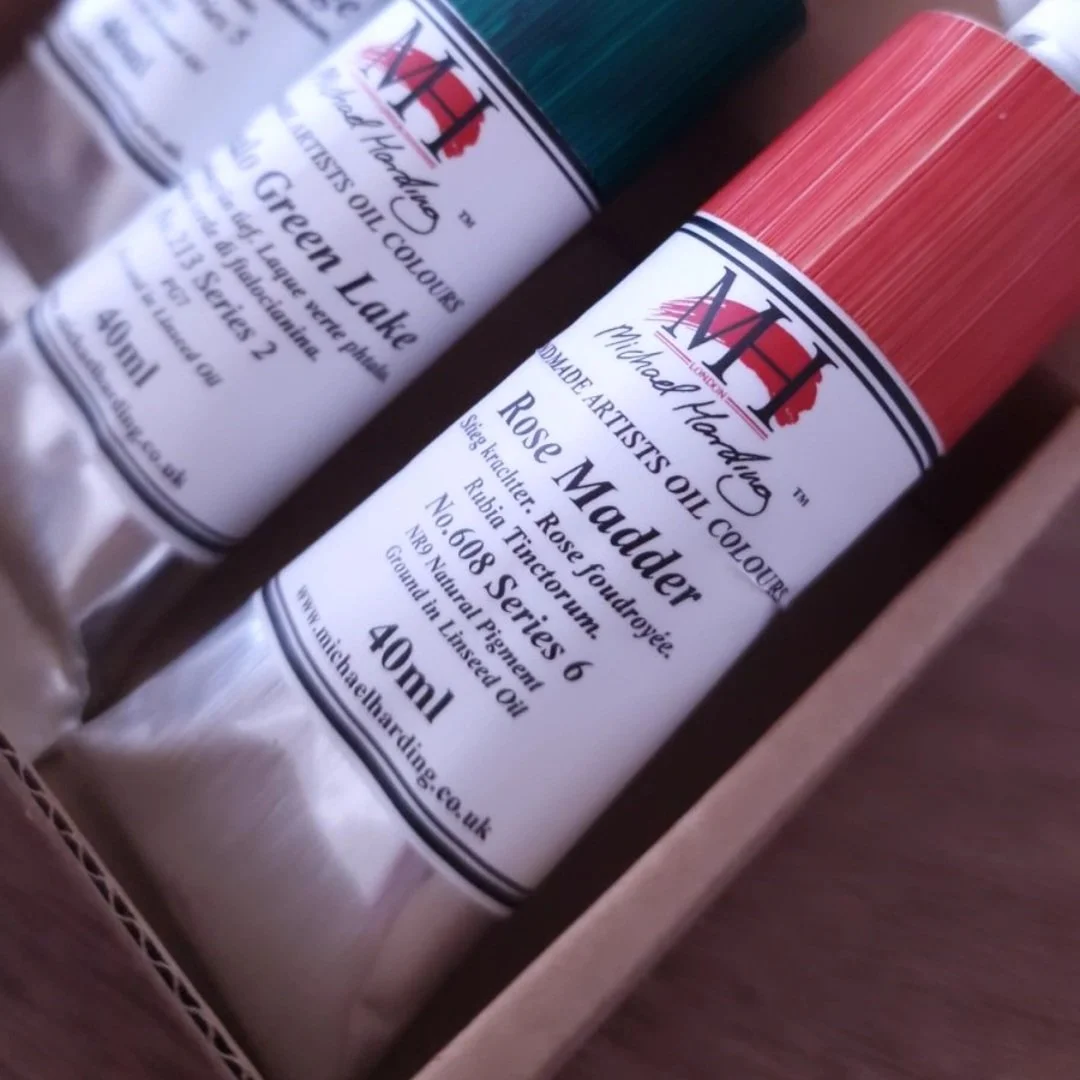
Seven oil paints can carry the same pigment code - NR9, Natural Red 9. In a list of materials, they appear to be the same material, but once we look beyond the code and at the paints themselves, that apparent similarity begins to break down.
NR9 denotes natural madder, traditionally associated with Rubia tinctorum. Madder, however, is not simply a coloured powder extracted from a plant. Its roots contain soluble organic colorants, primarily alizarin and purpurin. To produce a pigment suitable for painting, these substances must be extracted and converted into an insoluble form - a lake pigment. The resulting material depends on how the plant material is prepared, the conditions under which extraction takes place, temperature and pH, the method of precipitation, the mineral substrate, and the subsequent washing and drying. The pigment code records none of this.
The differences continue once the pigment becomes paint. One manufacturer grinds NR9 in linseed oil, another in walnut oil, and a third in safflower oil. Some manufacturers disclose how the plant was processed; others identify the botanical source but say nothing about how the lake pigment was produced. Some refer to a historical tradition of manufacture without specifying whether that particular process is used for the pigment found in the tube today. Pigment concentration, stabilisers and other elements of the formulation may also differ. Yet all of these paints can quite correctly continue to be designated NR9.
The problem is not the Colour Index. The system was never designed to describe the complete identity of an artist’s material. The problem arises when a pigment designation is used as though it could.
Lead white makes this even clearer. Two paints may carry the same PW1 designation, yet the way the pigment is manufactured affects its particle morphology and may influence the behaviour of the finished paint. Traditional lead white produced by the stack process is valued not simply because it contains basic lead carbonate. Particular features of its manufacture create physical characteristics in the pigment associated with the distinctive long or ropey behaviour of the paint - its ability to draw out beneath the brush in long, cohesive strokes. PW1 tells us the chemical identity of the pigment, but it does not preserve information about the process that produced these properties. The same thing happens with madder, only through an entirely different material system.
The identity of an artist’s material therefore exists on several levels at once. The Colour Index records its chemical identity, but beyond that lie the origin of the raw material, the method by which the pigment was produced, the formulation of the finished paint and its working properties. Mineral, botanical or synthetic origin; pigment production and processing; binder, concentration and additives; transparency, rheology, drying rate, tinting strength, brush handling and behaviour in mixtures - all of these contribute to the identity of a material, although none can be contained within its pigment code.
For historical materials, another dimension appears: historical identity. A modern paint may contain the correct historical pigment while being manufactured and formulated using technologies belonging to an entirely different period. This does not make it a bad or less professional paint, but for the reconstruction of historical techniques the distinction becomes fundamental.
The problem, however, extends far beyond historical reconstruction. A manufacturer may continue producing a colour under the same name and with the same Colour Index designation while the pigment supplier changes, a particular method of processing botanical material disappears, a traditional precipitation method is replaced, linseed oil gives way to safflower oil, or the formulation is adjusted to meet contemporary expectations of consistency or storage stability. Nothing on the label may change in a way that reveals the extent of what has happened. The absence of a change on the label is not evidence of material continuity.
This is where a particular vulnerability in the documentation of artists’ materials becomes visible. Loss is easy to recognise when production stops: a pigment is discontinued, a mine closes, a manufacturer disappears. It is much harder to recognise when the identifier remains while the material behind it changes.
For the Material Memory Project, this changes the preservation question itself. Recording that a paint contained NR9 or PW1 is necessary, but in doing so we may preserve only one level of its identity. If a future researcher needs to understand not only what a material was called or which chemical compound it contained, but also how it was made and what it allowed an artist to do, considerably more information will need to survive.
For a botanical lake pigment, such documentation might trace the material from its botanical source and the preparation of the raw material through extraction, precipitation and pigment processing to the binder, formulation and working behaviour. For lead white, the structure would be different: raw material, manufacturing process, particle morphology, subsequent processing, binder, formulation and the behaviour of the finished paint. Different materials require different documentation structures; a universal pigment code cannot preserve the entirety of their technological histories.
This leads to a broader proposition: a material does not have to disappear for its identity to be lost. Sometimes disappearance is obvious - the material is no longer produced. But there is another kind of loss: the tube remains, the name remains, the pigment code remains, while the very part of the material that the code was never designed to preserve disappears.
