When There Are More New Colours Than New Pigments
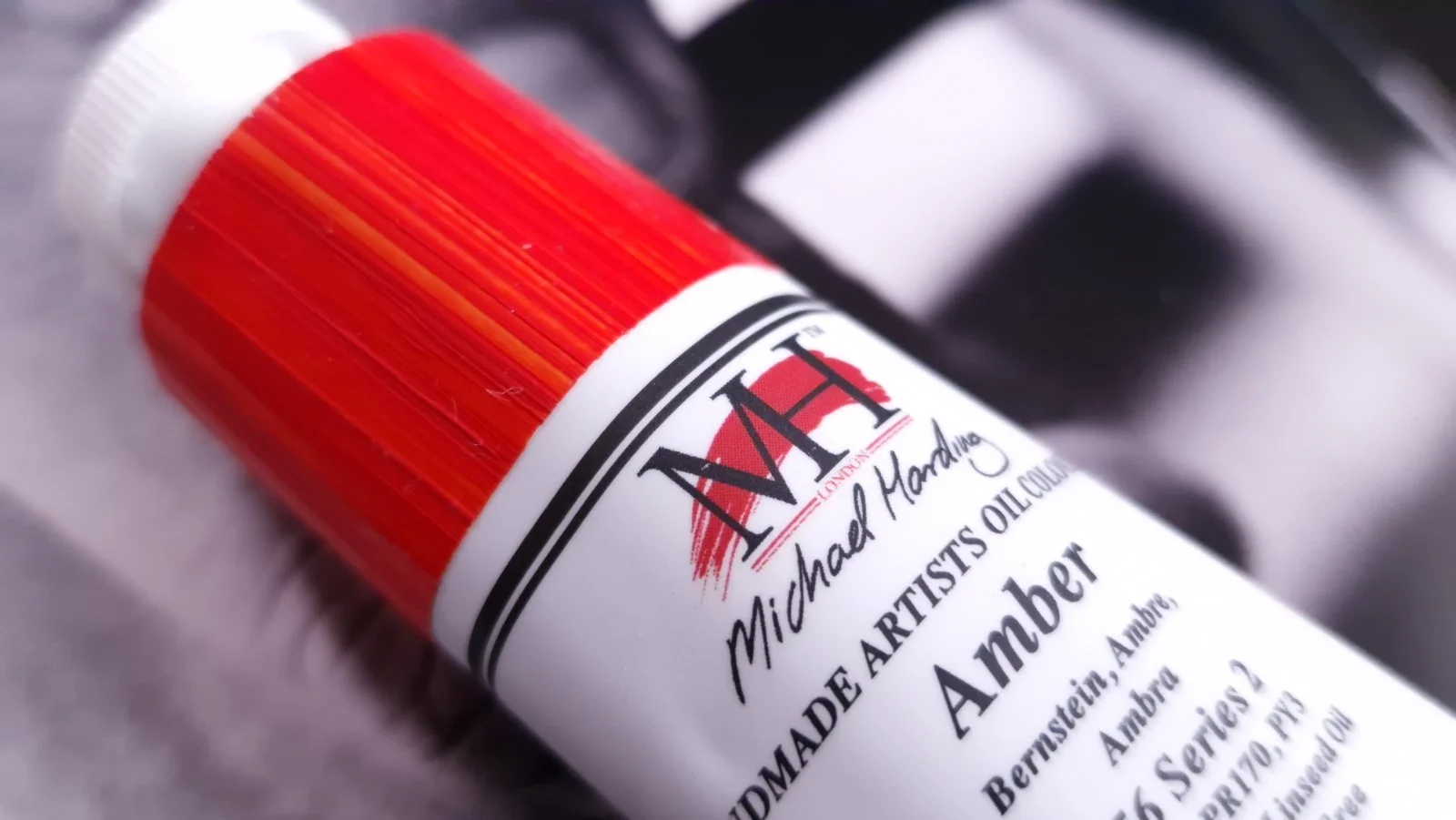
Michael Harding Amber, 2026. One colour name; a material construction of three pigments: PY74, PR170 and PY3.
In 2026, two manufacturers of professional artists’ materials released a paint under the same name: Amber. Michael Harding introduced Amber as an oil colour; Schmincke introduced it as a watercolour. Two identical names, on their own, tell us nothing about a trend. The interesting part lies elsewhere: behind the same word are entirely different pigment constructions and different answers to the question of what, materially, has to happen for a colour to become amber.
Michael Harding builds Amber from a combination of PY74, PR170 and PY3. In a full-bodied application, the paint has a rich red-orange character; in a thinner layer, it opens into a more golden luminosity. Schmincke uses PBr33, PR108 and PY150. With plenty of water, particularly on textured paper, what initially appears as a single amber colour begins to separate into transparent yellows, reddish areas, browns and violet-browns, with granulation becoming one of the paint’s defining properties. The same colour concept has been translated into two very different material systems.
There is little point in comparing these solutions in terms of which is “better”. What is far more interesting is that both exist. Neither manufacturer creates Amber from some common “amber pigment”; each constructs it from its own combination of pigments. The manufacturer first has to decide what exactly is being translated into paint: amber’s golden hue, its transparency, its depth, the transition between reddish brown and yellow, the sense of light held within the material. Only then does the work of formulation begin.
The principle itself is not new. The history of artists’ materials is full of mixed greens, greys, flesh tones, convenience colours and substitutes for historical paints. Manufacturers have long created useful working colours from combinations of existing pigments. A multi-pigment formulation is therefore not, in itself, a modern innovation. But today it allows us to ask a different question: what does it mean to develop a new professional colour when the number of possible hues is virtually unlimited, while the number of physical substances suitable for making durable professional paint is finite?
The digital environment has largely removed the scarcity of accessible variation in visible colour. A new hue does not require a new substance. Thousands of intermediate values can be generated between two closely related colours. Colour can be defined by coordinates, saved, copied and reproduced almost instantly.
Paint is different. For a colour to exist inside a tube, it requires a real pigment — or several. Those pigments must do more than exist chemically. They need to be manufactured at an appropriate quality and scale, offer the necessary lightfastness and stability, work with a particular binder, disperse successfully and form a paint film that a manufacturer is prepared to stand behind.
And that pool of substances is not fixed. Pigments and specific industrial grades appear, change and disappear. Production may cease as demand shifts in much larger industries; raw-material or manufacturing chains may change; toxicological and environmental requirements may affect a material’s continued use. Sometimes an artists’ paint manufacturer itself decides to stop using a particular material because of concerns about durability or working properties. The artists’ materials market, meanwhile, is too small to determine the fate of much of the industrial pigment infrastructure on which it depends.
This creates a paradox: the range of paints can expand faster than the range of fundamentally new pigments. There is nothing contradictory or deceptive about this. A “new colour” and a “new pigment” are simply not the same event.
The manufacturer works between artists’ expectations and a finite set of material possibilities. A modern professional paint must simultaneously meet requirements of durability, working properties and consistency from batch to batch. All of this has to be achieved with substances that are actually available to the manufacturer.
A complex formulation can therefore be both a technological opportunity and a response to constraint. It allows properties to be controlled that cannot always be obtained from a single pigment. When no one substance offers the required combination of characteristics, the required properties have to emerge from the relationship between several materials.
Formulation becomes both a space of freedom and a way of working within constraint.
An increase in the number of names on paint tubes does not therefore necessarily mean a comparable increase in the number of pigments available to artists. But that does not make a formulated colour less valuable. Sometimes the manufacturer’s intellectual work lies precisely in obtaining, from a finite set of components, a possibility that none of them can provide on its own.
At that point, what matters is no longer only what a paint looks like, but what it does.
Schmincke Amber makes this almost literal. Its components do not simply disappear into a visually uniform mixture. In water, the differences between them become part of the result: pigments distribute themselves differently, granulation emerges, water moves the particles, and the texture of the paper intervenes in the image. The formulation creates more than a particular hue. It creates a sequence of physical events.
In oil painting, these relationships manifest themselves differently. Pigment transparency, paint-film thickness, the tinting strength of individual components, rheology and glazing behaviour all become significant. Two colours that can be brought almost indistinguishably close on a digital swatch may prove to be entirely different materials in an artist’s hands.
This is where the digital context enters the discussion - but not as a ready-made explanation for what is happening. It would be too easy to claim that manufacturers are responding to screen fatigue. We do not know that such a causal relationship exists. The more interesting point is that the digital environment has largely removed the scarcity of accessible variation in visible colour, while physical colour remains dependent on a finite and changing world of substances.
At the same time, research into post-digital culture, materiality and haptic experience is paying increasing attention to what cannot be fully transferred into a digital image: surface, material resistance, bodily action, the physical trace of a process and time. This research does not explain the decisions made by paint manufacturers, nor should it be used as though it did. But considered together, these developments raise another question: what becomes particularly valuable in physical colour once access to visual variation is no longer the problem?
One possible answer is its behaviour.
A screen can show granulation, but no pigment particle actually settles within it. It can simulate a glaze, but what we see is a representation of an optical effect rather than the same physical system of interactions between light, pigment, binder and surface. A digital brush can reproduce the shape of a brushstroke, but the material offers it no physical resistance. Screen colour does not soak into a support, separate because particles behave differently, or age with the work.
A screen communicates colour. Paint produces an event.
The range of possibilities in digital and material colour therefore expands in fundamentally different ways. Digital colour can expand through computation. Material colour requires matter: either a new pigment or a new solution constructed from materials that already exist.
The growing complexity of formulations, by itself, tells us neither that the material palette is expanding nor that it is becoming poorer. Technology allows the working properties of paint to be designed with increasing precision, but that work still takes place within a finite set of suitable material components. Constraint and inventiveness are not opposites here. One can become the reason for the other.
This leads to another question. If a new possibility arises not from a single pigment but from the relationships between several components, will knowing their Pigment Index be enough to understand the material in the future?
If a future researcher identifies PBr33, PR108 and PY150, they will have obtained crucial information about the composition of Schmincke Amber. But those three designations will not reveal the proportions of the components, the characteristics of their dispersion, the binder, the rheology or the paint’s original working behaviour. The same substances, combined differently, can produce a different material.
It is useful here to distinguish between the analytical identity and the working identity of a paint. The first answers the question of which substances can be identified. The second concerns how a particular material system existed in use: how it moved, mixed, separated, granulated, formed a layer and interacted with the surface. For the artist, both identities exist at the same time. For the future researcher, the second may prove considerably harder to reconstruct.
The question of formulation therefore also becomes a question of preservation. If what remains is the colour name, the Pigment Index and the finished work, is that enough to preserve knowledge of the material? Or, when a particular formulation disappears, do we also lose part of the information about how that paint worked?
The answer requires a separate investigation. But the question itself already exposes the limits of the way artists’ materials are conventionally described.
The two Ambers of 2026 do not prove a trend towards amber. Nor do they prove that manufacturers are responding to digital culture. What they offer instead is a small, concrete cross-section through a much larger problem.
On one side lies an almost limitless space of visible colour. On the other, a finite and changing set of physical substances. Between them stands the professional paint manufacturer, tasked with finding material solutions for an ever-expanding range of colour and working demands.
It may therefore no longer be enough to measure the expansion of the contemporary palette simply by counting new colours. A more interesting measure is how many genuinely new material possibilities the artist actually gains.
The number of colour names can become almost infinite. Pigments remain finite.
And more and more of what is new has to be created in the space between them.
