Who Owns the Behaviour?
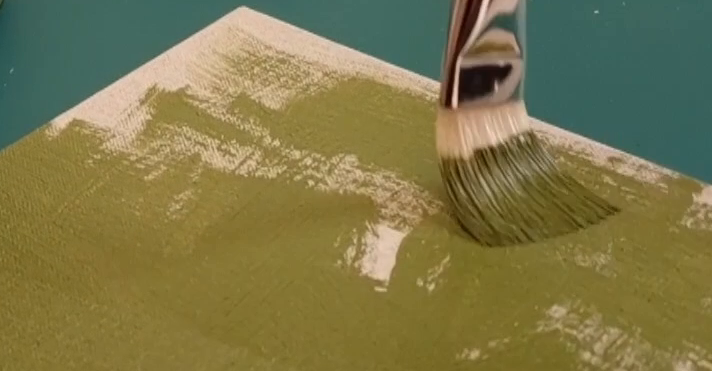
We tend to talk about artists’ materials as though their working properties belonged to the materials themselves. One paint is dense and plastic, another fluid; one holds the shape of a brushstroke well, another remains open for longer. Observations like these form our sense of a material’s character. Artists exchange them, compare paints and manufacturers, and use them to make decisions about what they work with. Yet oil paint is almost never used in isolation.
Consider a simple test. Two artists receive the same paint from the same production batch. Neither uses a medium; both use the same type of brush and comparable amounts of paint. Only the surface changes. One works on a conventional acrylic gesso, the other on Michael Harding Non-Absorbent Acrylic Primer.
On the more absorbent ground, some of the oil from the fresh paint may penetrate into the ground layer. On a ground designed to limit this absorption, the conditions at the interface with the paint layer will be different. Absorbency, however, tells us nothing automatically about surface smoothness or resistance under the brush. Absorbency and tooth are different characteristics, and one cannot be used to explain the other.
After the test, the two artists may describe the same paint differently. One may say that its working state changed fairly quickly; the other that it remained workable for noticeably longer. They may assess its handling differently, or disagree about how long the paint layer allowed a particular operation to continue. Both observations may be accurate, because the paint was the same, but the system in which it was used was not.
If changing only the ground changes what an artist observes and feels while working, how much of that behaviour really belongs to the paint?
Paint has its own composition and formulation. A ground has its own surface structure, porosity, absorbency and other characteristics. But working behaviour is observed when the two come into contact. This becomes particularly clear in the professional vocabulary artists use. Handling works perfectly well in the studio, but it is broad for research purposes: it may encompass consistency, the paint’s response to the movement of a tool, retention of brushstroke form, changes in the paint layer over time and the influence of the surface.
Open time presents a different problem. An artist may readily recognise that one material allows a particular operation to continue longer than another, but comparison requires us to establish what actually marks the end of that period. Without such a criterion, two people may speak quite accurately about open time while observing different events.
Even the resistance an artist feels through the brush is difficult to assign unconditionally to either the paint or the ground. The brush moves through a paint layer on a particular surface, and the result depends on the state and amount of paint, the structure of the ground, the properties of the brush fibres, the speed of movement and the force applied. The hand experiences a single sensation, although that sensation may have no single source.
Our language describes individual artists’ materials far better than it describes the relationships between them. We can name the paint, ground, medium, solvent and brush precisely, and record the manufacturer, composition and technical characteristics of each. But an artist does not work with a list of products. Once the first brushstroke is made, the ground continues to participate in what happens. A medium alters the paint material, the tool introduces its own conditions of contact, and the amount of paint and the way it is applied affect what the hand ultimately experiences.
The conditions of a test therefore cannot be separated from its result. If two paints are being compared, the surface should be recorded. If the influence of the ground is being investigated, the other parameters need to remain as constant as possible. In our example, this is why the same production batch, the same type of tool, the absence of a medium and comparable amounts of paint matter. Without such information, the statement “this paint behaves like this” tells us less than it appears to.
A manufacturer controls the formulation, the choice of pigment and binder, their proportions, dispersion and other parameters of the finished paint. Once the tube is opened, those properties meet conditions of use that the manufacturer no longer controls: the surface, the tool, the amount of material, the way it is worked, any added medium, and time. The question “How does this paint behave?” therefore needs another question beside it: under what conditions was that behaviour observed?
For the Material Memory Project, this distinction takes the problem beyond material testing. The identity of an artists’ material is usually documented through information that can be attached to the product itself: its name, manufacturer, date, pigment code, composition, formulation, packaging, physical samples or analytical results. All of this matters. But if some professionally significant behaviour appears only when a material is used under particular conditions, documenting the product alone does not preserve everything that was known about it.
We can preserve a tube of paint and fail to preserve the ground on which artists habitually used it. We can preserve its chemical composition and lose information about the medium with which it was worked. We can retain a sample of the dried paint yet have no record of how it responded to a tool during the first hours of use. We can document a reformulation without noticing that a particular working property disappeared with it, because no one recorded the conditions under which artists had previously observed it.
The disappearance of an artists’ material then begins to look different. Physical preservation of the product, chemical identification and even detailed technical documentation do not necessarily preserve the knowledge of how that material was used. Some of that knowledge resides not in the object alone, but in the relationships between materials, tools and practice.
This raises a more precise question for the Material Memory Project: what is the unit we need to preserve if we want to preserve material knowledge? Is it the individual product, a sample accompanied by its composition and physical properties, or must it also include a documented working system in which particular behaviours could be observed and reproduced?
When a material disappears, it may therefore be insufficient to ask whether we have preserved a sample and its formulation. We also need to know whether we have preserved the conditions under which its professionally significant properties were recognisable to the artist.
The question of who owns behaviour then becomes a question about the preservation of knowledge. Some characteristics can be attributed confidently to the paint itself, others to the ground. But part of what an artist knows about a material through working with it exists only when those materials meet.
If we preserve materials separately, perhaps that is the part we lose first.
Who Owns the Behaviour?
