The Missing Variable
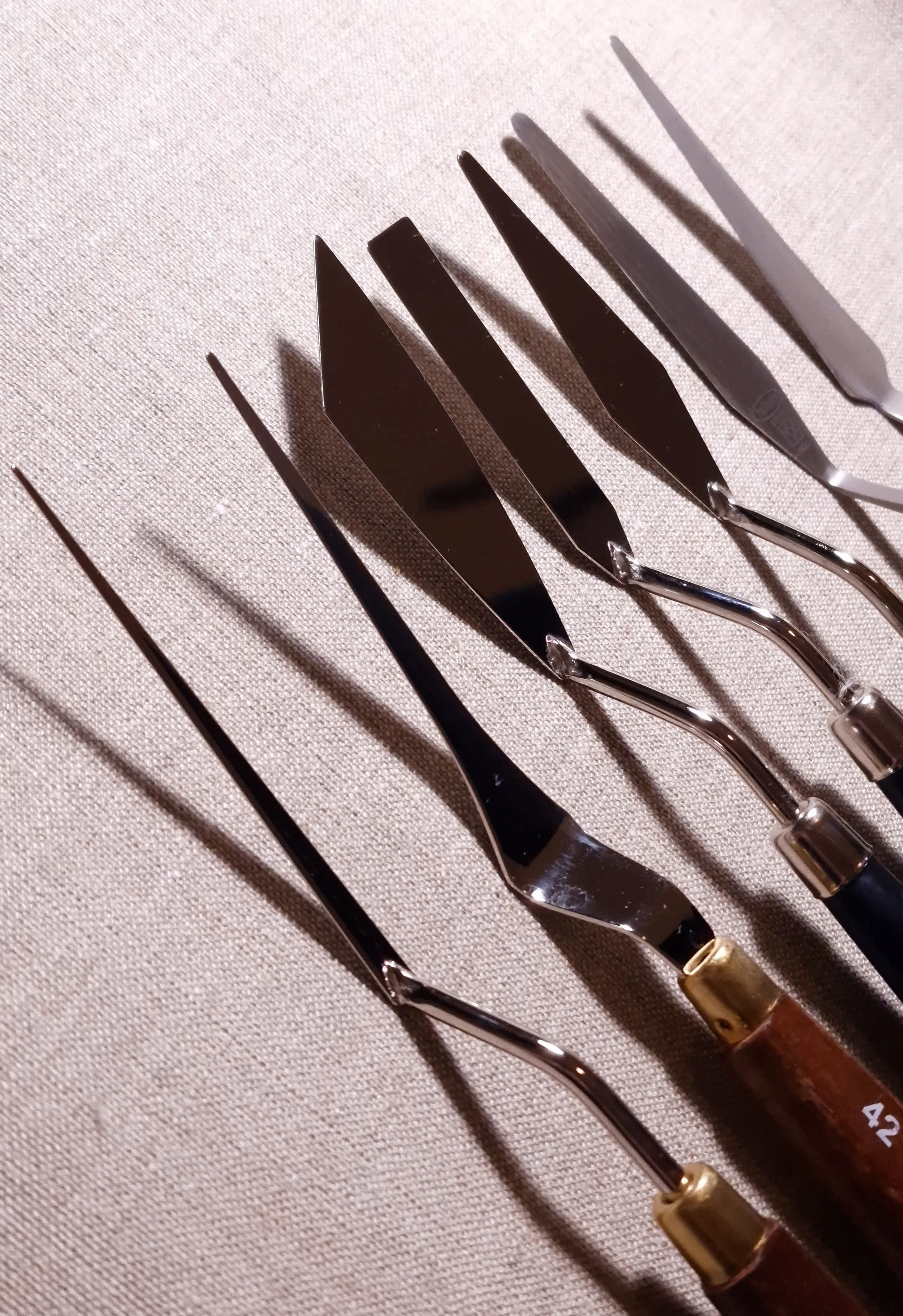
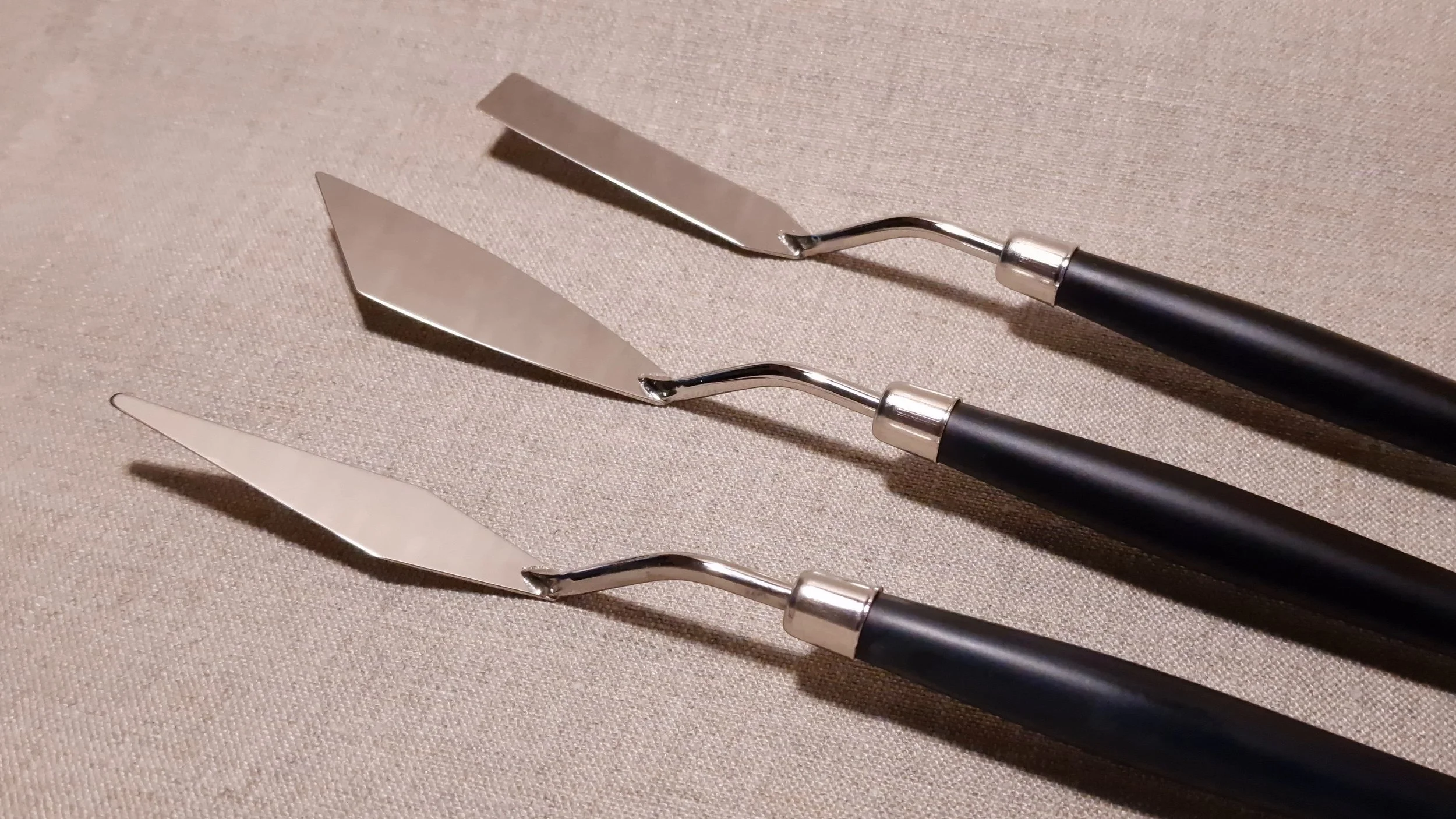
These painting knives are beside my palette today. At some point, I began to wonder: what does my hand know about these tools that I have never tried to put into words?
The photograph tells us almost nothing about that. We can see the shape and size of the blade and the construction of the handle. We can identify the manufacturer and model number. We can measure the length, width and thickness of the blade, describe its condition and the state of its edge. But even a fairly detailed description of the object does not explain why, for a particular action, we reach for one painting knife rather than the one beside it.
I distinguish between them by hand. I know which one begins to flex almost immediately and which resists for longer. Which one can pass over existing relief with almost no disturbance to the layer beneath. Which one can carry a large amount of paint and deposit it in a single movement. Which one gives me exactly the control over an edge that I need at that moment. I do not formulate these characteristics every time I reach for a tool. Over years of working, they have become practical knowledge that comes into play before conscious decision.
There is nothing unusual about this for an artist. But once we try to document technique, a problem appears. A mark made by a painting knife is not a direct record of the movement of the hand. Between the hand and the paint is a tool with its own geometry, stiffness, elasticity and behaviour under load. Then there are angle, pressure, speed of movement, the amount and rheological properties of the paint, the condition of the underlying layer and the topography of the surface. The same gesture performed with a different blade is not necessarily the same action. And that raises a question: how much of what we call the artist’s gesture actually belongs to the mechanics of the tool?
There is another participant in this system who is easy to overlook: the manufacturer. Before the painting knife ever reached my hand, someone had already made decisions about the shape of the blade, its thickness and the properties of the steel, the length and geometry of the shank, its connection to the handle, its balance and ergonomics. These are not neutral characteristics. They determine how the tool transmits pressure, where and how far it flexes, the angles at which it can be comfortably used, and the degree of control the artist has over its contact with the paint. Something has therefore already been built into the tool before it ever meets the artist.
This is an area I would like to know much more about. Who determines the working characteristics of a professional painting knife? Who tests it? Artists, engineers, craftspeople involved in its manufacture? With which paints and on which surfaces? What counts as successful flexibility, good balance or good ergonomics, and whose practice is that judgement based on? Something else interests me even more. Suppose a manufacturer has indeed designed a tool with a particular range of capabilities. Can the artist actually discover everything that has been built into it? And if so, where does that knowledge come from?
This is where I sense a serious gap. When an artist acquires a professional tool, they usually receive the object itself and a fairly limited set of specifications. Everything else begins to reveal itself in the studio. One painting knife proves uncomfortable and ends up in a drawer. Another unexpectedly works for an action for which it was never purchased. It may take months for the hand to become accustomed to a third. Sometimes the possibilities of a tool are discovered by chance years later. We call this the artist’s experience. But some of that “experience” may simply be the recovery of knowledge that was never transmitted with the tool.
It then becomes difficult even to locate the source of an apparent failure. An artist cannot obtain a particular result from a painting knife. Do they lack the necessary skill? Is the tool not intended for that action? Has its construction changed from the version on which the artist was originally taught? Or did the necessary knowledge exist with the designer, the person who tested it, or another artist, but was never documented? Without documentation, all of these situations look the same: “they don’t know how to use it.” That seems far too convenient an explanation.
Artists’ tools exist within a strange system of knowledge transmission. A manufacturer may know why a particular construction was chosen. The person who tested the tool knows how it behaved in a particular paint. A teacher passes on their own way of handling it. The artist gradually develops an entirely different kind of knowledge through thousands of repetitions. After several years, the hand may be so adapted to the resistance of a particular blade that some of this information becomes almost impossible to articulate. And then the model changes or disappears.
We can preserve an old painting knife. Measure it. Identify its material. Find the manufacturer’s catalogue. But that still does not reconstruct the working system. A new example of the same shape may flex differently and recover differently after being loaded. The old tool itself has also changed through years of use, while the artist’s hand has gradually adapted to those changes. At what point do the properties of a particular tool become part of an artist’s technique?
For a conservator or researcher, this problem appears much later. What remains on the surface is the result of an interaction between hand, tool and material. We can examine the paint, stratigraphy, layer thickness and topography, the character of edges, and traces of material being removed or displaced. But the mechanical behaviour of the tool at the moment the surface was formed is often no longer known. And that creates the risk of a particularly compelling error: attributing to the artist’s intention something that was partly a property of the tool.
Or, conversely, mistaking a limitation of the tool for a limitation of skill.
That is why these seven painting knives interest me now not as a collection of objects. I am more interested in the distance between what the manufacturer intended and physically built into the tool, what the artist managed to discover in it, and the material trace that ultimately remained on the painting. Perhaps the question “which painting knife did the artist use?” really is too simple. It would be far more useful to know what that particular knife allowed the artist to do, how the artist learned to do it, and whether any evidence survives that would allow someone else to reconstruct that knowledge.