THE BRUSH THAT NO LONGER EXISTS
A brush rarely enters the technical record of a painting with the same precision as a pigment, binder or ground. At best, the manufacturer, shape, size and hair type are recorded. That may be enough to identify the model. It is not enough to reconstruct what was happening to the paint while the brush was in use.
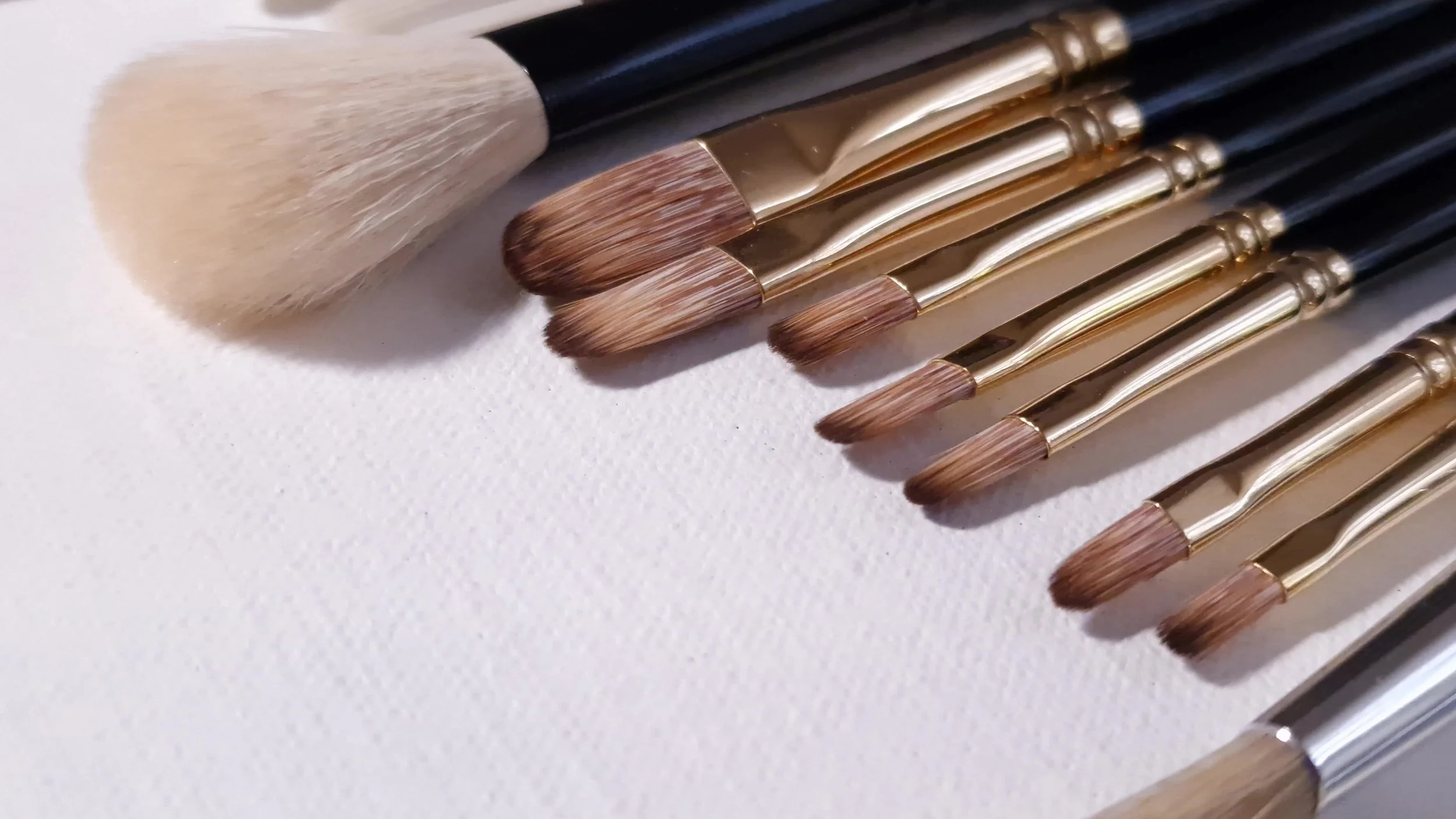
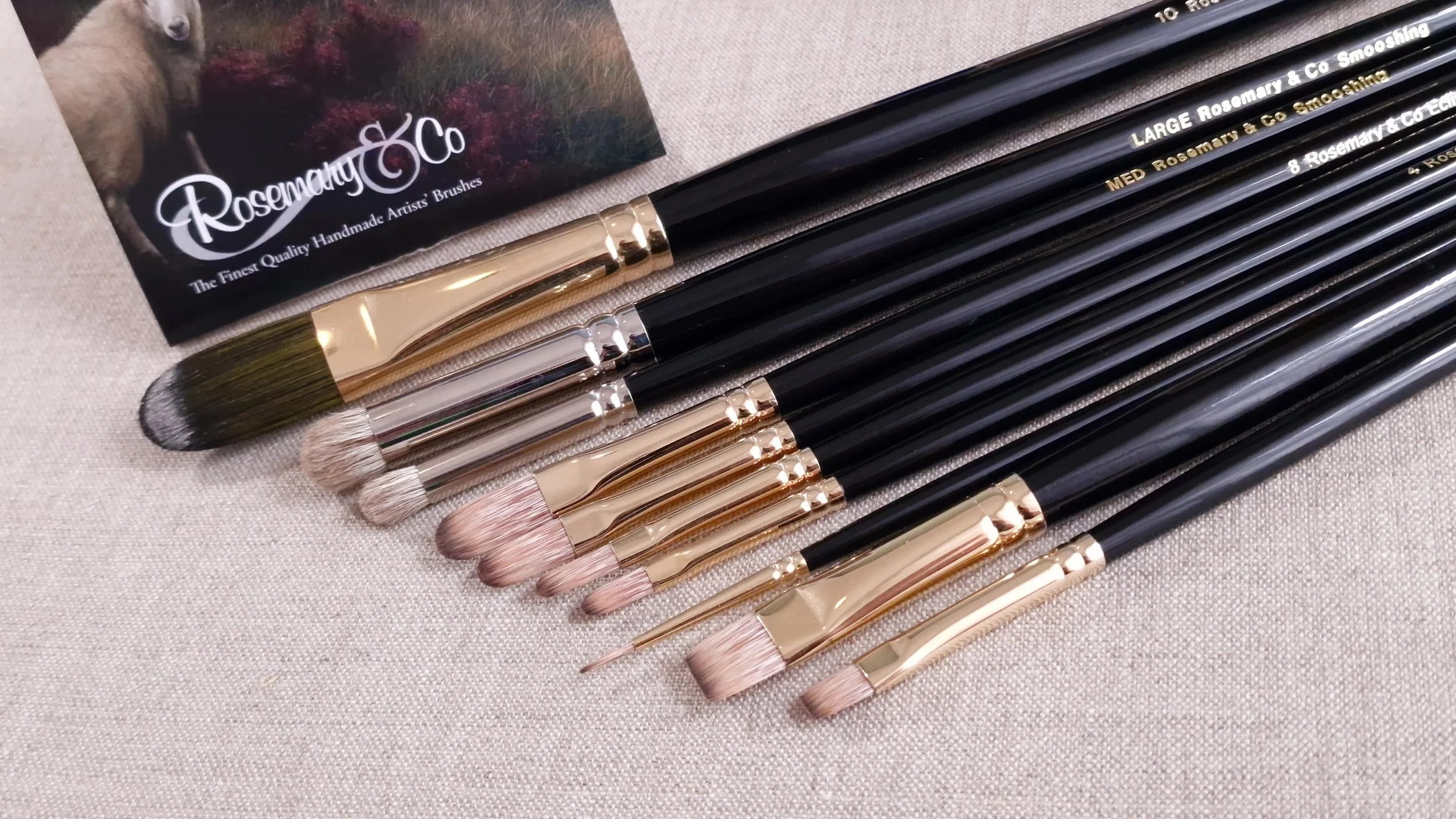
I have a particular interest in premium professional brushes and continually add unusual and highly specialised ones to my studio. Among them are brushes by Old Holland, Rosemary & Co, Chelsea Classical Studio, Léonard and other specialist makers. Over time, comparing them has become a distinct part of my practice. I return to particular ranges, observe how they change through use, and pay close attention to how differently they behave with the same oil paint.
I am especially interested in the differences between hog bristle, sable, badger and specialised synthetic fibres. For a painter, the choice between them cannot be reduced to softness or stiffness. The resilience of the tuft changes, as does its response to pressure, the amount of paint it holds, the way it releases that paint onto the surface, the degree of control it gives at an edge, and the physical sensation of contact with the paint layer itself. Sometimes an old brush works better than a new brush of exactly the same model. Sometimes two brushes that appear remarkably similar behave so differently that, in practice, they are no longer interchangeable.
Professional brushmakers describe some of these distinctions in their own technical vocabulary. The French manufacturer Léonard, whose brushmaking history dates back to 1779, uses ressort for the ability of the hair to return to its original position after bending, and capacité de rétention for its capacity to hold material. The intact natural tip of the hair, the fleur, also matters. During hand-forming, the hairs are aligned and shaped while their natural tips are preserved. The final form of the tuft is created in the hands of the brushmaker. This is already a considerably richer description of an instrument than “sable, round, size 8.”
Rosemary & Co provides an even more revealing example. The company distinguishes between snap and spring, paint-holding capacity and behaviour across the surface, and describes markedly different working characteristics across its ranges. Masters Choice is now made from a blend of badger hair; the range was formerly made with mongoose. Among its synthetic brushes there is an even more intriguing case. Evergreen began with the same fibre used for Ivory, but dyeing changed its behaviour: according to the company, the resulting brush is slightly softer while retaining good snap. Even the designation “synthetic fibre” tells us very little about how a brush will behave unless we also know how that fibre was manufactured and processed.
Working differences between brushes leave physical traces in the paint layer. Some are visible to the naked eye; others remain in the relief of the brushstroke and in traces of the brush’s movement. Optical profilometry records a painted surface as a three-dimensional height map. In a controlled study published in 2021, topographical information at very small spatial scales - down to dimensions associated with individual bristles or a small number of bristles - proved particularly informative in distinguishing between painters.
A century from now, a researcher may be able to measure a groove left by a bristle more precisely than the brush itself was documented while it was in use. I am interested in the gap between what an instrument leaves behind in the work and what we preserve about that instrument at the moment of use. A model name does not close that gap.
Consider a basic description: hog bristle, flat, size 8. It identifies the fibre, geometry and nominal size. Yet two brushes fitting that description may differ in tuft density, free hair length, the distribution of bristle diameters, the condition of split ends, resistance to bending, recovery after loading, paint-holding capacity and the way paint is released. Brush sizes themselves are not universal: even within a single manufacturer, the same nominal size need not correspond across different ranges.
For the painter’s hand, these are not experienced as a collection of separate parameters. They amount to one thing: how the brush works.
Much of this knowledge exists as an ability to recognise and reproduce an action rather than as a written instruction. A painter may reject a brush immediately as too soft without ever having measured its stiffness. The hand knows how much pressure can be applied before the tuft loses its form, how the instrument responds to a particular consistency of paint, and what kind of movement will preserve the intended character of the surface. Contemporary conservation already treats information about materials, techniques and working processes as evidence that may need to be recorded while access to the artist is still possible. Artist interviews, direct participation and, in some cases, documented paint-out sessions are used to capture information that may not later be recoverable from the object alone.
Once a painting is finished, this relationship begins to come apart. The paint remains on the surface while the brush continues to be used and to wear. Its geometry, the condition of the hair tips and the properties of the tuft change with use. Years later, the model itself may have changed or disappeared. The artist may gradually cease to remember which particular brush produced a particular passage. The surface, meanwhile, retains the physical result of their brief encounter.
A particularly clear example is mongoose hair. Rosemary & Co states that its Masters Choice range, now made from a blend of badger hairs, was formerly made with mongoose; its Eclipse range was developed as a synthetic mongoose intended to mimic the original material.
In such cases, the replacement material is intended to reproduce particular working properties even though the material identity of the fibre has changed. How closely the earlier behaviour has been reproduced cannot be established from the range name or stated purpose alone. The manufacturer’s description, the painter’s experience and instrumental measurement may not produce identical accounts.
Paint rheology introduces another variable into brush behaviour. In an experimental study published in 2023, researchers compared the yield stress and high-shear viscosity of oil paints with the profiles of automatically applied brushstrokes. These parameters describe different moments within the same process: how readily the paint moves during application and how effectively the relief formed by the brush survives after it has passed. The surface later examined by a conservator already contains the result of an interaction between the properties of the paint and those of the instrument.
This creates a practical problem for documentation: what is an appropriate unit of preservation for a working tool? The brush itself? The brush together with a paint-out? Its specification and condition at the time of use? Video of the hand in motion, measurement of tuft deformation, a three-dimensional record of the resulting brushstroke - or some combination of these forms of evidence capable of linking a particular instrument to a particular behaviour of paint?
Before metal ferrules became widespread, brush hair was mounted using quill, thread or wire-bound constructions. Metal ferrules, probably introduced in the eighteenth century and increasingly common in the nineteenth, made brushes sturdier and also introduced another possibility: a round metal ferrule could be flattened, allowing flat bristle brushes to be manufactured. Alexander Katlan notes that artists, particularly the French Impressionists, used such brushes to produce the tache, a broad, flat, even stroke.
Today, change can occur inside an object that remains outwardly familiar. A natural fibre may be replaced by another type of hair or by a synthetic system; new methods of processing synthetic fibres emerge; even a manufacturing operation such as dyeing can alter spring, snap or the way a tuft responds in use. “Brush” is too broad a category to describe these differences.
The material culture of painting can be lost without the physical disappearance of the object. Sometimes the object remains while its behaviour disappears.