We Already Have a Cultural Policy for Artists’ Materials. Nobody Voted for It.
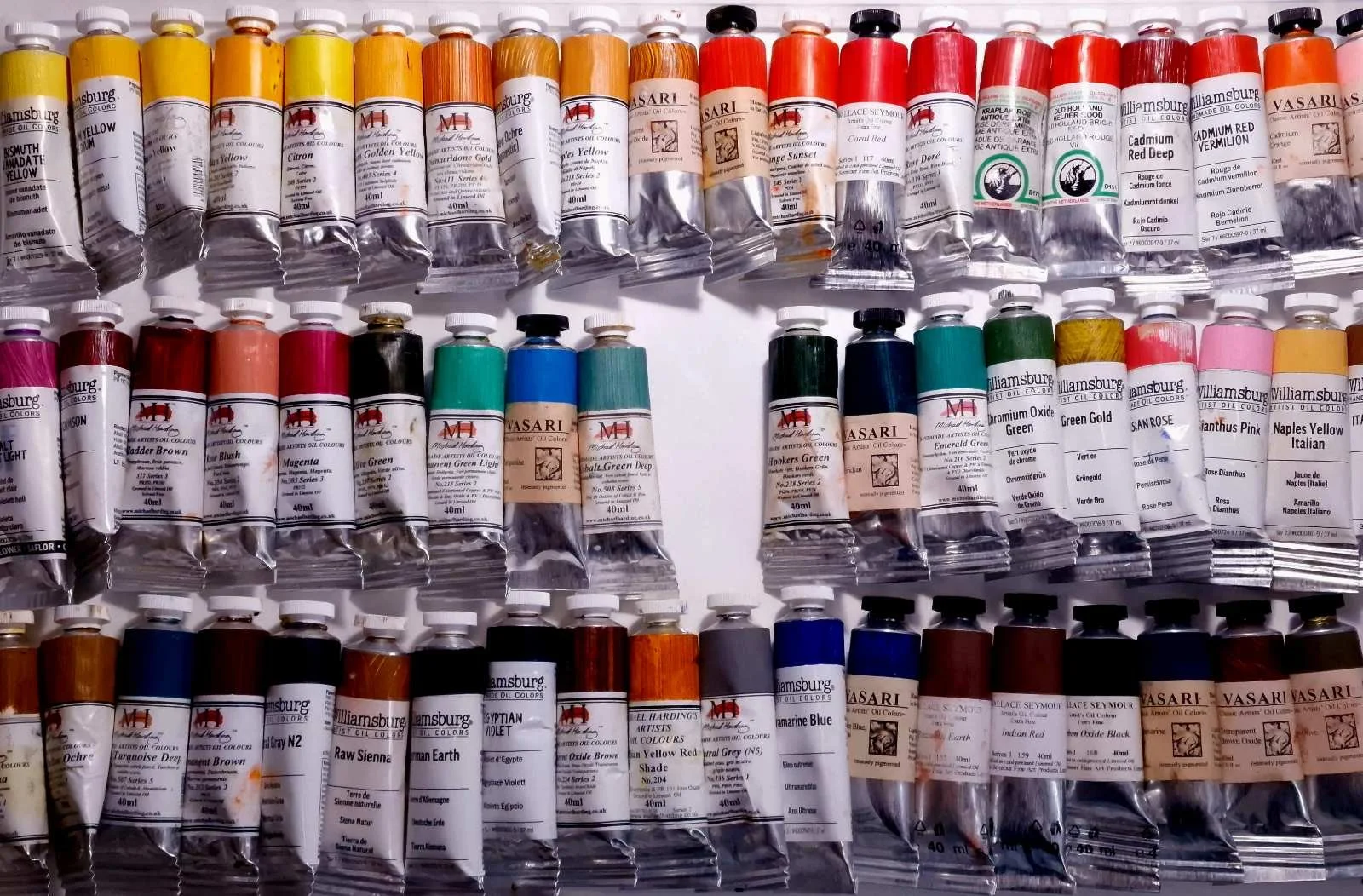
When an artists’ material disappears, almost no one calls it a cultural event. A manufacturer discontinues it. Distributors sell off the remaining stock. Artists who knew the material buy the last tubes. Before long, its place is taken by the nearest available substitute, while its disappearance is explained in entirely rational terms: the raw material became too expensive, requirements changed, production became more difficult, demand was insufficient. Each individual explanation may be perfectly reasonable. But if we stop looking at these cases one by one, a far more uncomfortable question emerges: what if we are not simply witnessing a series of disappearing materials, but a system that is effectively determining the material possibilities of future art?
For a pigment to disappear, no one has to make a deliberate decision to eliminate it. All it takes is a system in which no one is responsible for keeping it.
Cultural policy usually has institutions, programmes, budgets, and people who make decisions. Here, at first glance, none of these exist. There is no committee that meets once a year to decide which pigments should remain available to the next generation of artists. No one votes for a particular paint to disappear. No one announces that a particular material possibility is no longer needed by art. And yet selection is taking place constantly. Some materials withstand the pressures of the modern production system. Others do not. Some are sufficiently profitable, stable, accessible, and scalable. Others are too complex, too rare, too expensive, or too limited in demand to justify their continued existence as industrial products.
The result is a kind of artificial selection of the artist’s palette. Yet the criteria governing this selection are not a material’s artistic significance, the uniqueness of its optical properties, the knowledge accumulated around it, or even its place in the history of painting. Above all, a material must be able to survive within systems that were never designed to preserve artistic diversity.
I call this invisible process of selection the Material Selection System. It arises not from a single decision, but from the combined effects of economic, regulatory, industrial, logistical, and market mechanisms that determine which artists’ materials continue to exist, which are altered, and which disappear. The system has no single centre. And that is precisely why it is so difficult to see.
A manufacturer may make an entirely rational economic decision. A regulator may make a fully justified decision concerning safety. A raw-material supplier may act according to resource availability. A distributor may respond to demand. An artist may choose according to price and accessibility. None of them needs to want a material to disappear. Yet the cumulative result of their decisions can alter the material culture of art.
Perhaps the most influential cultural policy affecting artists’ materials today is being enacted by people and systems that do not consider themselves participants in cultural policy at all.
This is the paradox of the Material Selection System. We do not need a single actor consciously deciding what the art of the future should be. We need only an infrastructure within which some material possibilities have a significantly greater chance of continuing than others. The materials that survive, therefore, are not necessarily those most valuable to art. They may simply be the materials best adapted to the contemporary systems of production and circulation.
For a product, being stable, safe, scalable, transportable, and commercially viable is an obvious advantage. For art, the situation is more complicated. Some materials are valuable precisely because they are not interchangeable. Their significance cannot be reduced to a colour name or an approximate match in hue. Particle size and shape, transparency, density, rheology, interaction with the binder, drying behaviour, and the ways in which light is scattered and reflected can produce qualities that cannot be preserved simply by replacing one Colour Index designation with another.
And sometimes the most important part of a material is not inside the tube at all. It exists in the hands of the person who knows how to work with it: how to grind it, how thickly it can be applied, how it changes in mixtures, when it may become problematic for a painted surface, how it behaves after hours, days, or years, what can be done with it—and what cannot. In such cases, a material is not merely a substance. It is a substance plus the accumulated body of practical knowledge surrounding it.
This is where the economics of a material begins to diverge from its cultural value. Imagine a material used by only a few hundred artists. For a global market, this is almost a statistical irrelevance. Its production may be commercially insignificant. But if that material possesses properties that cannot be precisely reproduced by other means, its cultural significance does not diminish simply because its market is small.
We already understand this logic in other areas of culture. A rare language does not become culturally insignificant because few people speak it. A traditional craft does not lose its value because an industrial alternative is cheaper. An archive does not cease to matter because its contents cannot be efficiently monetised. It is usually precisely where market value ceases to be an adequate measure of significance that the conversation about heritage begins. Yet with artists’ materials, this transition has barely taken place.
We have built extraordinarily sophisticated systems for preserving works of art after they have been made. We analyse their pigments and binders, control light, humidity, and temperature, study ageing processes, and develop technologies intended to help works survive for generations. At the same time, the material infrastructure that made such works possible can disappear almost without a trace. Production closes. A formula remains unknown. A specialist leaves. Equipment is dismantled. Supplies of raw materials cease. Practical knowledge is no longer transmitted. And a strange cultural paradox emerges: we have learned to preserve the results of material knowledge far better than our capacity to continue producing that knowledge.
This is not an argument that every historical material should remain in production forever. Some substances genuinely pose serious risks to human health or the environment; some technologies cannot, or should not, be returned to industrial production. Preserving material culture should not mean abandoning environmental or human safety. But this does not remove another question: must disappearance be the only alternative to mass production?
Between “continue producing it as before” and “allow it to disappear” lies an enormous territory that cultural systems have barely begun to use: documenting formulas, preserving manufacturing know-how, controlled specialist production, archiving raw materials and samples, recording practical demonstrations, transmitting tacit knowledge, and creating collaborations among artists, conservators, researchers, museums, and manufacturers before the knowledge-holder or the production itself disappears. Perhaps what we need is not a museum of the last remaining tubes. We need an archive of possibilities - an archive that preserves not only the evidence that a material once existed, but the knowledge of what it made possible.
Seen this way, the Material Selection System is not an accusation directed at manufacturers, regulators, or markets. Something more interesting is at stake: it allows us to see a structural gap in responsibility that remains invisible when each participant is considered separately. Everyone is responsible for their own rational decision. But who is responsible for the cumulative cultural outcome of those decisions?
The material future of art is already being shaped. It is shaped every time production becomes unprofitable, a raw material becomes unavailable, a technology becomes too difficult to sustain, knowledge is no longer sought, or the disappearance of a material happens so quietly that the cultural field notices only when almost nothing can be recovered.
No one designed this system as cultural policy. No one voted for it. It is not cultural policy by intention. But it begins to function as cultural policy through its consequences.
The central question, then, is no longer who is to blame for the disappearance of the next pigment. It is much more difficult: if the Material Selection System is already shaping part of the material language of future art, who within that system represents the interests of artists who have not yet been born?
