What If Some Artists’ Materials Are No Longer Just Products?
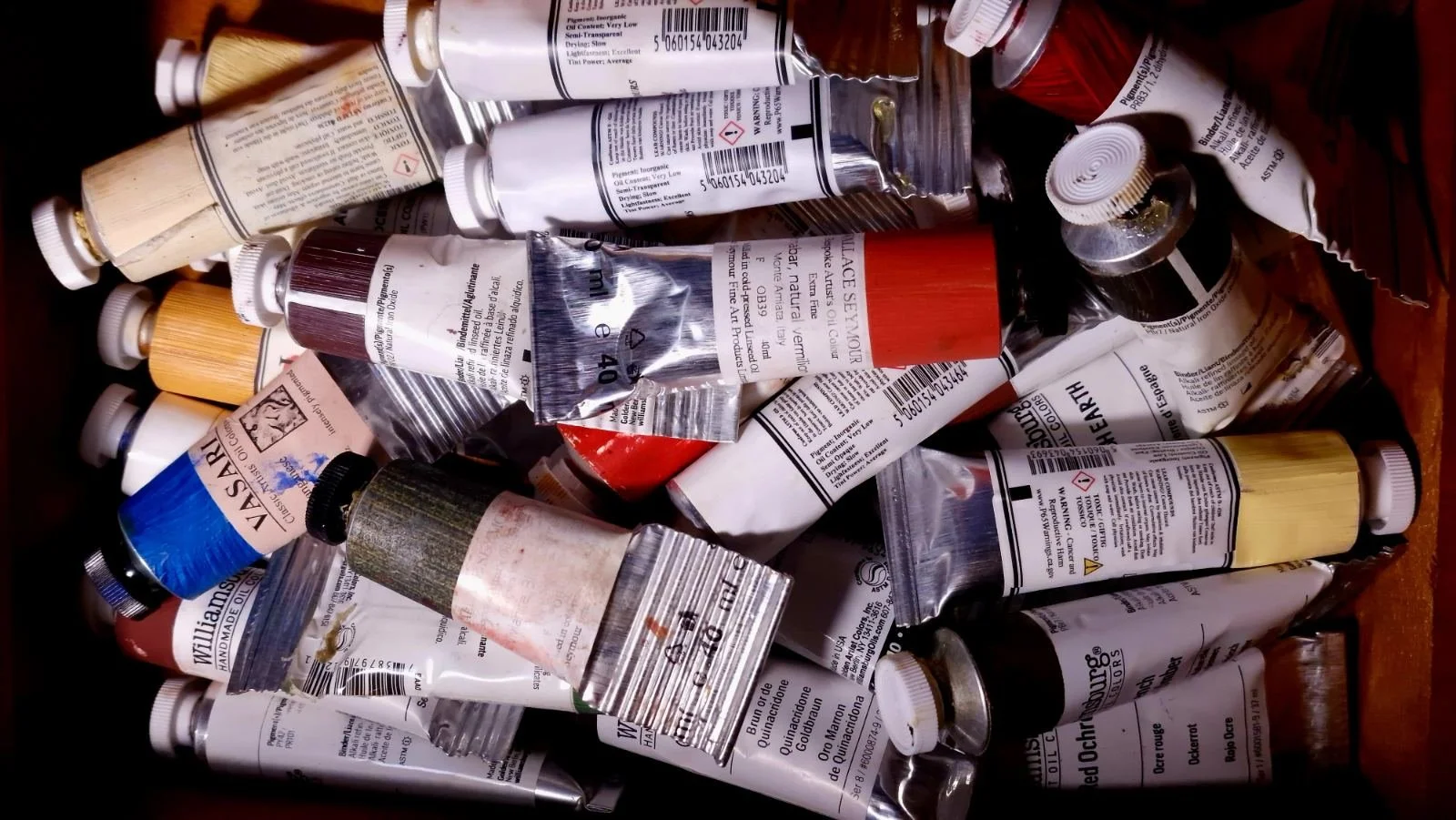
We are accustomed to thinking of artists’ materials as products. They have manufacturers, production costs, prices, sales volumes, and customers. As long as there is sufficient demand, they continue to be made. When demand declines, raw materials become more expensive, regulation grows more complex, or production becomes too difficult, a material may disappear from the market. From an economic perspective, there is nothing unusual about this. Companies change their ranges, technologies become obsolete, production lines close, and one substance is replaced by another. The market is under no obligation to preserve its own past.
The problem begins when something the market regards as a product is eventually recognised by culture as heritage. We have already accepted that the value of certain things cannot be reduced to their commercial viability. A historic building does not cease to matter because maintaining it is unprofitable. An archive is not automatically destroyed because no one is willing to buy its documents at a price that covers the cost of preserving them. A craft tradition does not become culturally meaningless because the objects produced within it cannot be turned into mass-market goods. Across many areas of culture, we have learned to distinguish between what pays for itself and what is worth preserving. Yet when it comes to artists’ materials, that distinction becomes surprisingly unclear.
While a paint remains in a tube on a shop shelf, it appears to be a commercial product. When that same paint becomes part of an artwork that enters a museum collection, its composition may become the subject of serious scientific research, conservation, and documentation. This creates a strange sequence. Yesterday - a product. Today — part of an artwork. A hundred years from now - an object of cultural research. But at what point in this sequence does the material acquire cultural value? After the artist dies? After the work is recognised as significant? After production ends? After the material becomes so rare that reconstructing the technology surrounding it is already extraordinarily difficult? And why are we so good at recognising the value of a technology retrospectively, yet so much less capable of recognising it while it is still alive?
Perhaps this is one of the blind spots of the contemporary cultural system. Imagine a material that artists have used for decades. Its manufacture requires specific raw materials, equipment, and technological expertise. Perhaps demand for it is limited. Perhaps changes in environmental or chemical regulation make production more difficult. Perhaps the number of suppliers is shrinking. Perhaps the manufacturer is maintaining an entire technological chain for a relatively small group of professional users. If one day production becomes economically unviable, the decision appears entirely rational: the material is discontinued. But was this only a commercial event? Or did a piece of technological culture disappear along with a single item in a catalogue?
We often cannot answer that question because there is almost no clearly defined moment at which an artists’ material passes from one category into another. While it is still being manufactured, it may seem too commercial to be considered heritage. Once production has ceased, it gradually becomes historical enough to deserve research. The result is almost absurd: sometimes a material has to die before culture notices that it was worthy of attention. That, to me, is the problem.
Not every artists’ material needs to be preserved. Not every old formulation is valuable. Not every disappearance constitutes a cultural loss. Materials have changed throughout the history of art, and that very process of change has opened new possibilities for artists. New substances may be safer, more stable, more environmentally responsible, and technologically superior to older ones. Attempting to preserve everything would be not only impossible, but intellectually meaningless. But between the two extremes - “preserve everything” and “let the market decide everything” - lies an enormous territory for which we still lack sufficient language, criteria, and mechanisms.
When does a material cease to be merely a product? What should make it a candidate for cultural or technological heritage? The length of time it has been used? Its role within a particular artistic tradition? Unique physical properties? The absence of a genuine substitute? The complexity of the manufacturing knowledge behind it? The number of significant works created with it? The fact that only a handful of manufacturers remain? Dependence on rare raw materials? Its connection to a particular region, workshop, or school? Or perhaps what matters is not any single characteristic, but a combination of several?
We can debate the criteria. But the absence of criteria does not mean the absence of a decision. The decision still happens. It is simply not made by the cultural system as a conscious decision. Circumstances make it instead. The price of a raw material. A new regulation. The closure of a factory. The disappearance of a supplier. A change of ownership. Insufficient sales. The loss of specialised equipment. A few lines in a financial spreadsheet.
None of these factors is inherently wrong. A manufacturer is not a museum and cannot be expected to subsidise an unprofitable product indefinitely for the sake of a presumed cultural value. A regulator should not preserve a technology at the expense of demonstrated risks to people or the environment. A supplier cannot be expected to continue producing a raw material for which demand has nearly disappeared. An artist is not obliged to buy a material simply to keep it in existence. Everyone can be right. And the material can still disappear.
This is where the problem becomes far more interesting than the search for someone to blame. Every participant can make a perfectly rational decision within their own system, while the sum of those rational decisions can produce a cultural loss that none of them intended. A manufacturer optimises production. A regulator reduces risk. A supplier closes an unprofitable line. A retailer removes a product that almost no one buys. An art school teaches students to work with what is currently available. An artist chooses an alternative. No one has made a decision to alter the history of art. And yet the boundary of what is materially possible has changed.
This is precisely why responsibility is far more complicated here than blame. If society genuinely considers a particular material culturally significant, why should the cost of keeping it in existence fall solely on the person or company that manufactures it? Demanding this of a private company would be an extraordinarily convenient way for the rest of the cultural system to absolve itself of responsibility. We do not expect the private owner of a historic monument to decide alone whether that monument deserves to exist. Heritage has systems of expertise, criteria, public institutions, foundations, research programmes, and various forms of support. They may be imperfect, contested, and bureaucratic, but they rest on an important principle: some forms of value cannot be fully expressed by market price.
Why, then, does the material culture of art so often seem to operate according to a different logic? Perhaps because we are accustomed to recognising heritage too late. We recognise it easily once it has become old. It is far more difficult to acknowledge the cultural value of something that can still be ordered from a manufacturer. There is an almost comic paradox in this. A container of material sitting in a factory warehouse today appears to belong to the economy. The same container, seventy years later in an artist’s archive, may become a source for technical research. Manufacturing documentation today may look like commercial routine; after a factory closes, researchers may spend years trying to reconstruct it from whatever records happened to survive. Age changes the way we look at an object more dramatically than its actual cultural function does.
But heritage does not come into existence on the day we finally decide to call it heritage. If a technology genuinely possesses cultural value, it possessed that value the day before production ended too. And at this point the conversation becomes uncomfortable not only for manufacturers. It becomes uncomfortable for museums, universities, art academies, foundations, professional associations, researchers, conservators, public authorities - and artists themselves. Because once we accept that certain materials and the technologies surrounding them may form part of cultural and technological heritage, the next question can no longer be addressed to any one party: Who is responsible for them?
The manufacturer? A manufacturer is primarily responsible for the viability of the business, the safety of its products and employees, and compliance with the law. The museum? A museum more often encounters the material once it is already embedded in an artwork or a historical collection. The university? A university may be able to research a technology without having the capacity to sustain its industrial production. The state? But who, and according to what criteria, should determine which artists’ material has cultural significance and which has simply become obsolete? Artists? An individual artist can hardly sustain a chain involving raw-material extraction, chemical manufacture, technological control, and international distribution.
If the honest answer is “no one,” that is not an absence of an answer. It is a description of how the system is structured. Cultural value can be collective while responsibility for its physical survival belongs to no one. This, I think, is where the real conflict lies.
We often speak about the disappearance of materials as though it were a natural process. A material “fell out of use.” A technique “became obsolete.” Production was “no longer viable.” Artists “moved on to modern alternatives.” But the language of passive disappearance can conceal fundamentally different situations. Sometimes artists genuinely stop choosing a material. At other times, the material disappears before the next generation has even had the opportunity to decide whether it needs it. These are not the same thing. Choosing not to use a possibility and never being given the possibility to choose are two different cultural events.
If a material disappears from commerce, education, and professional practice, the next generation may not even experience its absence as a loss. For them, the material world will simply have always looked this way. At that point, the question is no longer only about preserving the past. It is about the freedom of the future. We tend to understand artistic freedom as an artist’s freedom to choose among the possibilities available to them. Far less often do we ask who shapes the set of possibilities from which that choice is made in the first place.
That set is not shaped in any one place. It is shaped by manufacturers, raw-material suppliers, legislation, environmental standards, scientific understandings of safety, international trade, insurance, logistics, art education, technological innovation, and changes within artistic culture itself. No single participant holds complete power. And that is precisely why the outcome can be so difficult to see. The material future of art can be shaped by decisions, none of which were ever made as decisions about the future of art.
I think this is the thought that should wake us up. Not because there is a conspiracy against old materials. There is not. Not because the market is bad. It is doing what markets do. Not because regulation should give way to cultural nostalgia. It should not. The problem is far less convenient: a system may perform many of its individual functions perfectly well while having no participant responsible for the cultural outcome produced by those functions together.
This is no longer a question of finding someone to blame. It is a question of cultural policy. Not policy in the sense of prohibitions, campaigns, or directives, but in its more fundamental sense: how a society makes decisions about what it considers worth passing on - and who is entitled to participate in those decisions.
We already know how to ask such questions about architecture, archives, archaeological sites, languages, crafts, and other forms of heritage. Perhaps it is time to ask whether there are artists’ materials, technologies, and bodies of knowledge that likewise require not automatic preservation, but at least a moment of cultural consideration before they disappear. Not a prohibition. Not protected status. Not an obligation to manufacture something forever. Simply a moment when the disappearance of something ceases to be exclusively a technical or commercial event and becomes a question that culture should at least be able to see.
Perhaps this is the missing link. Not a mechanism for rescuing every material, but a mechanism for recognising cultural vulnerability before it becomes a historical fact. Such an approach would not necessarily end with a decision to preserve. Sometimes, after careful consideration, the right decision will be to allow a technology to disappear. Sometimes the risk will be too great. Sometimes the replacement will genuinely be adequate. Sometimes the cultural value will not be sufficient to justify the resources required. But then something fundamentally different will have happened. We will know what we decided not to preserve, and why.
That is a far more mature relationship with heritage than simply declaring everything old to be valuable. It accepts loss - but asks that significant loss at least be recognised as loss. And between indefinite production and complete disappearance, there are many other possibilities. We can preserve samples of raw and finished materials, document manufacturing processes and changes in formulations, record interviews with technicians, preserve technical drawings of equipment, document the reasons production ended, create comparative samples of substitutes, record methods of safe handling, and transfer manufacturing archives to research institutions. In exceptional cases, where the cultural value is genuinely high and the technology can be maintained safely, it may even make sense to support limited specialist production.
So the question is not necessarily whether every disappearing material should continue to be manufactured. The harder question is this: Should a culturally significant material be able to disappear without ever being recognised as culturally significant?
And here the fragmentation of responsibility becomes particularly visible. An artists’ material exists simultaneously in several worlds. To a chemist, it is a substance. To a regulator, an object of risk assessment. To a manufacturer, a product and a technological process. To a retailer, an item in a catalogue. To an artist, a working possibility. To a conservator, the future material structure of an artwork. To an art historian, part of an artistic context. Each sees something important. But who sees the whole system at once?
Perhaps no one. And then the greatest danger lies not in a wrong decision made by one participant, but in the possibility that a decision of enormous cultural consequence can emerge between participants without fully belonging to any of them. No one decided that a particular possibility was no longer needed by art. And yet one day it is simply gone.
That is precisely why this conversation should not remain confined to a handful of artists, collectors of rare paints, or manufacturers. Other people need to be part of it. We need technicians who know what happens inside production. Conservators who can recognise differences that may become significant decades later. Historians of materials. Heritage researchers. Museums. Art schools. Regulators. Foundations. Manufacturers. And artists themselves - not as consumers demanding that a favourite paint remain on sale, but as participants in a system whose decisions will shape the practice of those who come after them.
Not so that we can agree to preserve everything, but so that we can agree on something far more difficult: what, exactly, we do not want to lose by accident.
Because perhaps the most dangerous cultural decision is not the decision to destroy something. It is a decision that was never recognised as a decision at all. The material simply stopped being made. The technician left. The equipment was dismantled. The supplier closed the line. The documents were discarded. Artists found an alternative. Everyone did what made sense from where they stood.
No one voted for the disappearance of a possibility. No one signed such a decision. Perhaps no one even noticed the moment when it was made. And years later, culture discovers that an entire door closed along with a single product.
We do not have to keep every such door open. But if what lies behind it is part of the material history of art, perhaps before it closes, someone should at least see that the door exists.
And then we are left with a question that can no longer be addressed only to a manufacturer, a museum, or the state: Who should have the right to close that door - and should we at least know when it is closing?
